Press release from the Humboldt County Sheriff’s Office:
On March 12, 2021, deputies with the Humboldt County Sheriff’s Office Marijuana Enforcement Team (MET) conducted a special operation at a residence on the 2800 block of Lucas Avenue, in the county’s jurisdiction of Eureka, to investigate illegal cannabis sales. The Humboldt County Sheriff’s Office Special Services Division and the California Department of Fish and Wildlife assisted in this operation.
While conducting their investigation, deputies located 35-year-old Kou Her in possession of cannabis packaged for sale. Her was arrested and booked into the Humboldt County Correctional Facility on charges of possession of cannabis for sales (HS 11359(b)), manufacture of a controlled substance (HS 11379.6(a)), knowingly permitting manufacture/storage/distribution of a controlled substance at a residence (HS 11366.5(a)) and conspiracy to commit a crime (PC 182(a)(1)).
During the investigation, deputies also attempted to contact a male subject parked nearby the residence and believed to be associated with Her. As deputies approached the vehicle, the man began to back the vehicle up in an attempt to flee. While backing up his vehicle, the man struck a Sheriff’s deputy with the vehicle, causing minor injury. The vehicle then accelerated forward, striking a parked vehicle as it fled the scene.
At about 4:30 p.m. that afternoon, Sheriff’s deputies received information that the male suspect had been observed discarding a backpack from the vehicle on Myrtle Avenue near Mitchell Road. Deputies recovered the backpack and located two firearms and two loaded magazines.
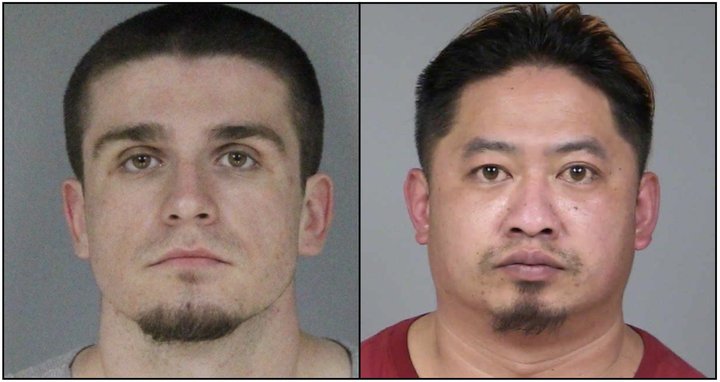
Through their investigation, deputies identified the male suspect as 25-year-old William Orsina Mattingly of Fieldbrook. Deputies have requested a warrant be issued from Mattingly’s arrest as a result of his assault on a deputy and being a felon in possession of firearms.
Mattingly is described as a white male, approximately 6 feet 1 inch tall, 220 pounds with brown hair and brown eyes. He was last seen driving a black 2012 Chrysler 300, California License Plate Number 6VHE579. The vehicle is believed to have a damaged front fender.
Anyone with information about Mattingly’s whereabouts or additional information about this case is encouraged to call the Humboldt County Sheriff’s Office at (707) 445-7251 or the Sheriff’s Office Crime Tip line at (707) 268-2539.
Hot dog! Humboldt’s President of Positivity is once again cookin’ up something delectable for her community with her fearless Rotarian buds. Next week, the Rotary Club of Southwest Eureka will stage a COVID-appropriate “Best of the Wurst” drive-by dinner at the The Lodge on Herrick Avenue in Eureka to raise funds for the Humboldt Senior Resource Center’s Home-delivered Meal Program.
For more details, we invite you to peruse the fresh-out-the-oven press release below:
The Rotary Club of Southwest Eureka is, once again, bringing the tasty and the tantalizing to diners on the North Coast. On Thursday, March 25, from 5PM to 7PM, The Best of the Wurst, a brat-fest that is new to the Rotary calendar, will connect brat fans with dinners that will feature grilled bratwursts, hot potato salad, sauerkraut and a giant pretzel according to club President John Vandermolen. This year the club, following the success of October’s Drive-by Fish Dinner, will feature another element, as well. Portability. Respecting county guidelines and health requirements, the need for social distancing, and the inability of guests to gather as they traditionally do, this 2021 event is going mobile.
“Current times certainly affect how we do things, but they don’t change who we are,” said Vandermolen. “We remain Rotarians who are known for good times that benefit good causes. With this event, we are tapping our members’ talent for bratwurst grilling—and for sharing that talent.”
On March 25th, guests will drive to The Lodge on Herrick Avenue and, guided by signs, stop in a designated space between The Lodge and The Lodge RV parking area. Rotarians will deliver their dinners to them as they remain in their cars. “Guests, in the comfort of their homes, will savor a dinner that is every bit as tasty as those we have served up for the past couple of decades,” promised Event Coordinator Haider Ajina who added his thanks to the Elks Lodge for their generosity in providing their facility.
This year’s event sponsors have been especially generous in their support of the event, according to Ajina. “We thank them all for helping us to help our community: Redwood Capital Bank, Coast Central Credit Union, Northwood Chevrolet – Hyundai, Rainbow Self Storage, Haider Ajina-Wells Fargo Advisors, AFLAC of Northern California, Jitter Bean Coffee Co., Champ CPA Group, David L. Moonie & Co. LLP, On-Call CFO, Firpo Law Firm, Coldwell Banker Commercial-Pacific Partners Real Estate, Whitchurch Engineering, Belle Starr, Sidney W. Noyes CPA, John and Leslie Vandermolen, Lorna Hall Petersen, Kenneth Singleton DDS and Ravi Singleton FNP, and Wahlund Construction.”
The dinner will be held at The Lodge in Eureka, 445 Herrick Avenue. Tickets are $20 each until March 18, $25 after that date, and can be purchased through the club’s website – www.swrotary.org – and at the point of pickup at The Lodge. All dinners must be paid for with credit or debit cards. There will be no cash purchases.
This year’s dinner event will provide funding for the Humboldt Senior Resource Center’s Home-delivered Meal Program (a program that provides food to fragile seniors) and other club community projects. “This event will serve up dinners that will help us improve lives in our community as we strengthen our club’s more than 52 years’ tradition of support for those in need, the hungry, the fragile,” said Vandermolen. “We’ll serve great food to brat fans so that others don’t go hungry.”
For more information: www.swrotary.org or call 707-572-4101.
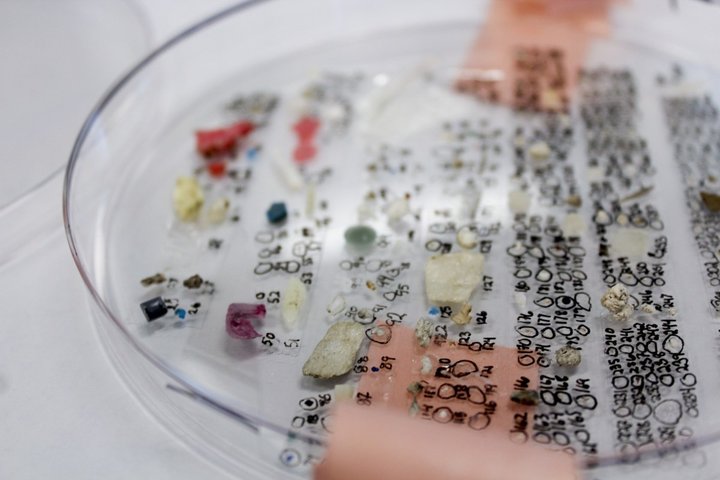
Microplastics collected in the San Francisco Bay Area are identified and labeled for research in a lab headed by Chelsea Rochman, an assistant professor at the University of Toronto. California is about to set the world’s first guidelines for microplastics in drinking water. Photo by Cole Brookson courtesy of Rochman Lab.
###
California is poised to issue the world’s first guidelines for microplastics in drinking water despite no data on how plentiful they are in the state, no scientific agreement on how to test water for them and little research on their health risks.
The pieces of plastic — smaller than an ant, some so tiny they can be seen only with a microscope — have contaminated wildlife and human bodies through their food, air and water.
Under a 2018 state law, California must require four years of testing for microplastics in drinking water, and the state must consider guidelines to help water providers and consumers determine what levels may be safe to drink.
Now the state Water Resources Control Board is blazing a trail to issue a preliminary health-based threshold and testing methods by July 1.
The state’s aim is to take a precautionary approach, moving to tackle potential threats posed by microplastics.
“Is it too early to do something? No, it is actually a bit late.” — Rolf Halden, director of ASU’s Biodesign Center for Environmental Health Engineering
But there are big obstacles to such early action: Research into the consequences of ingesting tiny plastic fragments is still in its infancy. No one knows how widespread microplastics in California’s drinking water really are. There isn’t even a standardized method to test for them. And no one knows what dose may be “safe” to consume, since the human health effects are largely unknown.
California’s water regulators are pushing to close those gaps. “To be honest, if the legislature hadn’t given us such an aggressive deadline, with rather high goals, this might not happen this year,” said Scott Coffin, a research scientist with the State Water Resources Control Board. “It really is accelerating the field quite a bit.”
Theresa Slifko, chemistry unit manager at the Metropolitan Water District of Southern California, which provides imported water to 19 million Californians, warns that monitoring drinking water for microplastics is going to be “very complicated and time consuming, and that’s why it’s expensive.”
Developing a health guideline for microplastics is “a tough one,” said Razmik Manoukian, the Los Angeles Department of Water and Power’s director of water quality.“But there’s a lot of studies worldwide done on plastic exposures … so it could be they can come out with a preliminary number.”
Researchers applaud California’s efforts to move forward, even though they caution that drinking water is not thought to be the biggest source of microplastics people consume. People probably absorb more simply by breathing.
“We now know that we live in a soup of plastic that is getting ever denser. And we don’t seem to be changing our ways. And the contaminants, they live longer than we do, meaning that the soup will get thicker,” said Rolf Halden, director of the Biodesign Center for Environmental Health Engineering at Arizona State University.
“So is it too early to do something? No, it is actually a bit late.”
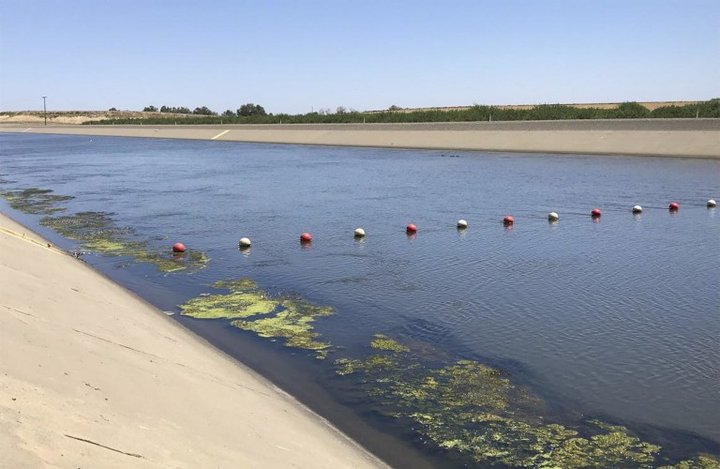
Runoff carrying microplastics can pollute open channels such as the California Aqueduct, which provides much of the imported water to the Metropolitan Water District’s 19 million customers in Southern California. Photo by Michelle Sneed, US Geological Survey.
Trillions of microplastic particles are floating on the surface of the world’s oceans, weighing at least 100,000 tons. And that doesn’t include the unknown quantities in freshwater rivers and lakes, or the particles that have sunk into the oceans, washed ashore or been consumed by marine life.
While from pole to pole there’s been widespread study of the environment to figure out where microplastics have wound up, there’s been less research into their possible effects on people.
No government has developed a health-based threshold for microplastics in drinking water, according to the water board’s Scott Coffin.
The health threshold won’t be an enforceable standard at this point; it’s unlikely to carry the weight of regulation. Instead, it will probably be a preliminary guideline to help water providers and consumers assess the levels in their water, and it is likely to change with more research, Coffin said.
“It will be the world’s first health-based guidance value of any sort for microplastics formally recommended by a working group or government agency,” he said. “This will carry a lot of authority, even if it is just a preliminary guidance level.”
California’s efforts took off when a constituent reached out to state Sen. Anthony Portantino, a Democrat from the La Cañada Flintridge area, warning that plastic fibers in drinking water may contain toxic chemicals.
Despite opposition from the Metropolitan Water District and other water providers, the Legislature passed Portantino’s bill in 2018 calling for standardized testing methods and four years of monitoring statewide. The law also urged the water board to consider recommending a health threshold by July 1 2021. Another law instructs the state’s Ocean Protection Council to develop a strategy for addressing microplastics in oceans.
“This will carry a lot of authority, even if it’s just a preliminary guidance level.” — Scott Coffin, Research Scientist at State Water Resources Control Board
The goal of the drinking water guideline is to help Californians understand the levels of microplastics detected in their water when the agencies start making the testing data public, which could happen as soon as next year.
“The question from the public (is), ‘Well, what does that (level) mean?’ It’s never a satisfactory answer to say, ‘Geez, I don’t know,’” said Mic Stewart, water quality section manager of the Metropolitan Water District. “We’ll need to look to the state for guidance on that.”
Now, an international team of researchers assembled by the water board and the Southern California Coastal Water Research Project, a public agency that has been studying waterway health since 1969, are scouring scientific literature for hints about the toxicity of microplastics.
The challenge is extrapolating the findings in lab animals to potential effects in people.
The World Health Organization concluded in 2019 that there was too little evidence to understand the toxicity of microplastics, and “no reliable information suggests it is a concern through drinking-water exposure.”
Water providers who opposed California’s microplastics bill also said at the time that it was premature to set a guideline. “Without studying the effect exposure to microplastics has on the human body, there is no way to determine the impact of the varying levels of microplastics found in drinking water,” the California Municipal Utilities Association wrote in 2018.
But environmental health researchers in Europe pushed back against what they called this “‘no risk’ soundbite.” Two scientists wrote in the journal Environment International that “logic does not allow the current knowledge gap… to steer the bias towards a belief that ‘microplastics are safe.’”
“We can say with pretty high confidence that eating plastic and breathing in plastic is not beneficial,” said Susanne Brander, an environmental toxicologist at Oregon State University who is working with Coffin’s team.
“We’re pretty sure this is a problem. It’s just a matter of having enough data to say how much is too much.”
Since the World Health Organization’s report, the number of toxicity studies about microplastics has roughly doubled, Coffin said in a recent hearing.
“We’ll actually be able to say with some level of certainty whether or not this is an immediate issue for people’s health, or if it’s an issue that will arise down the road,” he said.
“We can say with pretty high confidence that eating plastic…is not beneficial. We’re pretty sure this is a problem. It’s just a matter of having enough data to say how much is too much.” — Susanne Brander, environmental toxicologist at Oregon State University
It’s the opposite approach to how drinking water is usually regulated. In most cases, state or federal water regulators know how much of a contaminant is in the water, and research has already linked it to health effects in humans.
Bart Koelmans, a professor of aquatic ecology and water quality at Wageningen University in the Netherlands, said that California’s approach is warranted as an early risk assessment of an emerging contaminant.
“It is not that people do this (assessment) when it can be done. It is done when an answer is needed,” said Koelmans, who has participated in California’s assessment of the health effects. “That makes us then take a more precautionary approach, to stay on the safe side.”
The hunt for microplastics
Even as the state works to develop drinking water limits on microplastics, state officials know nothing about how plentiful they are in California’s water supply because testing has not started yet.
“We have been studying these things since 1959. And we still don’t have a standard method,” Coffin said.
Until just a few years ago, many scientists peered through a microscope and sorted the particles by hand, Coffin said. “You squeeze the particle with tweezers, and you kind of have a guess if it’s plastic or not,” he said. “Very crude, honestly.”
Now some labs stain the particles to make them easier to spot. They shine an infrared beam or laser at a particle and look for telltale wavelengths of light that it absorbs or bounces back to confirm it is plastic. Another way is to vaporize the sample and analyze the gases.
The state assembled an international assortment of laboratories working to streamline these techniques and figure out which are the most cost-effective for testing drinking water, sediment, ocean water and fish tissue. They expect to reveal by July what tests water providers must use.
The Southern California Coastal Water Research Project is leading the effort, sending jars of water spiked with microplastics and other materials to more than two dozen labs to see if they can distinguish microplastics from other contaminants and accurately count particles.
“The sample sets that were put together for us were very interesting,” said Slifko of the Metropolitan Water District, which is one of the labs. “They had rabbit hair in them. There was also cellulose fibers from toilet paper. There was a lot of different red herrings in there.”
Slifko’s researchers filtered the water and then peered at the particles through microscopes. They picked out pieces of plastic with forceps, then put them on a petri dish lined with sticky tape to count them.
“Each of those samples took at least 120 hours per sample,” Slifko said. “In drinking water, it’s essentially looking for a pin in a haystack.”
Another potential obstacle: contamination from plastic in the lab or researchers’ clothing, said Steve Weisberg, the Southern California water research project’s executive director.
“We actually have a lock on my laboratory. I do not have a key, and I run the place. Why? because I wear these polyester shirts! You’re not allowed in the lab with a polyester shirt,” Weisberg said.
“That health threat will not be addressed by just removing microplastics from drinking water, sadly,” said Arizona State University’s Halden.
Ultimately, experts say, the solution will be to reduce the flow of plastics into the environment.
When your house is flooding, “the first thing is you have to stop the pipe,” Halden said. “We have to stop the pipes that are flooding our environment, our food, our water, everything with these types of materials.”
California lawmakers are looking for ways to stop the flow of plastics with a package of bills announced last week. Somewould require new washing machines to be equipped with filters. But these bills may face an uphill battle. Last year, lawmakers after a fiery discussion rejected a pair of bills aimed at restricting single-use plastic packaging and food products. Another that would have required filters in state laundry facilities died.
Testing water and setting a guideline is the first step.
“I’m excited to see California’s influence on other states,” said Oregon State’s Brander. “It’s nice to see them taking the lead, and potentially setting a really good precedent going forward.”
###
CALmatters.org is a nonprofit, nonpartisan media venture explaining California policies and politics.
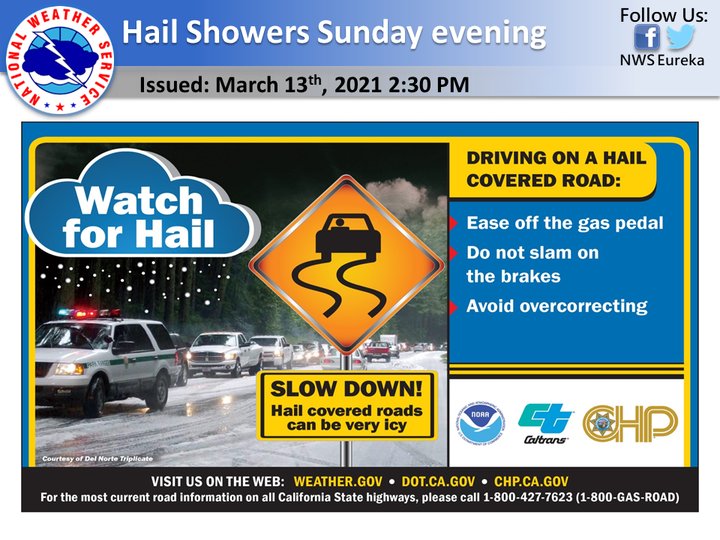
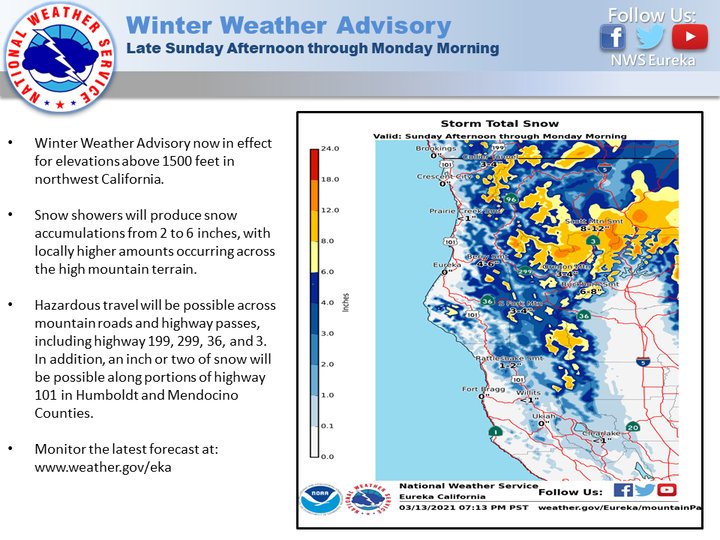
Eureka’s National Weather Service office reports that rain will be possible for much of coastal Humboldt until tomorrow afternoon. Hail is also in the forecast.
“Accumulating small hail will be possible near sea level and will result in locally hazardous driving conditions,” the NWS stated.
Snow is forecast to fall along highway passes in elevations as low as 1,000 feet starting this afternoon. Berry Summit is expected to see 4 to 6 inches of snow by tomorrow morning. Highways 299, 36, 101, 199 and 3 are all subject to hazardous driving conditions during this time.
Drier weather is expected for the rest of the week as Earth’s Northern Hemisphere moves into springtime.
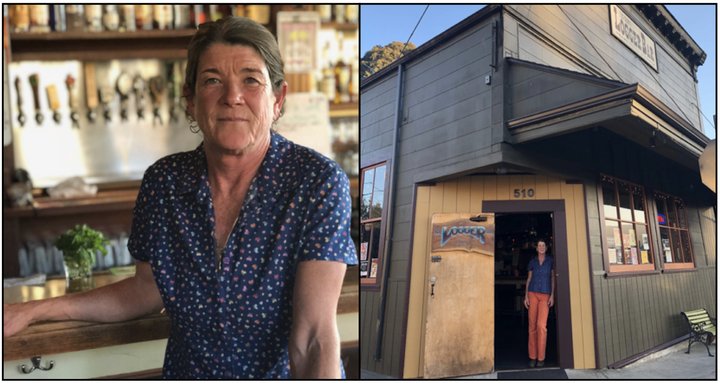
On this week’s episode of Humboldt Holding Up, LoCO’s zoomingest pandemic-era podcast, we talk to Kate Martin, owner of the Logger Bar since 2012, about how she and the citizens of Blue Lake have been managing through the pandemic despite not being able to congregate in their over-125-year-old place of boozy worship.
While the bar has remained closed through COVID, Martin has found ways to keep herself moving. In addition to making improvements to her “drinking museum,” back in September she flew back east and ended up taking a three-month solo bike trip back across the country.
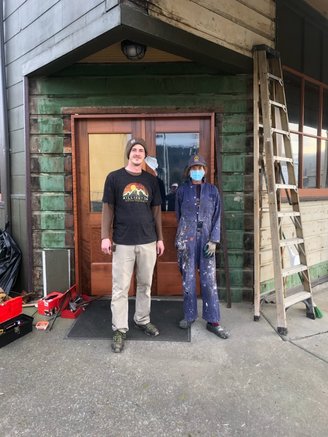
During COVID, the bar received a new snazzy door you’ll be able to stumble through when this is all over
“I’ve never felt so free in my whole entire life,” Martin told “Just to be able to go where I wanted to go, and stop where I wanted to stop, and follow my own curiosities.”
Hear more about Kate’s journey toward the end of this week’s podchat with LoCO’s Stephanie McGeary and Andrew Goff. Other topics include:
An overview of the history of the Logger Bar and Kate’s efforts to preserve and further its legacy
How the Blue Lake community have been making it through pandemic
Why is watching live music at the Logger so magical?
Oh, Blue Lake…
To listen, click the audio player above or, for easier phone access, click over to iTunes. And also check out past episodes of Humboldt Holding Up below.
“The first mistake is that saying that the universe had a
beginning is not the same as saying it popped into existence.”
(Cosmologist Sean Carroll, The Big Picture)
“Yeah, but what was there before the Big Bang?” I’ve
been asked this more times than I’ve had hot dinners, as they say.
It’s all very well proposing that the universe started from
something unimaginably hot, dense and tiny and has been expanding
ever since, but what did it start from? Reasonable questions:
we live in a classic world, where one thing leads to another and
everything has a cause, so what caused the Big Bang? Theologian
William Lane Craig puts it in terms of a reasonable-sounding
syllogism: (1) Whatever begins to exist has a cause; (2) The Universe
begins to exist; (3) Therefore, the Universe had a cause.
Strike one for God. Skipping over the usual objections (What caused
God? etc.), let’s try to get to the heart of the matter, which is
time. If time is fundamental, that it just is and
always has been (per Newton), then there was something before Big
Bang, and something before that, and…ad infinitum. Eternity
backwards and, presumably, forwards. In this way of thinking, the Big
Bang was just a blip in something infinitely larger. If you like the
idea of eternity, check out the (discredited) steady state theory, or
eternal time-directed inflation, or the “Janus point” mirror
universe (check out my
column), or branching cyclic cosmology…there’s
something for everyone. Now, I don’t know about you, but I find
this wholly unsatisfying, the universe just cruising along endlessly
with no beginning and no end. Surely we can do better.
And we can, simply (!) by considering time as emergent, that
is, time was born as a consequence of the Big Bang. There was no
“before” because there was no time. The universe didn’t
just pop into existence, even though—according to Big Bang
cosmology—it did have a definite beginning, about 13.8 billion
years ago, and has been expanding ever since. Referring back to Sean
Carroll’s point, “for something to pop into existence implies
that at an earlier moment it was not there, and at a later moment it
was.” But there was no earlier moment! You might say, “You mean
there was nothing before the Big Bang?” which begs the question,
“What is nothing?” Calling something “nothing” implies that
“nothing” is “something.” We can talk about and even
half-picture “nothing” as black and empty. Which is where our
common-sense view of existence lets us down: nothing is not even
nothing! As soon as we try to get a handle on it, it’s something.
The late Stephen Hawking, who spent much of his professional life
contemplating these things, used to complain that asking What came
before the Big Bang? is as unanswerable as What’s south of
the South Pole? We have certain intuitions, based on our
experience of life here on Earth, and one of those intuitions is that
time flows from the past to the future, so we can’t imagine a
scenario where time just starts, bang! (Big Bang.) For us, a
universe without a beginning is as weird as a person without a navel.
Yet this may simply be our collective lack of imagination: we want
the Big Bang to have a cause because, dammit, everything has a cause.
In classical physics, yes. In quantum physics, no. Just because the
universe doesn’t accord with our (classical) experience doesn’t
rule out an arbitrary beginning, along with that of time.
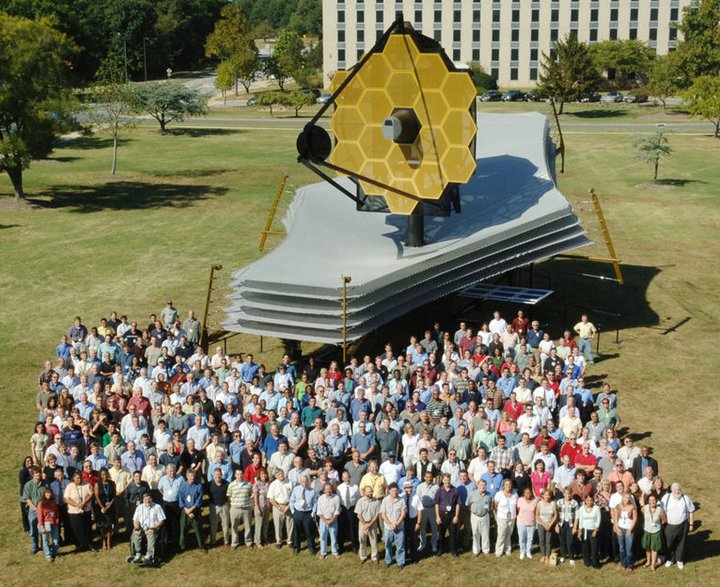
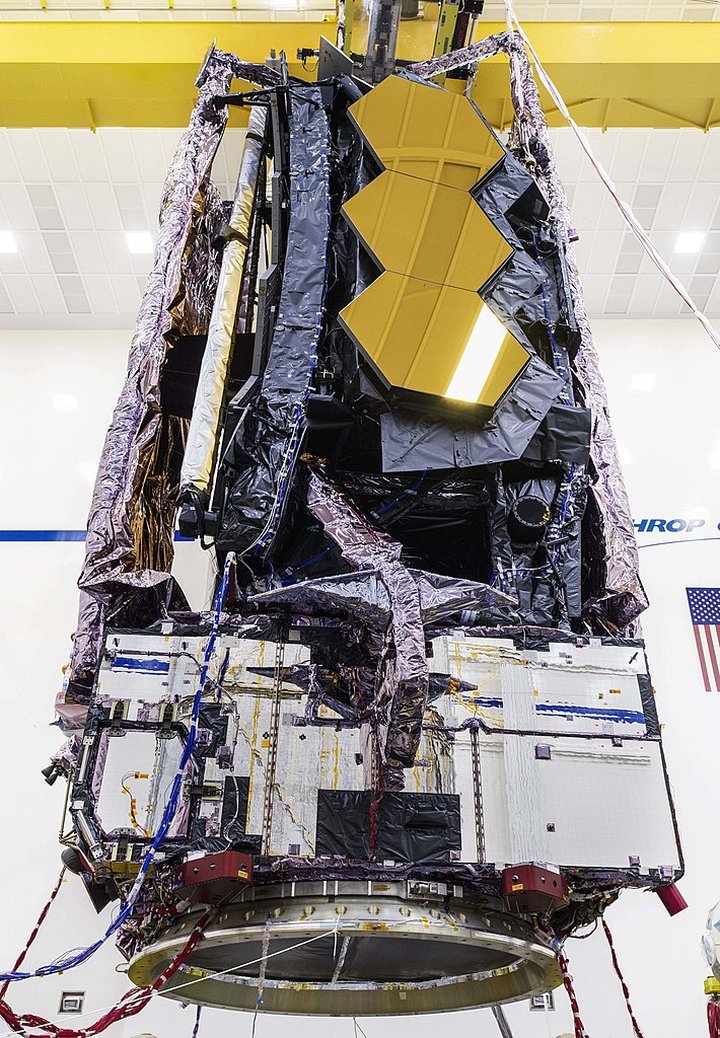
Looking back as far as we can: mock-up of the 21-foot diameter James Webb Space Telescope, five-layer sun shield below. The JWST will give astronomers their clearest view yet of the early universe. “Early” here means some 378,000 years after the Big Bang, before which the nascent universe was opaque. (Pat Izzo/NASA/Goddard Space Flight Center)
The actual telescope, folded origami-style before being loaded into its Ariadne 5 rocket. Launch is currently scheduled for October 2021.(NASA/Goddard Space Flight Center)
Another objection to the universe appearing ex nihilo (I’m
desperately trying to avoid using the word “nothing”!) is that
it’s full of stuff—that is energy, in one form or another (e.g.
radiation and matter)—and always has been, right from the start.
But that argument is a non-starter, because when cosmologists add up
all the characteristic quantities of the universe, energy being the
obvious one (momentum and charge are others), they seem to sum to
zero. For instance, protons and electrons cancel each other out
(hence zero charge) while energy, meanwhile, is cancelled out by
“negative energy,” aka gravity. In general relativity, matter and
radiation are thought of as positive energy, while the energy of the
gravitational field (curvature of spacetime) is negative. According
to the most recent estimates, the two energies, positive and
negative, balance. Meaning that (quoting Carroll again) there seems
to be no obstacle in principle to a universe like ours simply
beginning to exist.
Note that all this blue-sky speculation doesn’t rule out the
existence of God; rather, but it does make God unnecessary as far as
the existence of the universe is concerned. In this way of thinking,
the universe is, in the words of the late physicist Edward Tyron,
“simply one of those things which happen from time to time.”
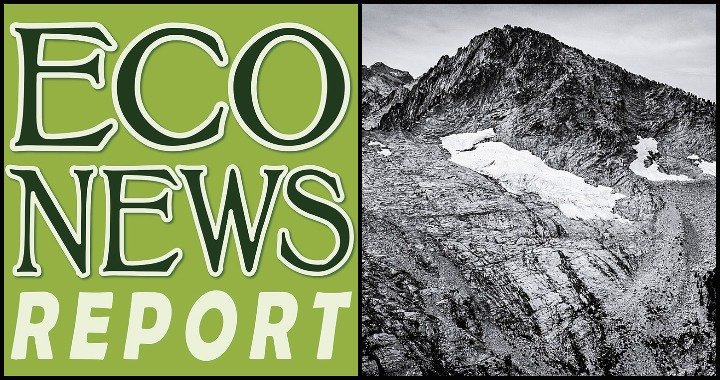
What happens when a group of friends goes on a hiking trip? If they are science nerds (and employees of the California Department of Fish and Wildlife), they document and map a set of quickly melting glaciers (publishing their findings in a peer-reviewed scientific journal) and the nearby flora and fauna (in prep). Two of the adventurer-scientists join Gang Green to talk about the weird and unique life that lives amongst old ice (such as the endemic beetle, Nebria praedicta, that lives beside Grizzly Glacier) and how documenting dying glaciers can change one’s perspective on life and time.