

(UPDATE) CLOSED AGAIN: Active Slide Shuts Down Highway 101 at Last Chance Grade
John Ross Ferrara / Monday, Feb. 15, 2021 @ 8:15 a.m. / Traffic
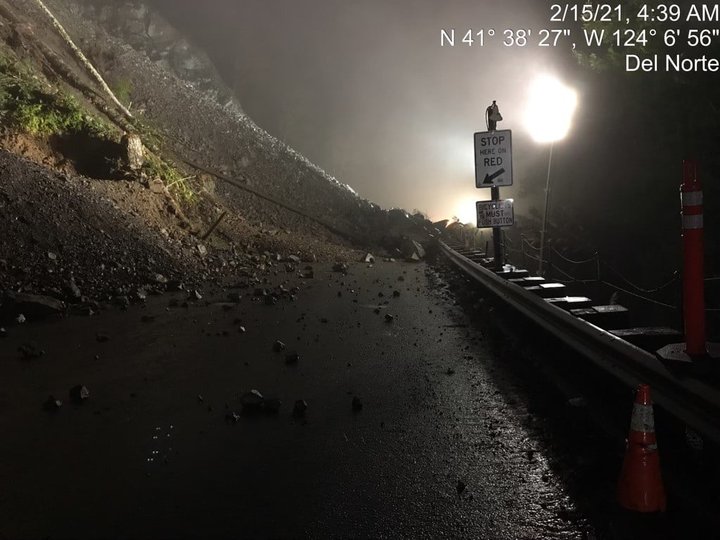
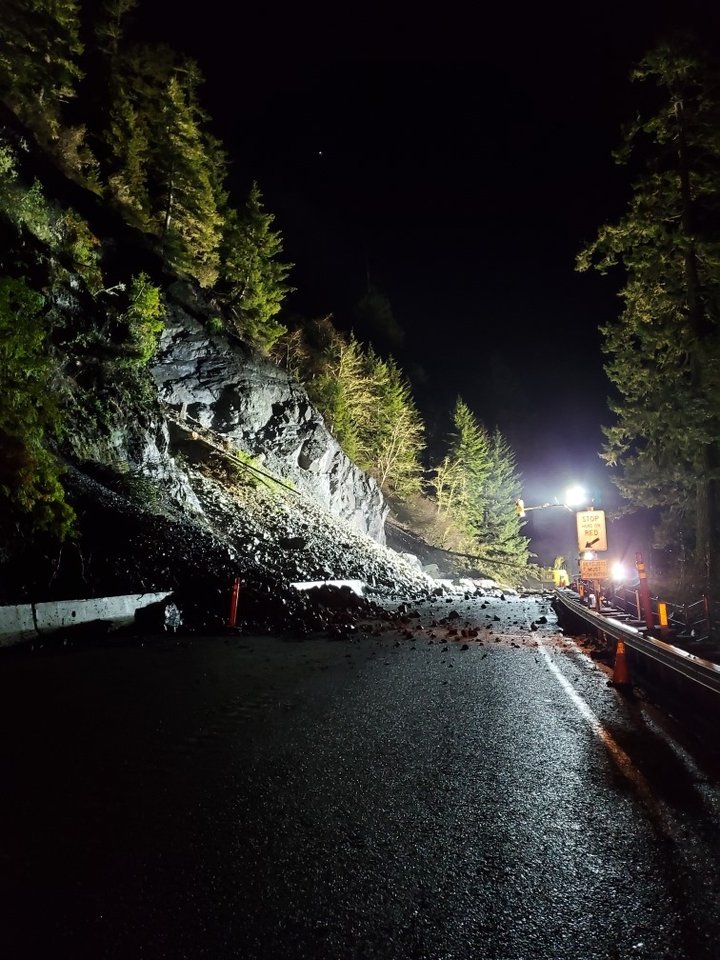
Latest photo of the slide provided by Caltrans.
UPDATE, 2:45 p.m.:
Caltrans estimates that Highway 101 will reopen to one-way traffic control at 6 p.m. if the hillside remains stable.
Drivers can expect 30-minute delays once the highway is reopened.
###
After the roadway was reopened for a few hours last night to one-way traffic, Highway 101 is closed again at Last Chance Grade due to an active slide in the area.
“There was significant slide activity last night,” Caltrans stated this morning. “Crews are removing slide material from the roadway.”
Caltrans expects one-way traffic control to be re-established sometime this afternoon if no additional slides occur.
The Del Norte Office of Emergency Services reports that a number of vehicles became stuck yesterday trying to use forest service roads as a detour.
“Please do not take forest service roads in an attempt to circumvent the Last Chance Grade closure,” the DNOES stated yesterday. “Many roads are snowed in and impassible. This is not a safe alternative at this time.”
Emergency officials say the only recommended detour at this time is highway 299 to I-5.
BOOKED
Yesterday: 6 felonies, 8 misdemeanors, 0 infractions
JUDGED
Humboldt County Superior Court Calendar: Friday, Sept. 18
CHP REPORTS
Us101 / Bayside Cutoff Ofr (HM office): Trfc Collision-Minor Inj
ELSEWHERE
Governor’s Office: Governor Newsom issues legislative update 9.20.2026
RHBB: Five Dead, One Seriously Injured in Fiery Head-On Crash on Highway 299 Near Whiskeytown
RHBB: Fire Burns Near Homeless Encampment Behind Lower Lake Walmart
MONDAYS WITH MICHAELE: Be Our Damp Valentine
LoCO Staff / Monday, Feb. 15, 2021 @ 7:30 a.m. / Mondays With Michaele
You didn’t think Valentine’s Day was going to pass you by without a little love from Michaele, did you? What shortsighted thinking!
Nope, your President of Positivity is kicking off this Monday by wandering the precipitation-pummeled streets of Old Town where she just happens to bump into members of the Rotary Club of Southwest Eureka. Who do they love? Humboldt’s local businesses, of course!
# # #
Perhaps You’d Like to Explore Previous Mondays With Michaele For Some Reason!
U.S. Coast Guard Rescues Distressed Kayakers Near Trinidad Head
John Ross Ferrara / Sunday, Feb. 14, 2021 @ 11:45 a.m. / Emergencies

Photos of the rescue by Erik Fraser.
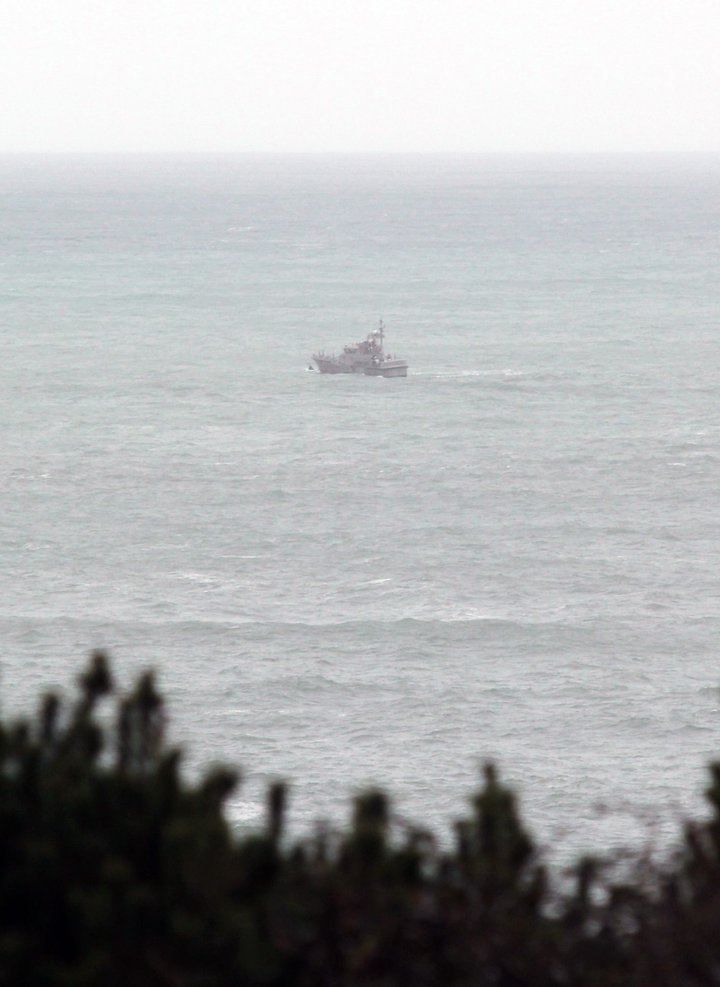
U.S. Coast Guard Sector Humboldt Bay’s helicopter crew hoisted two kayakers from the icy water near Trinidad Head this morning.
USCG Petty Officer Mitchell Amort told the Outpost that the kayakers became distressed after their kayaks began to take on water at approximately 10 a.m.
“Our Coast Guard helicopter crew was already airborne for training,” Amort said. “We were able to divert them and get on scene with the kayakers in 20 minutes.”
The two distressed kayakers were flown to Station Humboldt Bay and are reported to be in good health thanks to their high-quality wetsuits. Two additional kayakers from the group were picked up by a USCG motor lifeboat as a precaution.
(UPDATE) Highway 101 Remains Closed at Last Chance Grade Due to Slide
John Ross Ferrara / Sunday, Feb. 14, 2021 @ 9 a.m. / Traffic
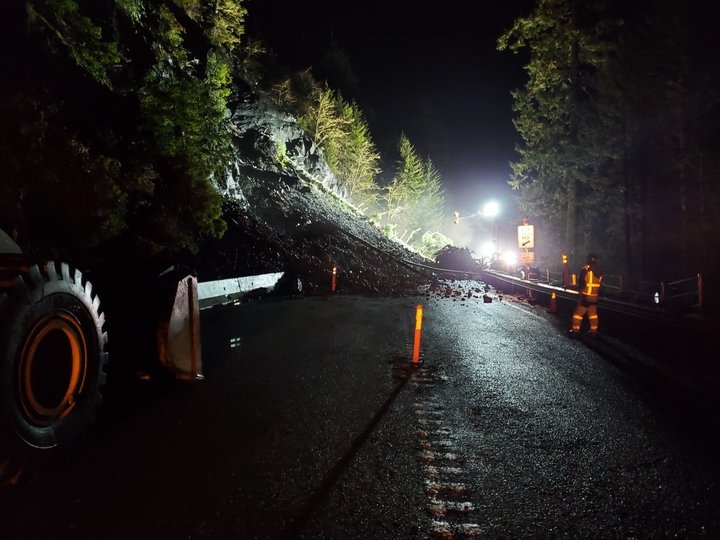
Photos of the slide provided by Caltrans.
UPDATE, 3 p.m.: Caltrans stated that Highway 101 will likely reopen to one-way traffic control at 6 p.m. This time may change if more slides occur in the area. Drivers can expect 30-minute when the highway is reopened.
###
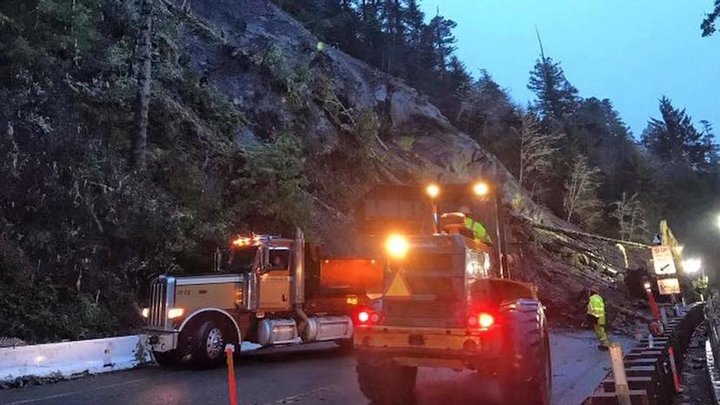
Highway 101 remains closed at Last Chance Grade today after an active slide caused crews to shut down the highway yesterday afternoon.
Caltrans reports that crews are actively removing debris from the roadway and that one-way traffic control could be established in the area as early as this afternoon.
“We estimate one-way traffic control may begin this afternoon assuming no additional slide activity occurs,” Caltrans stated this morning.
Eureka’s National Weather Service office reports that light rainfall is forecast for Coastal Humboldt County today, with moderate to heavy rain moving across Humboldt and Del Norte Counties tonight.
“Look out for rockfall and isolated slides along roadways near steep terrain tonight into early Monday morning,” the NWS stated.
The Outpost will continue to monitor the slide and provide updates throughout the day.
(AUDIO) HUMBOLDT HOLDING UP: Food For People Executive Anne Holcomb on Keeping Humboldt Fed During the Pandemic Year
LoCO Staff / Sunday, Feb. 14, 2021 @ 7 a.m. / Humboldt Holding Up
Subscribe to Humboldt Holding Up on iTunes!
(AUDIO) Anne Holcomb is Holding Up
For the past 20 years, Anne Holcomb has served as executive director of local nonprofit Food For People, helping the Humboldt food bank see to it that community members always have enough to eat.

Anne Holcomb
“If you come in and tell us that you need food then you’re going to get some food,” said Holcomb on this week’s episode of Humboldt Holding Up. That sentiment has held true even during this past pandemic year, surely one of the most challenging in Food For People’s history which saw the organization displaced from its main food storage facility even while they experienced unprecedented turnout at their food distribution events.
Click the audio player above to hear Holcomb chat with LoCO’s Andrew Goff and Stephanie McGeary on a number of topics, including:
- How she found her way from Maine to her Humboldt home
- The history of Food for People and how she sees its current role
- How COVID has forced her team to redesign their distribution model
- “The Great Poop Storm of 2020” that forced Food For People out of their main facility in Eureka
- Food for People’s current programs
- Ways Humboldt residents can get involved and volunteer
PREVIOUS HUMBOLDT HOLDING UP GUESTS:
- AHHA President Nezzie Wade
- Performance Artist Noël August/Tucker Noir
- Eureka Mayor Susan Seaman
- Eagle House Owner Jennifer Metz
- Absynth Quartet Drummer Mike “Tofu” Schwartz
- HACHR Executive Director Lasara Firefox Allen
- Alchemy Distiller Owner Amy Bohner
- Eureka City Councilmember Kati Moulton
- Eureka City Councilmember Scott Bauer
- Ungraceful Ager Barry Evans
- Arcata City Councilmember Sofia Pereira
- HumBrews Music Booker Laurel Weston
- Eureka City Councilmember Kim Bergel
- Film Commission’s Cassandra Hesseltine and Nate Adams
- Marble Maker Topher Reynolds
- Arcata Playhouse Director Jacqueline Dandeneau
- Humboldt Political Junkie Eric Kirk
- Rio Dell Mayor Debra Garnes
- Second District Supervisor Estelle Fennell
- Arcata Food Aficionado Jada Calypso Brotman
- Body Piercer Jackie Silva
- Dick Taylor Chocolate’s Adam Dick
- FUHS Teachers Mark Thom and Inma Thompson
- Eureka City Manager Miles Slattery
- Savage Henry Co-Founder Chris Durant
- Eureka Street Art Festival Organizer Jenna Catsos
- SCRAP Humboldt Founder Tibora Bea
- Gym Owner Tyler Parr
- Six Rivers Brewery Co-Owner Meredith Maier
- Multicultural Skincare Therapist Levia Love
- Annie’s Cambodian Server and Social Worker Joshua Coppock
- Eureka City Councilmember Austin Allison
- HSU Professor Deidre Pike
- Pastor Bethany Cseh
- Singer/Songwriter Chris Parreira
- Eureka City Councilmember Leslie Castellano
- Arcata City Councilmember Paul Pitino
GROWING OLD UNGRACEFULLY: Thursday — Those Last Seven Minutes
Barry Evans / Sunday, Feb. 14, 2021 @ 7 a.m. / Growing Old Ungracefully
Even if you don’t give a tinker’s damn about Mars or space or extraterrestrial life, for sheer graphics, this three-minute “How to Land on Mars” animation is soul-stirring, imho. Please give yourself the treat of watching it (with sound on), then carry on reading.
This is what wakes me up, anytime I’m getting cynical about life, politics, the environment: the fact that we humans, with our three-pound brains optimized for surviving in the African savanna a few million years ago, can design, build and land a vehicle like Perseverance on Mars. If all goes well, this Thursday afternoon, our species will be able to say:
- Not only can we send a spacecraft to Mars (currently farther from Earth than Earth is from the sun), but we can land within a predetermined area about the size of the City of Eureka
- We have figured out how to decelerate a one-ton machine from 12,000 mph to a gentle landing (1.5 mph) in just seven minutes. (Actually, we already did this with a smaller, lighter machine, Curiosity, in 2012.)
- We have sent a helicopter drone to Mars, capable of flying in the thin—one percent that of Earth—atmosphere to take photos (via both black-and-white and color cameras) that will help scout Perseverance’s future route on the surface and check out areas the rover can’t reach. All autonomously.
- We’ve safely landed a rover capable of drilling into the surface, obtaining samples and storing them for a future mission to retrieve and return to Earth for analysis.
And humans have figured out how to do this in just 64 years—a couple of generations—after launching the first object into space, an Earth orbiting two-foot diameter aluminum alloy sphere named “Sputnik 1.”
To appreciate the magnitude of the achievement, consider what’s involved in landing Perseverance on the Martian surface. Landing a spacecraft safely on Earth is comparatively easy, due to our planet’s thick atmosphere: “aero-braking,” combined with parachutes, is a well understood re-entry process. Mars, with its thin atmosphere, presents a different challenge. Skimming across the top of the Martian atmosphere, Perseverance, protected by its heat shield, decelerates from 12,000 mph to less than 1,000 mph in four minutes, after which a new piece of technology, a “range trigger,” instructs the craft to deploy its supersonic 70 ft. diameter parachute at just the right moment. The ’chute has to be sturdy—it initially slows Perseverance down to 360 mph in just 20 seconds.

Seven-minute landing sequence (NASA)
Following separation of the “backshell” attached to the parachute, rockets slow the landing even more, If Mars wasn’t dusty, that would do it—the rockets would bring Perseverance down for a safe landing. But in fact, the rockets would kick up so much dust that the craft’s delicate instruments might be damaged, which is why the crazy-looking “skycrane” is used, to let the rover rappel safely down on three 25 ft. nylon tethers from its rocket-powered “jetpack.” As soon as Perseverance touches down, the tethers are cut and the jetpack flies away to a crash landing.
Here’s the thing: this all happens completely automatically. Earth is 11 radio minutes distant, so there’s nothing anyone back here can do if something goes wrong. By the time we receive a signal saying that the descent has started, Perseverance will, hopefully, already be sitting safely on the Martian surface. That’s assuming every one of hundreds of computer-actuated processes has worked correctly and on time. For instance, the angle of entry has to be just right; the timing of parachute deployment has to be perfect; all the rockets need to fire impeccably; and there’s no second chance for the pyros—small explosive devices—to sever the tethers. One malfunction and eight years of development and $2.7 billion goes kaput. (Is that a lot? It’s Disney’s global box office takings for Avengers: Endgame; or 33 hours of DoD spending…)

(NASA)
Mars
is not for the faint-hearted! I hope you’ll join me watching the
white-knuckle show on Thursday. Check here
at 11:15 am Humboldt time.
THE ECONEWS REPORT: Busting Myths about the Klamath Dam Removal
LoCO Staff / Saturday, Feb. 13, 2021 @ 10 a.m. / Environment

Copco #1 dam. Photo: U.S. Fish and Wildlife Service.
###
Mike Belchik, senior fisheries biologist with the Yurok Tribe, joins Gang Green to give an update on the Klamath dam removal (spoiler: it’s on track to be completed by 2024!) and helps resolve a number of myths concerning the Klamath dams that you might see shared on social media.
To wit:
1. No, it won’t increase in-stream water temperature (dams do that);
2. No, it won’t result in severe flooding (these are hydroelectric dams, not flood control dams, and don’t operate to control flooding);
3. Yes, while there is a loss of power generation, that power generation is not very large (~170MW at full capacity, which hardly ever happens) and the power is not particularly low-carbon when you consider the methane produced by the reservoir behind the dams.
AUDIO:


