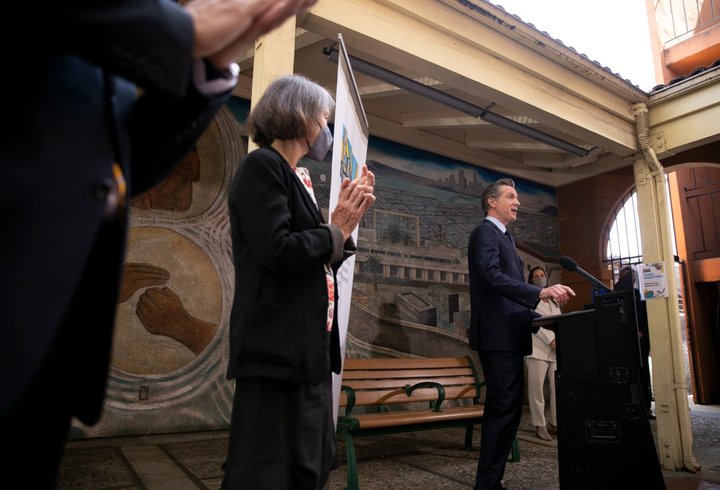
Gov. Gavin Newsom holds a press conference at The Unity Council in Oakland to announce a budget surplus in addition to new stimulus checks, tax rebates and additional rent relief for Californians on May 10, 2021. Photo by Anne Wernikoff, CalMatters
###
At the start of the pandemic a year ago, today’s news would have seemed unimaginable: The Golden State is sitting on a budget surplus so big, it’s considering giving $600 stimulus checks to California households making up to $75,000, paying off back rent of tenants affected by COVID and helping millions of residents catch up on their water and electricity bills.
“California is not just back, California is roaring back,” Gov. Gavin Newsom said today in announcing a whopping $75.7 billion surplus that’s enabling him to propose what he claims is the largest state tax rebate in American history.
California is not just back, California is roaring back.
Gov. Gavin Newsom
At a press conference in the Oakland neighborhood of Fruitvale, Newsom announced an $11.9 billion expansion of his Golden State Stimulus program to send one-time $600 payments to Californians, $5.2 billion to help low-income renters stay housed, $2 billion to help Californians pay overdue water and utility bills, and $1 billion in college grants to help workers whose jobs have been decimated by the pandemic find better-paying work.
The rest of the relief proposal will address “five of the state’s most stubborn challenges,” according to his office. Lawmakers have until June 15 to negotiate a finalized budget.
“I’m just very proud that we are a state that reflects the type of values that recognizes that so many people were disproportionately hurt by this pandemic,” said Senator Nancy Skinner, an Oakland Democrat who leads the Senate budget committee.
Her counterpart in the Assembly, San Francisco Democrat Phil Ting, piled on: “This is an opportunity to build the California, not of next year, but really, of the next 100 years.”
Good timing
For Newsom, who is facing an all-but-certain recall election later this year, it’s a politically fortuitous time to have tens of billions of dollars worth of goodies to sprinkle around the state. That’s particularly true of the stimulus payments, which, if enacted by the Legislature, would likely wind up in taxpayers’ mailboxes in the fall — around the same time as the recall ballots.
Newsom’s relief plan comes as new jobs data paints a mixed picture of California’s economic recovery. Despite a pick up in business reopening and hiring, the state still had 1.5 million fewer jobs in March than in February 2020 — with the lowest-paying jobs hit hardest — according to a California Budget and Policy Center analysis. High unemployment rates continue to disproportionately affect Black and Latino Californians, especially women.
Newsom dodged a question about the political motives behind his new spending proposals at the press conference, but his Republican opponents were quick to draw the connection. “Californians can’t be bought,” Republican gubernatorial candidate John Cox said in a press release. “Californians need permanent, real tax relief, not just one-time stimulus checks,” added former San Diego mayor Kevin Faulconer, another Republican challenging the governor.
Newsom continued to affirm his plans to reopen California on June 15 should the state continue its vaccination trend. California’s seven-day coronavirus positivity rate has dropped below 1%, the lowest since the start of the pandemic, he announced. So far, 62% of all Californians over 16 had received at least one vaccine dose.
Expanding the Golden State Stimulus
Newsom is proposing to send $600 tax rebates to California households who earn up to $75,000 in adjusted gross income per year. An additional $500 will go to families with kids or other dependents, as well as undocumented families. Newsom said that 78% of California tax filers would ultimately receive a stimulus payment.
It’s a significant expansion of the $3.8 billion Golden State Stimulus program that Newsom authorized in February, which is sending one-time $600 payments to Californians who earn less than $30,000 per year, plus an extra $600 for undocumented taxpayers. It also authorized $600 grants for CalWORKS families and elderly, blind and disabled people who receive Supplemental Security Income or the state’s Cash Assistance Program for Immigrants.
Millions of Californians have already benefited from the first round of payments. Of the 5.7 million people the state estimates are eligible, as of today the state had received tax returns from about 3.3 million eligible people, including nearly 470,000 undocumented workers who file taxes. The state tax agency has sent out 2.5 million payments worth $1.6 billion, with more pending.
Newsom’s proposed second round of payments marks a change in strategy. The first round of payments targeted the neediest workers, while this would target higher-wage earners and their children.
“The middle class have been hurt hard by this pandemic. They’ve been squeezed across the spectrum,” said Newsom, who held his press conference from The Unity Council, a nonprofit that assists workers and families in Oakland. “Women, notably, have been disproportionately impacted in this pandemic and that’s why we are…providing additional $500 to support families with children.”
People who received the first round of payments are not eligible for the second, according to a fact sheet that the governor’s office handed out at the press conference. It’s unclear how soon the payments could be sent out.
In the coming weeks, a coalition of safety net advocates will push for much bigger relief checks for undocumented immigrants, especially those who don’t file taxes, in this expanded Golden State Stimulus program, said Anna Hasselblad, public policy director of United Ways of California. Undocumented immigrants have been left out of federal stimulus checks and unemployment benefits.
“This is not a charity thing. This is a solidarity with a community that has been excluded,” Hasselblad said.
Help paying rent, utility and water bill
Details remain sparse on Newsom’s proposals to help Californians pay back debt on rent, water bills and electricity payments.
The state’s eviction moratorium expires June 30, raising the stakes for Newsom’s new rent relief proposal. Half of the $5.2 billion he announced today was already allocated to rent relief in January, and has been slowly rolling out to landlords and tenants as part of the COVID-19 Tenant Relief Act. The second half of funds will also come from the federal government, according to the state Department of Finance.
The first set of funds came with a series of stipulations laid out by state law, including that the money would cover 80% of back rent, and landlords would forgive the remaining 20%. If the landlord opted out of the program, tenants would then be eligible for only a quarter of back rent.
Who will qualify for the additional $2.6 billion in rent relief and how they’ll get it under Newsom’s proposal is still up in the air. Newsom suggested the new plan will do away with the 80% deal, opting instead to reimburse tenants for 100% of the back rent they owe.
CORRECTION: For the record, this story has been updated to clarify that the $75,000 income threshold is per household, not tax filer, according to the Department of Finance. — CalMatters
###
CalMatters reporters Ben Christopher and Manuela Tobias contributed to this report.
This article is part of the California Divide, a collaboration among newsrooms examining income inequality and economic survival in California.
CALmatters.org is a nonprofit, nonpartisan media venture explaining California policies and politics.
California Gov. Gavin Newsom today declared a drought emergency in 39 additional counties, including most of the parched Central Valley and Klamath River area.
The declaration comes amid mounting pressure from lawmakers and growers in the Central Valley, who this year are receiving only 5% of their expected water allocations from the state. Growers say the sharp cutbacks in state and federal water supplies will mean they will suffer huge economic losses and be forced to fallow fields and sell off cattle.
A bipartisan group of Central Valley lawmakers wrote to Newsom in April pushing for a statewide emergency that would give the state more flexibility in granting water transfers. They also sought easing of some rules for reservoir releases, which would “allow for more water to go to communities throughout the state.”
The governor’s emergency drought order “sounds positive to us, particularly the flexibility for water transfers,” said Mike Wade, spokesman for the California Farm Water Coalition, which represents state growers. “We have water in some areas and we want to make it available in other areas. Those transfers have to be approved in time periods that work for growers on another end.”
Natural Resources Secretary Wade Crowfoot said the order will expedite transfers of water wherever possible among growers and agencies — which means one grower can sell water to another. But he told CalMatters that the state cannot increase reservoir releases to give growers more water at this point. In fact, the emergency declaration will waive water quality standards to allow more storage of water in reservoirs for the dry days ahead.
“That being said, we want to support growers however we can,” Crowfoot said.
The new order expands the drought emergency to a total of 41 counties. Declarations already were announced last month for Mendocino and Sonoma counties due to severe conditions in the Russian River watershed.
Extreme drought in nearly all of California
The news comes as drought spreads across California, with most of the state experiencing extreme drought conditions or worse.
Water levels in the state’s major reservoirs have dropped far below average, and there’s little hope of refilling them.
“None of that water is entering the rivers and streams and flowing into reservoirs,” said Daniel Swain, a climate researcher at the University of California, Los Angeles. “It’s been steadily getting worse and steadily approaching the peak magnitude of the last big one.”
Crowfoot said the emergency order will allow the state to modify water quality requirements in rivers and the Bay-Delta in order to hold more water in reservoirs such as Lake Oroville, the largest reservoir the state operates.
The goal, Crowfoot said, is “so that we can hold more water within the reservoirs for later in the season, and next year, if it’s a dry year.”
Under the emergency powers, the state also can curtail water rights in drought-stricken river systems in order to protect threatened fish and prevent saltwater from backwashing from the San Francisco Bay into the Sacramento-San Joaquin Delta, which 29 million Californians rely on for at least some of their drinking water. The Delta is also a key source of water for irrigating the state’s multi-billion dollar agricultural industry.
“We need to make sure there’s enough water flowing into the Delta to repel salinity, in other words, to keep the salt water from intruding,” Crowfoot said.
The emergency powers will cut down on requirements for purchasing and contracting in the affected counties that Crowfoot said could otherwise slow critical services such as trucking fish stranded by low flows and warm water to the Pacific and providing assistance to communities whose groundwater wells have dried.
It will also waive some requirements under the California Environmental Quality Act, which requires an assessment of a project’s environmental effects, for constructing physical rock barriers in parts of the interior delta to protect against saltwater intrusion. Crowfoot said he expects the project to begin later this spring.
Among the groups that have been lobbying state officials is California’s commercial, recreational and tribal salmon industry, which says it is often at the end of the line when state water is doled out. California’s salmon provides $1.4 billion in economic value and supports 23,000 jobs throughout the state, particularly in the Bay-Delta region.
“Obviously, there’s not enough water to go around, and obviously drought hurts everybody,” said John McManus, president of the Golden State Salmon Association.
“Those of us in the salmon industry would like to see a little bit more compromise and a more balanced allocation of water,” he said. “The way it’s currently being allocated borders on a social justice inequity. Fishing families, especially on the coast, are being forced to shoulder more of the pain from the drought than the big growers in the Central Valley.”
###
Julie Cart contributed to this story
CALmatters.org is a nonprofit, nonpartisan media venture explaining California policies and politics.
McKinleyville, CA - The U.S. Consumer Product Safety Commission has shared a recall
of smoke and carbon monoxide alarms that may fail to alert properly.
Kidde has recalled about 226,000 of its TruSense smoke and combination
smoke/carbon monoxide alarms that can fail to alert consumers to a fire.
The recalled units are Kidde Model Series 2040, 2050, 2060 and 2070. Only alarms
with the TruSense logo of “AMBER=FAULT” printed on the front of the alarm are
included in the recall. The model numbers are printed on the back of the alarms.
Anyone with a recalled alarm should immediately contact Kidde for a free replacement.
The company advises customers to keep using the recalled alarms until a replacement
is installed.
Kidde toll-free at 844-796-9972 from 8 a.m. to 8 p.m. ET Monday through Friday and 9
a.m. to 3 p.m. ET on Saturday or online at www.kiddetsalarmrecall.rsvpcomm.com or
www.kidde.com and click on “Support” and then “Product Alerts” for more information.
Arcata Fire District would like to remind the community of the importance of having
operational smoke alarms. Have one in every room. Change the batteries twice a year.
Test them. If you are not sure, or if they are older than 10 years, replace them.
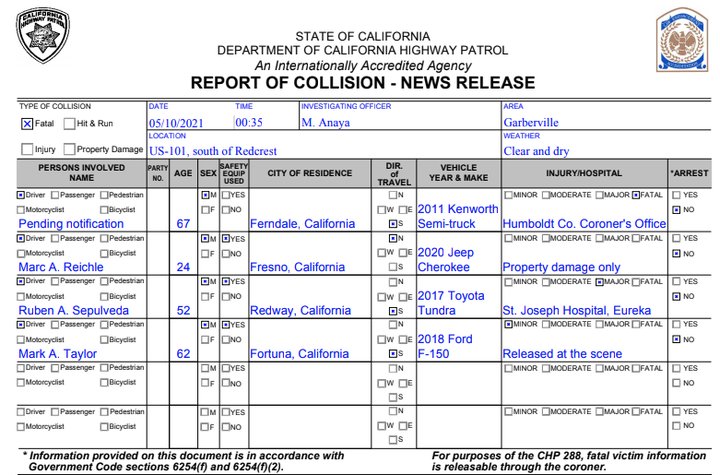
On May 10, 2021, at 12:35 a.m., a large tree fell across US-101, south of Redcrest, blocking the northbound and southbound traffic lanes that resulted in a series of traffic collisions minutes apart.
A white 2011 Kenworth semi-truck pulling an empty milk tank trailer was traveling southbound on US-101 within the right lane when it collided head-on into the tree. The semi-truck crossed the northbound traffic lanes and drove off the east roadway edge where it came to rest down an embankment.
The driver of the semi-truck was pronounced deceased at the scene. A red 2020 Jeep Cherokee driven by Marc Alexander Reichle of Fresno was traveling northbound on US-101 when the Jeep collided head-on into the tree and came to rest within the northbound traffic lanes.
Mr. Reichle was uninjured. Minutes later, a white 2017 Toyota Tundra driven by Ruben Anthony Sepulveda of Redway was traveling southbound on US-101 when it collided head-on into the tree and came to rest within the southbound traffic lanes.
Just after the Toyota came to rest, a 2018 Ford F-150 driven by Mark Allen Taylor of Fortuna was traveling southbound on US-101 when it collided head-on into the tree and then collided into the Ford before coming to rest on its side. Mr. Sepulveda was transported to St. Joseph Hospital in Eureka with major injuries and Mr. Taylor sustained minor injuries.
US-101 was closed and traffic was diverted onto SR-254 for approximately 5 hours. The California Highway Patrol was assisted in this incident by Calfire, Caltrans, Rio Dell Volunteer Fire Department, Redcrest Volunteer Fire Department, City Ambulance of Eureka, and the Humboldt County Sheriff’s Office.
The CHP Garberville Area is investigating this traffic collision.
Ahoy, Humboldt! Your President of Positivity has decided she and her boogie buds will be kicking off your week with a dance party aboard everyone’s favorite local pleasure craft, The Madaket!
And there’s even more good news! The Madket’s Captain Zippo informs Michaele that the vessel will resume normal cruisin’ in June, so look forward to that, OK?!
It’s been nearly four years since a group of local dreamers and community organizers founded Cooperation Humboldt with the lofty goal of pushing for a more equitable world. In that time, the organization has launched numerous programs focusing on the community’s needs — from food education, to housing, to arts workshops, just to name a few — while also attempting to prepare people for a potential post-capitalist world.
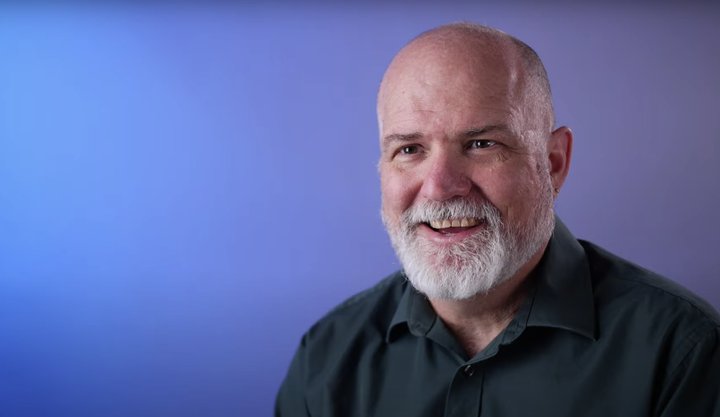
On today’s miraculous 50th episode of Humboldt Holding Up, LoCO‘s apparently never-quit podcast, we chat with David Cobb, longtime Green Party activist and one of the founders of Cooperation Humboldt about all aspects of the organization plus other topics, including:
His journey from student political organizer to earning the 2004 Green Party nomination for President and later working as campaign manager for 2016 nominee Jill Stein
Following his heart to Humboldt County and why he feels at home here
A discussion of Cooperation Humboldt’s various community programs and its leadership structure
What a future CH “Ecovillage” might look like
The upcoming launch of the Full Cycle Compost, a new CH-incubated, worker-owned business
Click on the audio player above or head on over to iTunes to hear Cobb’s chat with the LoCO’s Stephanie McGeary and Andrew Goff. And if you feel up for it, scroll through the growing list of past guests below.
“When used
judiciously, swearing can be hilarious, poignant, and uncannily descriptive…it recruits our expressive faculties to the fullest:
the combinatorial power of syntax; the evocativeness of metaphor; the
pleasure of alliteration, meter, and rhyme…”
– Steven Pinker,
linguist
###
So here’s Bono, 2003
Golden Globes ceremony, accepting the award for the Best Original
Song in a Motion Picture on behalf of his group U2 for The Hands
that Built America featured in Gangs of New York. He’s
obviously excited as all get-up: “This is really, really fucking
brilliant!” he enthused as he ran up to the microphone. NBC, which
was broadcasting in real time (no delay), was swamped with
complaints, leading to conservatives asking the FCC to impose a stiff
fine on the broadcaster.
Which—surprisingly—it
didn’t, noting that Bono’s “fucking” didn’t come under its
guidelines for indecency, “material that describes or depicts
sexual or excretory organs or activities.” Government to the
rescue! California Representative Doug Ose introduced, arguably,
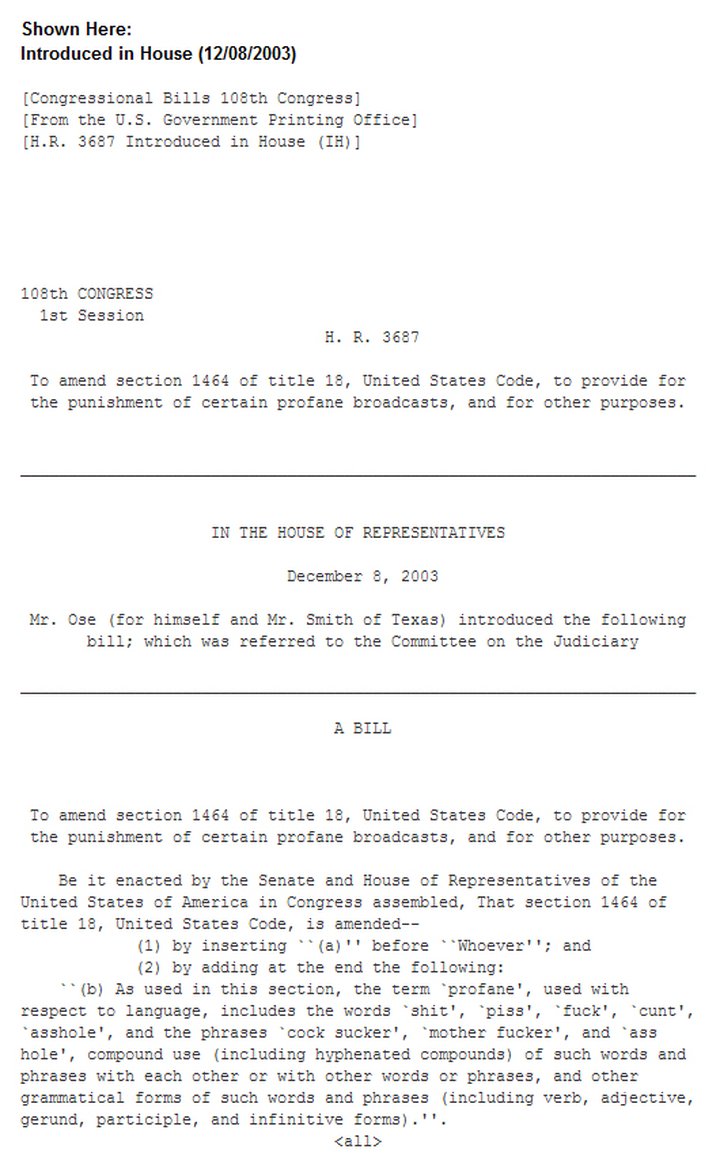
Washington’s most obscene bill, HR 3687, aka the Clean Airwaves
Act, which would have forbade from broadcast:
the words “shit”,
“piss”, “fuck”, “cunt”, “asshole”,
and the phrases “cock sucker”, “mother fucker”,
and “ass hole”, compound use (including hyphenated
compounds) of such words and phrases with each other or with other
words or phrases, and other grammatical forms of such words and
phrases (including verb, adjective, gerund, participle, and
infinitive forms).
It’s fun to analyze
Ose’s bill, which, fortunately for the sanity of the nation, died
in committee. Had this bill been read aloud over the air, it
presumably would have become a victim of its own language!
Ironically, the act wouldn’t have applied to Bono’s “fucking
brilliant,” since in conventional English grammar, only adverbs can
modify adjectives (“eerily quiet,” “blindingly obvious”).
Formally, “fucking” here is an adverb in that it modifies
“brilliant”—and adverbs get a pass, according to HR 3687.
(To be pedantic, Bono’s
“fucking” probably isn’t a true adverb—someone pointed out
that you can imagine a conversation that went, “How brilliant was
it?” “Very!” but not, “How brilliant was it” “Fucking!”
So it’s probably best to just call his “fucking” an expletive
and be done with it.)
In any case, what’s
the problem here? I guess the idea is that kids will hear these
“obscene” words and consequently be corrupted for life. As if
they don’t hear them every day; as a friend explained long ago, “I
say ‘fuck’ because it makes me feel powerful.” So it is with
kids—they’re not going to pass on this easy way to appear cool in
front of their peers. And isn’t it weird that four-letter words are
obscene, yet the depiction of violence on TV—the same networks
targeted by Ose’s bill—is OK? So how did it come about that fuck,
cunt and all the rest set off our emotions so powerfully? (Even
“shit”! The New York Times refers to philosopher Harry
Frankfurt’s best-seller as “On Bull****”.)
Linguist Steven Pinker
attributes our deep-seated response to swear words to their origin in
(wouldn’t you know it) religion: “Thou shalt not take the name of
the Lord thy God in vain,” per the Third Commandment. So when our
ancestors cursed with “Jesus Christ!” or “goddammit” or
“dammit all to hell” or “Holy Mary” or “God strike me
dead,” they were blaspheming (from Greek blasphemein = to
speak evil of), meaning they were literally incurring the wrath of
God. Over the years, however, when people noticed that blaspheming
didn’t bring dire consequences, bodily parts and actions took over
as religious curses lost their power. (Although we still swear on a
Bible in court, “as if an act of perjury undetected by the legal
system would be punished by an eavesdropping and easily offended
God,” as Pinker puts it.)
Why? What’s so
terrible about the four-letter words we now use? Because, according
to linguists, they bring to mind scary and/or fatal outcomes. For
instance, feces can transmit cholera, hepatitis A and E, and a host
of other diseases; and in addition to pleasure, intercourse can bring
a whole realm of terrors such as STDs and AIDS, unwanted pregnancies,
the break-up of marriages (along with the fact that sex isn’t
always between consenting adults). Especially disease: according to
Wikipedia, more than 20% of individuals in the range of 15–34 years
old in late 18th century London were treated for syphilis—hence the
curse “A pox on thee!”
So we went from cursing
our enemies with the wrath of God to cursing them with the threat of
disease and more. (Begging the question, if you tell me to “go fuck
myself,” what exactly are you requiring of a non-contortionist like
me, I wonder?)
Well golly-gee
Jehosaphat, we’ve sure come a long way from when Rhett challenged
the mores of the day (1939) on the silver screen when he blew off
Scarlett with the risqué, “Frankly, my dear, I don’t give a
damn.”