

Faced With Massive Juvenile Salmon Infection and Year After Year of Drought, Karuk Tribe Declares a Climate Change State of Emergency
LoCO Staff / Tuesday, June 1, 2021 @ 1:46 p.m. / Environment
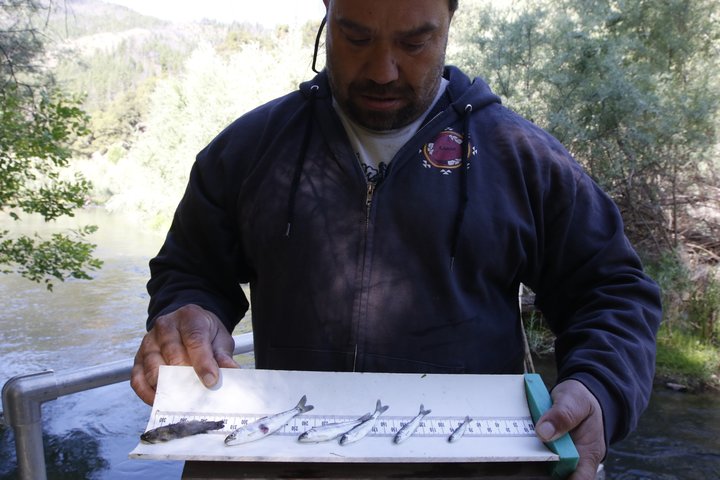
Studying the juvenile fish kill currently underway on the Klamath. Photo: Klamath Salmon Media Collaborative.
###
DOCUMENT:
###
Press release from the Karuk Tribe:
In response to record low precipitation in the Klamath Basin, the Karuk Tribe has declared a state of emergency. This emergency declaration acknowledges the reality that climate change is upon us, and the dangers that it poses to rivers, forests, wildlife and communities.
Hydrological conditions in the Klamath River Basin are the worst in modern history, although in recent years this has become an all-too-common refrain. Ecosystems and economies all along the California/Oregon border are strained to their breaking point. A massive fish kill is currently underway in the Klamath River that could result in losing an entire generation of salmon.
“Our monitoring traps are full of dead juvenile salmon. The few fish still alive are infected with disease. It’s a catastrophic blow to the fishery and Karuk culture,” said Toz Soto, Fisheries Program Manager for the Karuk Tribe.
The disease-causing parasite Ceratonova shasta (C. shasta) has been linked to Klamath salmon declines for decades. A complex of dams in the mid-Klamath disrupt natural flow patterns and cause warmer than normal water temperatures. This creates an ideal habitat for the parasite to flourish downstream of the dams. However; these dams don’t control how much water is in the Klamath River, that’s a function of how the Bureau of Reclamation (BOR) manages irrigation diversions from Upper Klamath Lake in Oregon, 50 miles upstream.
The current BOR operations plan calls for “flushing flows” to scour the river channel and dilute parasites during disease outbreaks. This year, historically low inflows to Upper Klamath Lake led BOR to rule out a flushing flow to the river.
“BOR’s decision to not provide flushing flows is allowing a massive juvenile fish kill to take place. Over 95% of sampled fish are infected. We have to keep as much water in the river as possible to allow some fish to survive,” continued Soto.
Officials have made drought declarations in the Klamath Basin in 8 out of the last 12 years. The Karuk Tribe says this year’s crisis is not an aberrant weather pattern but reflects a change in climate. “It’s time to face the reality of climate change which means we must change how we manage the Klamath’s water resources,” noted Karuk Chairman Russell ‘Buster’ Attebery. “We need long term solutions to adapt to this new climate immediately, or it will be the end for salmon and the cultures that depend on them.”
Tribal officials have asked congress provide disaster relief funds to all affected communities to address economic hardship, and ecological breakdown. In order to protect as many fish as possible, the Karuk Tribe urges state and federal agencies to broker temporary water transactions to keep critical stream reaches wet, but also point to long term solutions to recover fisheries and make the ecosystem resilient in the fact of climate change.
Some relief for salmon is on the horizon. An agreement is in place to remove the lower four Klamath River dams in 2023. The dams offer no irrigation diversions or flood protection and the parent company Berkshire Energy has agreed to removal. “Dam removal will improve water quality, disrupt the habitat for disease vectors, and allow salmon to access historic spawning grounds,” says Attebery. “We are praying the fish can hang on until then.”
BOOKED
Today: 7 felonies, 9 misdemeanors, 0 infractions
JUDGED
Humboldt County Superior Court Calendar: Today
CHP REPORTS
489 El Dorado St (HM office): Trfc Collision-1141 Enrt
SR299 / Riteway Ln (RD office): Report of Fire
Greenwood Heights Dr / Dean Ln (HM office): Trfc Collision-1141 Enrt
ELSEWHERE
Governor’s Office: Governor Newsom signs first-in-the-nation AI safeguards to protect Californians, calls on the federal government to do its part
RHBB: Body Recovered from Humboldt Bay Near Foot of Commercial Street
KINS’s Talk Shop: Talkshop September 9th, 2026 – Michelle Bushnell
RHBB: HCSO Credits Jail Staff with Saving Inmate’s Life During Medical Emergency
Can California Withstand a Teacher Retirement Boom?
Eli Wolfe / Tuesday, June 1, 2021 @ 7:30 a.m. / Sacramento
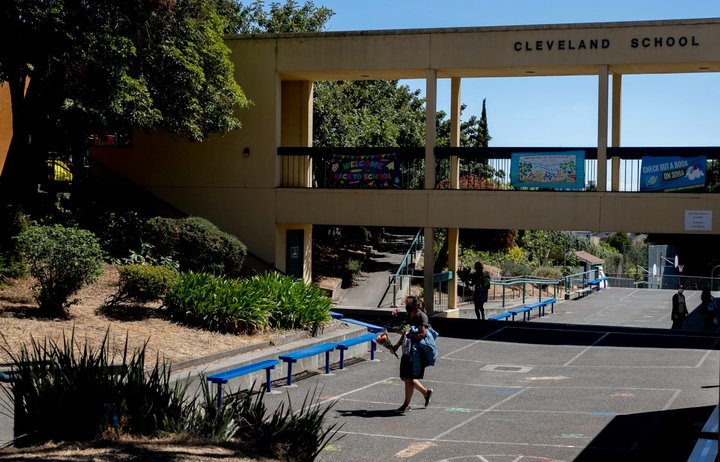
Staff members carrying balloons and bouquets of flowers leave the Cleveland Elementary School campus on the last day of school, May 27, 2021 in Oakland. Despite higher than usual teacher retirement this year, Oakland Unified has already filled 141 out of 241 vacancies, including newly created positions across the district. Photo by Anne Wernikoff, CalMatters
###
Earlier this year, the California State Teachers Retirement System issued an ominous statement: teacher retirements in California are projected to hit nearly record-breaking heights in 2021.
The statement, which came in the form of a February blog post, said that the numbers will be almost as bad as the year after the Great Recession when more than 16,000 teachers retired.
While short term effects are being felt in some areas, in many school districts the tsunami of retirements is barely registering as a ripple. While interviews with administrators, teachers, and union leaders do not paint a rosy picture of the situation, neither is it expected to be crippling.
Fremont Unified reported no significant difference between the number of retirees this year compared to last. At Long Beach Unified, which has about 12,000 employees, retirements over the past two years rose from 95 to 113. At Elk Grove Unified, there have been fewer certificated retirements this year than the previous one. At Oakland Unified, departures are higher than they have been in recent years, but the district is rapidly filling vacancies.
“We’re retaining more people than ever,” said Sarah Glasband, director of talent development, recruitment and retention for Oakland Unified. Looking to the fall, Glasband said her district is recruiting aggressively to make sure schools are fully staffed, and they’ve already filled the majority of open positions.
“It’s not worth that extra little bump on your pension if you’re not physically or mentally well.”
— David Fisher, president of the Sacramento City Teachers Association
Many more teachers could retire by the end of the school year. But the first surge already occurred in the second half of 2020, which saw a 26% increase in retirements over the same period from the previous year, according to CalSTRS.
David Fisher, president of the Sacramento City Teachers Association, said his city normally has 60 to 70 retirements annually, but this year has already seen 110, and he expects more by the end of the school year. Fisher believes some educators bumped up their retirement timeline at the beginning of the pandemic when they realized it would be a brutal slog.
“From people we’ve talked to, they’d say, ‘I was going to stick it out another couple of years but I’m out of here,’” Fisher said. “It’s not worth that extra little bump on your pension if you’re not physically or mentally well.”
Enrollment drops
While districts generally haven’t experienced retirements as a serious problem this past year, several administrators said they were overwhelmed by the large number of teachers who resigned or transferred during the pandemic.
San Mateo County Superintendent of Schools Nancy Magee said some of her districts have been hit hard as many educators left to be closer to family. Burlingame, for example, had twice as many teachers leave during the pandemic than during an average year.
However, record drops in enrollment have somewhat mitigated the retirement boom, she said.
Such enrollment drops would normally result in staff layoffs, but the sheer number of retirements and resignations appears to be cancelling each other out.
Unexpected resignations, coupled with routine and early retirements, have created staffing shortages in some districts, raising concerns about how schools will manage when they reopen in the fall. Magee said her districts are trying to plan what classes will look like next year but they still don’t have guidance from the California Department of Public Health.
“The school where I worked, the kids were already behind. And now they’ve missed a year of school, because we can’t call what they did school.”
— Christina Casas, special education teacher in Santa Ana
More immediately, districts are scrambling to find teachers who have the energy to pitch in for summer school sessions.
“Educators are exhausted, and many of our districts are having trouble staffing summer school programs,” Magee said. “They’re all making it happen to the best of their ability…but they’ve been on emergency hours and activities for nearly two years straight without a break.”
Fisher said Sacramento, following the lead of neighboring Elk Grove Unified, nearly doubled its normal summer rate to recruit teachers for summer sessions.
“Our normal summer school rate for teachers, it’s not a bad rate, it’s about $40 an hour, but they couldn’t hire teachers (at that rate),” Fisher said.
What about pensions?
One major concern with the rise in retirements is the effect it could have on teacher pensions. In an email, Rebecca Foree, a CalSTRS spokesperson, said the organization doesn’t expect retirements to have a material impact on funding levels. Outside experts tend to agree with this assessment.
“In the scope of things, this is not that big of a number,” said Paul Bruno, an assistant professor of education policy at the University of Illinois at Urbana-Champaign. He noted that CalSTRS’ outstanding unfunded liabilities dwarf the potential impact of an unusual number of retirements. As of the latest actuarial valuation report, CalSTRS has unfunded liabilities of $105.7 billion.
“California is a really big state with an awful lot of teachers who are already receiving benefits and paying into the system, so a small increase in retirements this year would not by itself be a big threat to the pension fund,” he said.
Administrators in California didn’t express much surprise with the number of retirements during the pandemic. This is partly because teachers have to retire within a set age range to qualify for their pensions, so most districts can plan for their departure well in advance. Districts also incentivize teachers to give ample notice by offering financial bonuses for letting schools know of their plans by specific dates.
Some districts are also able to rely on retirees as a source of labor. Xanthi Soriano, a spokesperson for Elk Grove Unified, said many of the district’s retirees return to schools after they meet CalSTRS’ six-month separation-from-service requirement.
“We have a pretty robust substitute list, and a good number are retirees,” Soriano said.
Recruitment problems
Recruitment is also a challenge at the leadership level. San Mateo’s Magee said it’s been difficult to find replacements for several long-term employees who left her office during the pandemic because recruiting firms are struggling to find candidates.
“Statewide, they’re seeing an unprecedented number of people either retiring or moving around,” she said. “So those agencies are really very overbooked right now.”
Several administrators said they were concerned that retirements and resignations may be exacerbating chronic staffing shortages for positions that were already difficult to fill before the pandemic, specifically special education.
Christina Casas, a credentialed special education teacher, left her job at a charter school in Santa Ana earlier this year. She said the logistical challenges of organizing virtual special education classes while raising two children of her own was simply too much.
She also felt like the district could have marshalled more resources for teachers who were struggling to manage virtual classes that were overflowing with 30 to 40 students when they were supposed to only have 20. While there was only one resignation at her school last year, she knows several people are planning to leave at the end of this term. Going forward, she said school districts should recruit more reading and math specialists to make sure students don’t fall farther behind.
“The school where I worked, the kids were already behind,” she said. “And now they’ve missed a year of school, because we can’t call what they did school.”
###
CALmatters.org is a nonprofit, nonpartisan media venture explaining California policies and politics.
(VIDEO) Let This Traveling Hooper Performing Among Humboldt’s Redwoods Signal the Return of Summer Fun
John Ross Ferrara / Monday, May 31, 2021 @ 10:45 a.m. / Feel Good
Travel and summer fun are picking up as the pandemic wanes in Humboldt County and across the U.S.
Traveling hula hooper Zach Lambert, 27, of Salt Lake City is among the tourists flowing back into the area.
“I’ve always wanted to see the redwoods, so I decided to do a 10-day trip and visit all the different parks,” Lambert said. “It’s definitely one of my first big trips since COVID.”
Lambert recorded a few hula hoop sessions while visiting our redwoods this month and shared them on social media for your enjoyment.
Lambert told the Outpost that he’s been hooping for 7 years and that he enjoyed his trip to Humboldt County.
“It’s so so nice to be traveling again,” he said. “The redwoods and NorCal were both super magical. I definitely hope to be back again sometime soon!”
MONDAYS WITH MICHAELE: How Would You Feel About a Li’l Arts Alive?
LoCO Staff / Monday, May 31, 2021 @ 6:15 a.m. / Mondays With Michaele
The Humboldt we once knew is slowly returning and it is in that spirit that Humboldt’s President of Positivity stops by one of her fav Monday spots, Mendenhall Studios at the corner of C and Second streets in Eureka!
Upon arriving, Topher Reynolds, Glass Garage marble maker and good local dude, gives Michaele exciting news: The artists of Mendenhall are going to ease back into Eureka’s Arts Alive tradition at their outdoor location this coming Saturday, June 5 from noon to 9 p.m. Check out this week’s Mondays With Michaele for all the details. Ciao Bella!
# # #
Perhaps You’d Like to Explore Previous Mondays With Michaele For Some Reason!

It’s never a bad time for HumBubbles.
River Conditions Can Still Be Deadly Despite Spring Heat, National Weather Service Warns
LoCO Staff / Sunday, May 30, 2021 @ 11 a.m. / How ‘Bout That Weather

A joint message from local agencies.
Warm weather and a holiday weekend might seem like the perfect combination for a trip to one of Humboldt’s many swimming holes. However, the National weather service is warning folks that local river conditions may still be dangerous.
“Local rivers are cold and swift this time of year,” the NWS shared on social media. “Be sure to check the weather forecast and current water temperatures.”
A join message from the NWS, U.S. Forest Service and Office of Emergency Services advises local swimmers to wear a life jacket if they plan to take a dip this week.
“Don’t let rivers fool you,” the message reads. “Cold water and swift currents can overpower any swimmer. Trees, rocks and undercut banks trap people under the surface.”
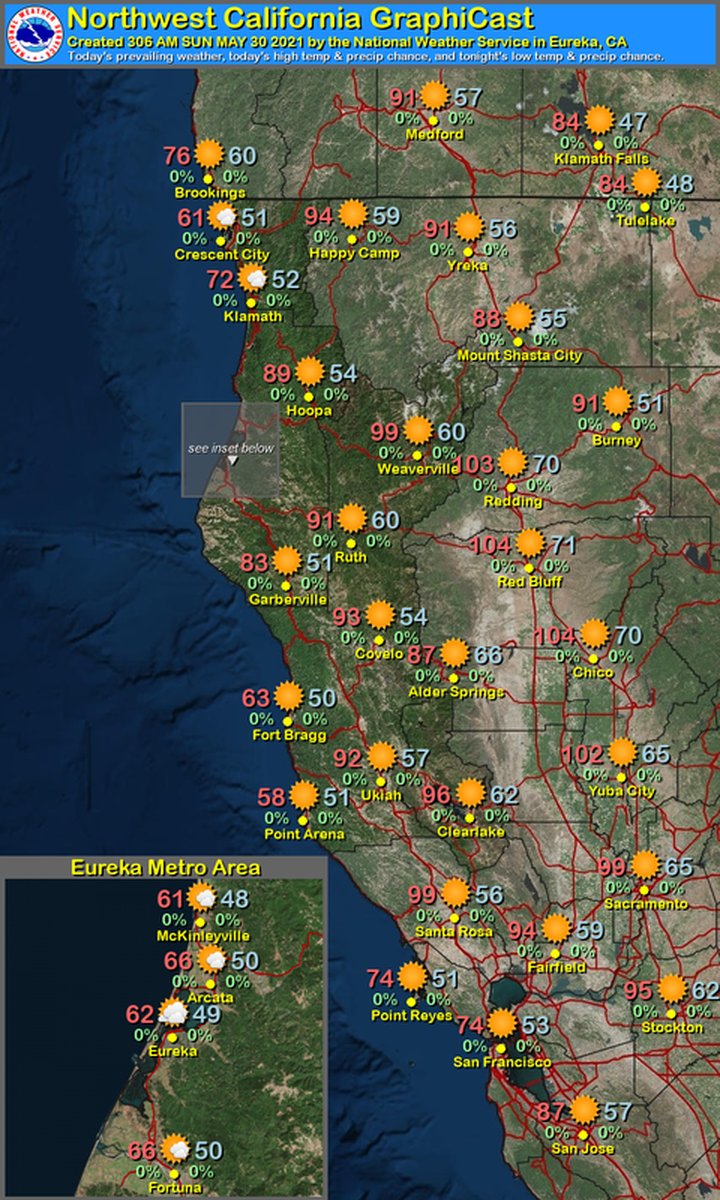
Today’s weather forecast. | NWS
GROWING OLD UNGRACEFULLY: That 60 Minutes UFO Show
Barry Evans / Sunday, May 30, 2021 @ 7 a.m. / Growing Old Ungracefully
If it weren’t for movies, none of this crap would exist.
— Chuck Nice
###
What happened to “one of the most esteemed news magazines on American television,” per the New York Times? Two weeks ago, the CBS flagship show 60 Minutes broadcast a 14-minute segment on UFOs, when Bill Whitaker interviewed, for starters, Luis Elizondo, a familiar face to anyone following the UFO saga within (and without) government ever since he popped up as an expert on the History Channel four years ago. Supposedly, Elizondo directed AATIP, the government secret Advanced Aerospace Threat Identification Program while it was operational. (Except he probably didn’t – “Mr. Elizondo had no responsibilities with regard to the AATIP program,” according to Pentagon spokesperson Christopher Sherwood.)
For that matter, AATIP was a boondoggle from the start. It was instigated in 2008 by UFO/paranormal enthusiast Robert Bigelow via Harry Reid, then Senate Majority Leader (Bigelow was a contributor to Reid’s 2008 campaign.) Your tax dollars paid for this nutty $22 million operation.
With all the times the media has been fooled into thinking ETs are in the sky over our heads, coming down occasionally to stick probes in our various orifices (not to mention lizard-men posing as politicians and generals), wouldn’t you think the producers of a program with a reputation to uphold would have done their homework? 60 Minutes has the resources of several roomfuls of fact-checkers, editors and professional newshounds. It took me, with virtually no background in this, using an ancient Dell PC, just an hour or so to find prosaic, non-alien rationales for all their Amazing Stories. Couldn’t they have shown just a little curiosity faced with such far-fetched tales? Or at the very least had a skeptic — there are many — on the program to counter the easily debunked claims of the show’s “experts”? I guess it’s all about ratings.
The big reveal of the program was the showing of four brief, fuzzy videos of UFOs that have been available for years (one for over a decade) on YouTube. These have been analyzed to death by folks who understand night vision cameras, gimbal camera mounts, bokeh (blur produced by out-of-focus objects) and other imaging artifacts. And, um, trigonometry. Here’s debunker Mick West on one of these UFOs:
First, we see “Go Fast”, a video presented as showing an incredibly fast craft skimming low over the ocean. But if you do the very simple trigonometry invited by the numbers on screen, it turns out to be something far above the surface and moving at a speed that matches the wind at that altitude, making it almost certainly just a balloon. Yet the 60 Minutes host, the highly respected journalist Bill Whitaker, repeats Elizondo’s baseless claim that it’s “fast moving.”
Then we have the green flashing “pyramid,” the latest of these “oh, not again!” Whack-a-Mole® videos. This one was filmed from a USN ship with a night vision camera, and shows (almost certainly) out-of-focus navigation lights of commercial airplane. (The ship, USS Russell, was directly under the flight path of planes flying into LAX from Hawaii.) Turns out, many night-vision devices have triangular irises (to control the amount of light let into the camera) that give rise to classic bokeh effects. Check this:

(via Mick West, used with permission)
“Jesse,” who is “Jesse 3959,” follows Mick West’s Metabunk channel and owns a night vision monocular with a triangular iris. It was, apparently, easy for him to mimic the “pyramid” shown in that startling (!) 60 Minutes video.

The triangular iris inside Jesse 3959’s night vision monocular. (Used with permission)
You can see the details here or read about it here (while wondering where that $22 million actually went).
I could go on endlessly — people have been seeing UFOs regularly since the 1946 flying saucer scare, and ETs have been around for much longer. Back in 1877, Italian astronomer Giovanni Schiaparelli (uncle of Elsa) reported seeing a network of “canali” on the surface of Mars — meaning “channels,” but picked up by the U.S. and British press as “canals.” Hence H.G. Wells War of the Worlds, 20 years later. (The idea that a dying Martian civilization was bringing water from the poles to the equator wasn’t fully debunked until the Mariner 4 mission in 1964.)
In 1967, astronomer Jocelyn Burnell jokingly wrote “LGM” on a printout from a radio telescope showing a regular one-second extraterrestrial blip; little green men were trying to contact us! She had, in fact, discovered “pulsars,” i.e. rotating neutron stars. (For which her advisor got a Nobel Prize!) And just six years ago, “Tabby’s Star” (for astronomer Tabitha Boyajian) made headlines—its light curve was suggestive of a “Dyson sphere,” a putative enclosure around a star that powers an advanced ET civilization. That’s before more mundane alternatives were proposed.
Or, most recently, Oumuamua (“Messenger from Afar” in Hawaiian), the oddly-shaped body that passed through our solar system in 2017. Because of its weird acceleration, Harvard physicist Avi Loeb claims it’s evidence of an extraterrestrial civilization. Actually, it’s probably a chunk of frozen nitrogen split off from a nitrogen planet in another solar system. Bet that explanation doesn’t make the headlines, the way Loeb’s claim did.
C’mon guys. Who hasn’t seen a UFO? I certainly don’t know any amateur astronomer and/or pilot (like myself) who hasn’t wondered about some oddball object. Probably a drone, weather balloon, airplane, Venus, marsh gas, fly on the camera lens, lenticular cloud, “earthquake light”, stealth bomber, meteor…but, big but—“unidentified” is just that. It’s a big jump from “unidentified” to “alien.” As Neil deGrasse Tyson puts it, “The fact that you don’t know what it is not evidence that you know what it is.”
Meanwhile, with half the world’s population now able to livestream high-resolution videos on their smart phones, someone will finally get a non-fuzzy, non-shopped, real-time image of something actually worthy of investigation.
I’m not waiting up nights.
(AUDIO) HUMBOLDT HOLDING UP: Go, Crabs, Go! President of the Humboldt Crabs David Sharp On the Return of Local Baseball
LoCO Staff / Sunday, May 30, 2021 @ 7 a.m. / Humboldt Holding Up
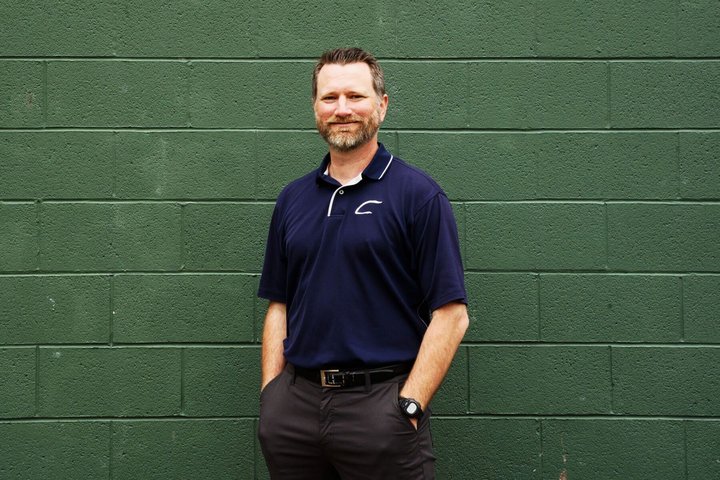
Crabs president David Sharp is ready to play ball
In April the Humboldt Crabs announced that, after a baseball-less year, there will be a 2021 season and that fans will again be welcome to the Arcata Ball Park (with extra COVID safety precautions in place, of course.) Well baseball lovers, opening night — Friday, June 4 — is now nearly upon us. Play ball!
On this week’s episode of Humboldt Holding Up, president of the Crabs David Sharp tells the Outpost all about what changes to expect this season when it comes to reserving tickets, regulating crowd size and purchasing refreshments. One thing Sharp promises won’t be different: the team is still strong and will be kicking some serious butt!
Other topics discussed with Sharp include:

- The beloved Crabgrass Band, when it’ll be at games and some of Sharp’s favorite tunes
- How COVID impacted the Crabs financially, effected the players and visiting teams
- Sharp’s journey from Crabs fan, to player (1999-2002), to board member
- How the Crabs have never had a losing season in 75 years
- Heckling! It’s important (but keep it clean)
- The BYOB days and why the park now sells beer instead
- More!
So, get yourself excited for the return of the Crabs by clicking the audio player above, or directing your phone to iTunes, to hear Sharp’s chat with Andrew Goff and Stephanie McGeary.
PREVIOUS HUMBOLDT HOLDING UP GUESTS:
- #52 Ferndale Organic Dairy Farmers Kristina Radelfinger and Dorice Miranda
- #51 Former Arcata Mayor Alex Stillman
- #50 Cooperation Humboldt’s David Cobb
- #49 Ink People Center for the Arts’ Libby Maynard
- #48 Humboldt Bay Social Co-Owner Amy Cirincione O’Connor
- #47 Musician Lyndsey Battle
- #46 Mad River Brewing CEO Linda Cooley
- #45 LoCO Editor Hank Sims
- #44 Humboldt Republic’s Jason Brandi
- #43 Table Bluff Farmer Hannah Eisloeffel
- #42 Logger Bar Owner Kate Martin
- #41 Teacher/Rapper Zach “Zigzilla” Lehner
- #40 Madaket Captain “Zippo” Libby Tonning
- #39 Event Planner Alegria Sita
- #38 Food For People’s Anne Holcomb
- #37 AHHA President Nezzie Wade
- #36 Performance Artist Noël August/Tucker Noir
- #35 Eureka Mayor Susan Seaman
- #34 Eagle House Owner Jennifer Metz
- #33 Absynth Quartet Drummer Mike “Tofu” Schwartz
- #32 HACHR Executive Director Lasara Firefox Allen
- #31 Alchemy Distiller Owner Amy Bohner
- #30 Eureka City Councilmember Kati Moulton
- #29 Eureka City Councilmember Scott Bauer
- #28 Ungraceful Ager Barry Evans
- #27 Arcata City Councilmember Sofia Pereira
- #26 HumBrews Music Booker Laurel Weston
- #25 Eureka City Councilmember Kim Bergel
- #24 Film Commission’s Cassandra Hesseltine and Nate Adams
- #23 Marble Maker Topher Reynolds
- #22 Arcata Playhouse Director Jacqueline Dandeneau
- #21 Humboldt Political Junkie Eric Kirk
- #20 Rio Dell Mayor Debra Garnes
- #19 Second District Supervisor Estelle Fennell
- #18 Arcata Food Aficionado Jada Calypso Brotman
- #17 Body Piercer Jackie Silva
- #16 Dick Taylor Chocolate’s Adam Dick
- #15 FUHS Teachers Mark Thom and Inma Thompson
- #14 Eureka City Manager Miles Slattery
- #13 Savage Henry Co-Founder Chris Durant
- #12 Eureka Street Art Festival Organizer Jenna Catsos
- #11 SCRAP Humboldt Founder Tibora Bea
- #10 Gym Owner Tyler Parr
- #9 Six Rivers Brewery Co-Owner Meredith Maier
- #8 Multicultural Skincare Therapist Levia Love
- #7 Annie’s Cambodian Server and Social Worker Joshua Coppock
- #6 Eureka City Councilmember Austin Allison
- #5 HSU Professor Deidre Pike
- #4 Pastor Bethany Cseh
- #3 Singer/Songwriter Chris Parreira
- #2 Eureka City Councilmember Leslie Castellano
- #1 Arcata City Councilmember Paul Pitino


