

OBITUARY: Gloria Jean Briceland-Alfred, 1942-2020
LoCO Staff / Wednesday, Nov. 11, 2020 @ 6:56 a.m. / Obits
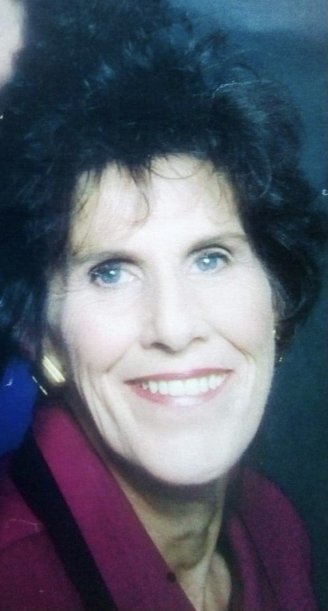
Gloria
Gloria passed
with family by her side on November 2, 2020, in Fortuna. She was born
to April 14, 1942 to Calvin Briceland and Nellie Hixson. She is a
descendant of the Briceland Family.
Gloria was born in Fortuna and was raised in Briceland and Ettersburg. She then married Jack Hudson and had two girls, Sandra and Dawn. She was then remarried to Lawrence Alfred and had twins Angel and Brian, who died at birth. A few years later she had Amber and Sacheen. Gloria was always a hard worker on the ranch in Ferndale for many years till they sold and she worked as a CNA at St. Luke’s and Bethel Care home.
Gloria is survived by her sister Dee Dee Gunther, her daughters Amber Bowlds and Sacheen Alfred. She has many grandchildren and great-grandchildren she was blessed with. David Corley and his boys Marty, Kenny, David, Issac .Christopher Cook, and his daughters Kailey and Elle. Carrie Campbell (Kent) and their children Lane and Paisley and baby Campbell on the way. Joey Filyau (Devin) and their children Lilith and Hexxus. Cheyenne Filyau and her boys Cameron, Hunter and Kayden. Tyler Day and his baby girl due in December, Kurtis Day and his daughter K’Elle, Cody Donoho, and Kayla Gibbens. She is also survived by numerous other family members — her niece Lori Shultz, who she was very close to, and sister-in-law Doris Hudson.
Gloria was preceded in death by her father Calvin Briceland, mother Nellie Hixson, brother Michael Allen, sister Dolores Shultz, her twins Angel and Brian, daughters Sandra Middleton and Dawn Cook, grandson Raymond Middleton.
All funeral arrangements are being made with Goble’s Mortuary and Oceanview Cemetery. Services will be at a later date to be determined and family and friends will be notified.
###
The obituary above was submitted on behalf of Gloria Briceland-Alfred’s loved ones. The Lost Coast Outpost runs obituaries of Humboldt County residents at no charge. See guidelines here.
BOOKED
Yesterday: 6 felonies, 12 misdemeanors, 0 infractions
JUDGED
Humboldt County Superior Court Calendar: Friday, Oct. 9
CHP REPORTS
No current incidents
ELSEWHERE
RHBB: REMINDER: Southbound 101 Closure Starting Tomorrow at the Eureka Slough Bridge
RHBB: Del Norte County Recreational Razor Clam Fishery Closes Due to Public Health Hazard
RHBB: Man Missing in Eureka
RHBB: Artists Wanted: Sooty Grouse to Star on California’s Next Upland Game Bird Stamp
HSU Foundation Purchases Craftsman’s Mall Property, Site of Stymied Housing Project ‘The Village’
Ryan Burns / Tuesday, Nov. 10, 2020 @ 5:29 p.m. / HSU
###
The Outpost got word earlier today that the Humboldt State University Foundation, a nonprofit that manages a sizable endowment for the university, has purchased the 9.5-acre parcel north of campus known as the Craftsman (or Craftsman’s) Mall.
This property, as many Arcata residents no doubt recall, was slated to be developed into a large-scale mixed-residency development, with a big focus on providing student housing. The proposal was met with controversy, community debate, developer revisions and seemingly interminable deliberations from the Arcata City Council (see links below) before the developers finally withdrew their application in May.
Reached this afternoon, HSU Vice President for University Advancement and Executive Director of the HSU Foundation Frank Whitlatch confirmed that the nonprofit purchased the property for $3.95 million.
A press release forwarded by Whitlatch doesn’t identify any specific plans for the property, saying only that it will be available “for any number of uses to support students, academic programs, and campus life.”
Whitlatch adds, in the release, that “as the University grows, there is no doubt that this will be an important asset.”
Here’s the full release:
The Humboldt State University Foundation — the non-profit organization that accepts donations and manages the endowment for the University — has made a new investment in local real estate. It completed the purchase of nearly eight developable acres within one mile of campus that is known as Craftsman Mall.
The property will be held as part of the endowment investments, generating income through rent paid by various small-business tenants. A local property manager will be selected to handle day-to-day oversight.
When needed, the property will be available to the University for any number of uses to support students, academic programs, and campus life. In the short term, the University will be exploring the possibility of providing free satellite parking for students as well as the possibility of parking for faculty and staff.
“The HSU Foundation Board took a very close look at this, and it made good sense,” said Jenny Harris, the Foundation Board Chair.
“This is an investment into the community that embraces HSU. It’s our commitment to grow and expand with the community. Additionally, the property will serve as a good income-producing investment. The Foundation will hold the property and the income generated will be used for the scholarships and programs that are supported by the endowment.”
“This was a unique opportunity,” said Frank Whitlatch, HSU’s Vice President for University Advancement and the Executive Director of the HSU Foundation. “The property is flat and open, and very close to campus. As HSU plans for future success and as the University grows, there is no doubt that this will be an important asset.”
The HSU Foundation Board reviewed and discussed the property purchase for a number of months before making the decision to invest in it.
The HSU Foundation oversees an endowment worth more than $33 million. The endowment is made up primarily of donor-created funds for specific purposes, including various scholarships and programs such as the Schatz Energy Research Center. The Foundation invests these funds so that they exist in perpetuity while also generating income to support the purposes for which they were created. Investments are mostly in mutual funds, bonds, and real estate funds, and have generated a return of just over 6 percent over the last two decades.
During the last year, the endowment distributed about $1.3 million for scholarships and programs.
The Foundation is overseen by a Board of Directors made up primarily of volunteers, nearly all of whom are also major donors to the University.
More information about the Foundation, and about how individuals can support the students and programs at HSU, is at giving.humboldt.edu.
###
PREVIOUSLY:
- Private Affordable-Housing Developer Applies to Build New Off-Campus Housing for 800 HSU Students at Craftsman’s Mall Property
- ‘The Village’ Student Housing Plan Will Go Before Arcata City Council Tonight and Tomorrow
- HSU Has Announced a Partnership With AMCAL on ‘The Village’ Student Housing Development
- Arcata City Council Listens to Community Members’ Thoughts on ‘The Village’ Development; Sets Public Meeting to Tour the Property
- HSU Will Host a Public Meeting to Discuss ‘The Village’ Proposal
- Arcata City Council Takes a Tour of ‘The Village’ Site, Sets Public Hearing to Further Ponder the Proposed Student Housing Development
- (VIDEO) Arcata’s Controversial ‘The Village’ Housing Project Explained
- In Open Letter to Arcata Council, Former HSU President Says Approving ‘The Village’ Student Housing Project is a ‘Moral Obligation’
- (UPDATE) Arcata City Council Fails to Approve ‘The Village’ Student Housing Development, Killing the Project for Now
- ‘The Village’ Revived? Arcata City Staff Schedules Meeting to Reconsider Revamped Student Housing Project
- The Return of ‘The Village’; Arcata City Council Advances the Revised Housing Development
- Rejecting All Offers on the Table, Arcata City Council Asks ‘Village’ Developers to Come Up With Yet Another Version of the Big Housing Project
- ‘The Village’ Housing Project Will be Back Before the Arcata City Council, Yet Again, on June 5
- KUMBAYA! For Once, the Arcata City Council Sees a Version of ‘The Village’ That All Its Members Can Get Behind
- THE VILLAGE IS DEAD: Developers Withdraw Application for Proposed Arcata Housing Project, Which the City Council Has Been Debating for Years
Dr. Ennis Urges You to Get Tested and Tells You You’re Probably Not Going to Get Those Monoclonal Antibodies Quite Yet
LoCO Staff / Tuesday, Nov. 10, 2020 @ 4:58 p.m. / COVID-19 and Humboldt
Today, Dr. Josh Ennis — Humboldt County’s deputy health officer — took questions from the local media on a variety of topics related to the pandemic, including what are preparations are for a potential new vaccine, whether or not a new therapy will be available to local residents soon, what happens if we move into a more restrictive tier in the state’s COVID framework, and much more.
He also spoke about the surge in cases — nationally, statewide, locally — and urged everyone to schedule a test.
Video above, rough transcript below.
###
Good afternoon, thank you for being with us. Would you like to start by addressing the community?
Yeah I’d like to take a moment to talk a little bit about where we’re at right now.
So as a nation, there is a third wave, ongoing, with the pandemic. Confirmed case positivity rates are higher than they’ve been before. Some parts of the country are seeing unprecedented numbers. California’s also seeing somewhat of an uptick, and here locally in Humboldt County, we certainly are experiencing that as well. And the vast majority of these cases appear to be travel related and in many of them, out-of-state travel, specifically to places that have much higher rates of disease. So what we’re looking at now is many smaller clusters or cases that are seemingly unrelated, and so the cases are scattered throughout. This is very different from what we experienced a couple months ago, whereas related to a couple big clusters we were chasing for some time.
So this is very different this time around, and I would like to put the call out to really make responsible decisions and question if now is the time to be traveling out of state, and bringing multiple, different households from different areas together. We need to support our local businesses, we need to keep our test positivity rate down, so I challenge you to go get a test and show that it’s negative. The sooner we can get on top of this, the more likely it is that we stay where we’re at, we can support our local businesses, make sure that they thrive, and that their livelihoods are supported.
So, inherent in this is that asymptomatic spread is playing some role. I said this a couple weeks ago when we looked at our hospitalizations, that we felt there was more asymptomatic spread based on the hospitalization census numbers.
And so I will just reiterate, prove to yourself, prove to me that you are negative. Drive our test positivity rate down and keep our businesses open.
The Two Rivers Tribune asks, “Why are the County’s numbers for Hoopa different than what Hoopa is reporting?”
The way we report this data is by ZIP code, because that is how it’s entered in the state’s CalREDIE system. So we look in the CalREDIE, we extract the data by ZIP code, and we report it out.
Now what you need to understand is that as investigations happen, a nurse picks up the phone, asks ‘What’s going on, what symptoms are you having, where do you live?’ And what we experience is that the address of record can change over time. People don’t always put the appropriate address on the paperwork that’s involved in testing. And so this can change on a day-to-day basis. So the ZIP code data on our dashboard is not useful on a day-to-day comparison.
Now because of that, and that Hoopa is maintaining their own records and parallel investigations and tracing, sometimes there can be a slight discordance in what Hoopa is reporting and what we see in CalREDIE. I’d reassure you, though, that if you have any concerns, that our communicable disease team is in close contact with the team in Hoopa and we’re working, any time there are discrepancies identified, to reconcile those differences.
The Two Rivers Tribune asks, “Why does the County lump other towns into the geographic report? For example, Hoopa’s zip code is 95546. Weitchpec and Pecwan also use 95546, but are their own communities that are approximately 10-30 miles away from Hoopa. For the purpose of reporting data to the public, could it be misleading to lump multiple towns into one zip code?”
So I explained a little bit about the CalREDIE data extraction by ZIP code. The ZIP code reporting is really the easiest way to do this for what’s available. We wish to build upon what’s already available to us rather than to recreate parallel databases that we have to actively manage and pull data from. So we’re building upon what already exists at CalREDIE.
I don’t think this is misleading because people should not be using this information to judge and assess risk with towns that are only 10 to 30 miles apart. The reality is we have seen cases everywhere. This data speaks to their address of record, and you and I know that people drive 10, 20 miles, sometimes on a daily basis if people have work that brings them to other areas.
So it’s really not a great way to judge risk, it should not change our practices. So I don’t think it is misleading in any way.
The Two Rivers Tribune asks, “If there are cases on the Yurok Reservation, how will those communities be notified?”
Any time there is a case on tribal land, we have reached out to the liaison or appointed tribal government leader, whether that’s the incident commander or if they’ve appointed a health officer, and we communicate and work closely with that person. And for each individual tribe it has looked a little bit different depending upon capabilities on the ground, as well as the governmental OES structure within the tribe. For Yurok, they do have an appointed health official, and so we would typically reach out to that person first and take it from there. Thank you.
The North Coast News asks, “Recently, there has been a slight uptick in new daily cases reported by the JIC. Do you believe Halloween gatherings contributed to this increase?”
Certainly, we know that gatherings, when you bring more people together, there’s more risk for transmission. The uptick started before that. So did Halloween gatherings spurn all the recent cases? No, we thought it was floating out there just based on the hospitalization census data to some degree. But did it have the potential to amplify the cases? It certainly did and in some of our recent investigations, we have seen gatherings on Halloween play a role. So it does contribute in part and if we’re going to really make any difference in slowing down transmission, this is a big area where it can make a difference. It’s in gatherings. And trying to keep the cohorts stable, trying to minimize the number of people who are brought together, and this is especially important as we go into the colder months and the holiday season, to be really mindful of this and keep our businesses open. Thank you.
The North Coast News asks, “One of the chief concerns about the Pfizer vaccine is the need to keep it extremely cold. Do any Humboldt County medical facilities have the resources to keep vaccine doses at such a temperature, and if not, is the state providing any help to purchase such equipment? Could more rural counties like ours be left behind when statewide vaccine rollout begins due to equipment inequities?”
So the most likely vaccines to come out early on do require ultra-cold storage. Our county has been planning for well over a month around a vaccine rollout in anticipation of that coming in the near future. So we’ve been having discussions with health care partners for quite some time.
I’d like to reassure people that we do have ultra-low temperature storage capacity in Humboldt County. It naturally introduces a lot of logistical challenges, because that storage, that cold-chain management, certainly complicates things a lot. Once you thaw it out, it’s only good for a fairly limited amount of time. So there’s a lot of planning that has to go around this. The state is very attuned to inequities, so they want to ensure equitable access. So this is well on the state’s mind, and in fact, we are well positioned in Humboldt to serve as a regional hub for a greater distributional model.
So in fact, I think we actually are better positioned where we’re at, because we’ve shown that we can be strong in being a leader for the greater region.
The North Coast News asks, “When and if small amounts of a vaccine are provided to Humboldt County, has public health decided which medical facilities are being prioritized? Would priority be given to larger hospitals before smaller ones?”
So building upon that planning that we’ve been doing, the CDC has released a playbook around this, the state has developed their own plan, and similarly, we’ve adopted some of those guidelines for our planning efforts.
The first phase, we know there’s going to be limited vaccine, and so that’s Phase One if you go by the CDC playbook. And we’re planning to target health care workers who have direct exposure to patients who are potentially infected or known to be infected. And so naturally that’s the acute care setting. I would hope that there would be some amount of planning at the state level around this. And based upon the surveys they’re sending out, they are planning around this, that we look at how many people work in that setting, and we deliver it for all of them, that we don’t have to pick and choose.
Now if there were a prioritization that needed to happen, I don’t know that we’d frame it as a larger vs. smaller, we’d probably look to where the most burden of disease is at and try and make decisions based upon where the burden of disease is at.
The Lost Coast Outpost asks, “Given our rising case counts, is the county at risk of moving back up into the state’s orange tier? When is the earliest that could happen?”
This is certainly something that we’re paying very close attention to. The more our case counts go up per population per 100,000 people, the more likely it is that we have to move backwards into a more restrictive tier. I’ve already explained that this can have a dramatic impact on some of our businesses because they cannot have the maximum amount of capacity allowed in the yellow tier. They may have to move some operations outdoors, instead of indoors. So this can have a dramatic impact upon our businesses.
We have to be in a higher, more restrictive tier, for two consecutive weeks before we actually move. And the state has been announcing these assessments typically on Tuesdays. So we’re awaiting the state’s announcement today with where we’re at.
Once it’s determined that we’ve been in a more restrictive tier with our numbers, our case counts, for two consecutive weeks, the state says we have three days to enact those more restrictive measures. So we’re looking anxiously to see what the numbers demonstrate today.
And next week, come every Tuesday, we’re anxiously awaiting. So, the soonest would be two weeks from the moment we are assessed to be in a higher tier for our case counts.
The Lost Coast Outpost asks, “The FDA recently gave Eli Lilly a new emergency use authorization for bamlanivimab, a monoclonal antibody therapy for COVID-19. When might Humboldt County residents have access to this therapy? Or when will we have it in sufficient supply for all patients who might benefit from it?”
First I want to clarify what emergency use authorization is. This is a very preliminary authorization by the FDA to allow use of an investigational drug. It is not the same thing as FDA approval.
So that being said, it’s based on very limited, small amounts of data that look promising. So this drug as far as I know, the analysis part way through was based on a few hundred patients, and the data looked promising. And it didn’t appear to cause dramatic harm so they’re allowing it’s emergency use authorization.
Now, that being said, I believe that they had cued up on the order of a couple hundred thousand doses. If you think about the entire nation and what kind of disease burden there is, I think it’s safe to say that it’s gonna be quite some time before we see this locally. The experience with remdesivir, is that it took on the order of several weeks before we started seeing appreciable quantities here locally.
And so, I don’t know that I’d be calling the hospital quite yet asking about this therapy. I think it’s going to be at least several weeks before we start seeing it show up locally.
The Times-Standard asks, “What would happen in terms of changes if the county shifts tiers in the state system? Is it an expected move?”
I think I’ve already discussed this to some degree. Our recent rise in case counts are of concern. That can only go so long before we ultimately have to move back if we’re in the higher tier - orange - or higher for two weeks in a row. This would have a dramatic impact upon businesses. So again, we’re trying to put the call out now. Let’s drive our test positivity rate down. We may see cases go up slightly, but in the longer run this is buying insurance to help keep our businesses open longer.
The Times-Standard asks, “There seems to be an increase locally in folks not wearing masks. Is there any effort by the county or by local law enforcement to be more strict about enforcing masking rules?”
This is something we’re still hearing in our Joint Information Center fairly regularly. These complaints are now being sent on to local jurisdictions. So for example, if the business is located within city limits, this goes on to the city of Eureka. At this point, nine months in, we all have to exercise some amount of responsibility for this. This is a social responsibility. We are all public health, this is far bigger than just the employees that work within public health that work within the county and we’re really asking for folks to buy into that social responsibility.
The Times-Standard asks, “Given that vaccine hesitancy is prevalent in Humboldt County — more than a dozen schools fail to meet the 95% threshold for vaccines among students — what is the best-case scenario for spreading a potential COVID-19 vaccine? What’s the worst-case?”
The answer to this question hinges upon how efficacious the vaccine is. Pfizer has released some initial numbers, but it’s very hard to make a judgment on those numbers when it is reported exclusively through media. So until that data has been vetted and analyzed by the scientific community, it’s really difficult to answer this question because the efficacy will dramatically affect how many people will need to be vaccinated. And over what period of time before we reach this concept of herd immunity where we can stop transmission.
So, there’d be a lot of speculation in answering this question about best case scenario, worst case scenario - it all hinges upon how well the vaccine actually works, so rather than speculate, I look forward to reviewing the data from Pfizer.
Reporter Ryan Hutson asks, “On Oct. 21st, there was a notice regarding the alert system via texts being interrupted, stating “the vendor that hosts the county’s website, CivicPlus, is working to resolve the issue, but there is no timeline for restoration of text message notifications.” Is this fixed, and if not, do you know when it is expected to be functioning again as intended?”
So the CivicPlus program has been fixed, our website wasn’t impacted by it and my understanding is that only the notifications were affected. If you’re experiencing otherwise, we encourage you to reach out, but this issue has been resolved to our knowledge.
Reporter Ryan Hutson asks, “The data presented in the county dashboard is proving to be useful, except when the dashboard is translated via the Google Sheets option Google Translate, which somewhat reformats the data as presented in English, causing many of the graphs to overlap, making them difficult to read, while other aspects of the data are not translated at all, leaving most of the specific data factors noted in English even after selecting a new language. Is there anything that the county/technical staff with the JIC can do to fix these issues?”
So this sounds to be a problem based upon Google Translate and certainly it has its limitations. This would be something that would probably need to be taken to Google. I don’t know that we have any fix locally for this issue that’s pointed out.
The Redheaded Blackbelt asks, “If Humboldt County is moved to a more restrictive tier as a result in the spike in cases lately, can you give us an idea of what restrictions would be put into place for local businesses currently open to the public?”
Sure, so if we were to move to a more restrictive tier, and the most likely scenario is to move from yellow to orange - generally speaking most of the sectors have to reduce maximum capacities, they have to move some of the activities from indoors to outdoors. And then all together close some of the indoor activities.
And the most impacted here from a move to yellow to orange would be bars, breweries, distilleries; it’d be restaurant capacities, wineries, family entertainment centers, museums, zoos and gyms. And so, this would naturally have a large impact on the workers in these places, it would have an impact on the revenue.
And so this is really important to try and work hard to prevent movement between tiers. And I’d just like to remind everyone that this is not a local county order, this is the state’s tier framework and it’s determined by them. So this is something that is not negotiable. It is a state-developed tiered framework and it is enforced by the state as well.
Jury Finds Coleman Guilty of 2019 Rio Dell Murder
Rhonda Parker / Tuesday, Nov. 10, 2020 @ 4:21 p.m. / Courts
A jury has convicted Demetrius Donald Coleman of special-circumstance, first-degree murder for gunning down Johnny Mack Renfro on a Rio Dell street in August 2019.
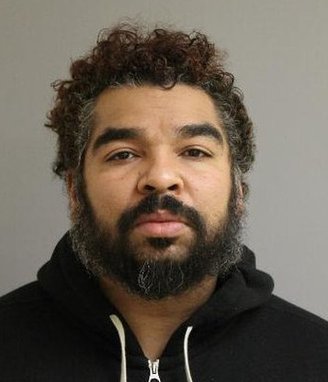
Coleman.
Jurors reached their decision this afternoon after nearly three days of deliberation, in the end finding the 40-year-old Coleman guilty of all charges. Because he was convicted of the special circumstance of firing from a vehicle, he faces life in prison without possibility of parole. Sentencing is set for Jan.7.
Coleman shook his head slightly when the court clerk read the verdicts, then looked down at the table in front of him. He did not stand when jurors left the courtroom.
Before he went to trial, Coleman rejected Deputy District Attorney Carolyn Schaffer’s offer to plead guilty to first-degree murder and be sentenced to life in prison with a possibility of parole. Coleman already has two strikes under the state’s Three Strikes You’re Out law, and he was warned more than once about the consequences if he was convicted at trial.
He decided to take the risk. Testifying in his own defense, Coleman told a story the jury apparently didn’t buy: He claimed a Jamaican man named Dread was driving his green Honda coupe and shot Renfro as Coleman cowered behind the driver’s seat. As Schaffer pointed out during her closing argument, it was very unlikely a man as large as Coleman would have fit in that small space.
The prosecution’s theory was that Coleman believed Renfro was one of the people who had robbed him of marijuana, and when he saw Renfro driving his blue Jeep past the Bayshore Mall he followed him in the green Honda. In another car behind Coleman was his girlfriend, Alma Ahumada-Mendoza, and a woman named Mariah Acosta.
Acosta testified during the trial that during the drive south on Highway 101, Coleman was on the phone with Ahumada-Mendoza giving her instructions: “Stay back. You know what to do.”
Once they reached Rio Dell, Acosta said, Ahumada-Mendoza stopped her car and got something from under the hood. She tucked the item under her shirt and walked away. Seconds after she returned, Acosta testified, she heard the popping of gunfire.
A video surveillance camera showed the 26-yearold Renfro standing behind his Jeep in front of 70 Monument Road. He was changing his clothes, reportedly for a date with a woman in the neighborhood. The green Honda passes by once, then returns. During the second drive-by, the Honda driver begins firing. Renfro is hit and falls and the driver keeps shooting, blowing out the back window of the Honda.
Shortly afterward Coleman showed up at the home of an Alton couple he knew. His car’s back window was shattered, and he told the couple he had been robbed and shot at and wanted to leave the car with them.
Ahumada-Mendoza then arrived and Coleman left with her.
At a preliminary hearing, Judge Timothy Canning dismissed charges that Ahumada-Mendoza, 23, was an accessory after the fact. She was released from custody. Both she and Coleman were arrested in North Dakota a few months after Renfro was killed.
Defense attorney Andrea Sullivan, representing Coleman, argued that prosecution witness Acosta was out to get Coleman because they once had a business and sexual relationship.
Acosta, however, said she met Coleman for the first time on the day of the shooting and didn’t even know his name. A text message to her daughter confirmed that, as Acosta asked for the name of “Alma’s man.”
Judge Kelly Neel presided over the trial.
###
PREVIOUSLY:
- RIO DELL MURDER TRIAL: Police Officer, Witness Testify About the Day Johnny Renfro Was Shot Dead
- RIO DELL MURDER TRIAL: Expert Testimony Anchors Second Day of Trial
- RIO DELL MURDER TRIAL: Prosecution Witness Testifies That Suspect Dumped Car at Their Home, Issued Veiled Threats
- RIO DELL MURDER TRIAL: Young Mother Testifies She Was Brought Along on Ride That Ended With One Dead Against Her Will
- RIO DELL MURDER TRIAL: Prosecution Shows Jurors Texts Sent by Suspect After the Shooting
- RIO DELL MURDER TRIAL: Suspect Takes the Stand
- RIO DELL MURDER TRIAL: Suspect Fingers Unknown Jamaican Man Named ‘Dread’ as Actual Shooter
- Rio Dell Murder Trial Goes to the Jury
- RIO DELL MURDER TRIAL: In Closing Arguments, Defense Attorneys Lean Hard on Theory That Unidentified Jamaican Man Named ‘Dread’ Was the Actual Killer
- RIO DELL MURDER TRIAL: Jury Locked in Deliberations After Two Days
TODAY in SUPES: Board Approves Live Concerts, Motorcycle Races at County Fairgrounds Despite Neighbors’ Objections
Ryan Burns / Tuesday, Nov. 10, 2020 @ 4:10 p.m. / Local Government
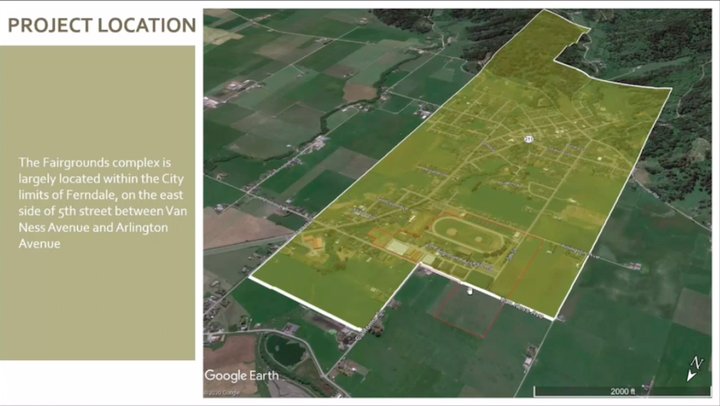
Slide from county staff presentation offers an aerial view of the Humboldt County Fairgrounds and downtown Ferndale.
###
Start your engines and fire up the band: Live concerts and motorcycle races are coming back to the Humboldt County Fairgrounds — that is, once COVID restrictions are eased.
At its Tuesday meeting, the Humboldt County Board of Supervisors gave a green light to the Humboldt County Fair Association, granting the financially struggling nonprofit a conditional use permit to host up to five concerts and two motorcycle-racing events per year at the county-owned fairgrounds in Ferndale.
And at the suggestion of Third District Supervisor Mike Wilson, the board tossed in an incentive for electric motorcycles, adding a provision that will allow event organizers to host a second day of racing per event as long as the bikes used on that day are all electric.
The decision marked a defeat for group called Friends of Ferndale for a Livable Community (FFLC), which was appealing a Sept. 17 ruling from the county Planning Commission granting the permit. FFLC had retained legal representation from L.A.-based firm RWG Law.
Following that Planning Commission decision, which came via a rare unanimous 7-0 vote, an RWG attorney sent a letter to county officials reiterating concerns about noise, traffic, aesthetics, air quality and more. In appealing the Planning Commission ruling, FFLC argued that a full environmental impact report should have been required per the California Environmental Quality Act.
Senior Planner and local history enthusiast Steve Lazar delivered the staff report, which highlighted the 100-plus-year history of often raucous events at the fairgrounds, including auto races, circuses, fireworks and live music from the likes of Willie Nelson, Loverboy and Tim McGraw. Fairs were held onsite as far back as 1870. Such events must be factored into the “baseline” conditions when analyzing environmental impacts, including noise, Lazar said.
He also noted that the two sides in this dispute — the fair association and FFLC — had communicated with one another in an effort to resolve their differences, and while the fair association made some compromises, cutting the proposed number of annual events in half and withdrawing proposals for monster trucks and tractor pulls, the appellants couldn’t reach a consensus before today’s meeting.
Per the conditions of the permit, concerts must take place between noon and 10 p.m., and noise levels will be monitored, recorded and reported back to the county if they exceed established limits. Motorcycles will be required to include noise-reducing exhaust systems, and a wall of hay bales will be built behind the stadium to dampen the sound.
Fair Board President Andrew Titus urged the supervisors to reject the appeal. “I really feel like we have done our due diligence on this one,” he said, adding that the proposed events are “good, clean family fun,” like a smaller version of Disnleyland for those who can’t afford to take the family to the real deal.
Titus also said these events are a financial necessity for his organization. “I can tell you, the [Humboldt County] Fair can’t generate enough revenue in 10 days to foot the bill for 365,” he said. “If people want the fair here in Humboldt County … we need to be able to do other events.”
Speaking on behalf of the appellants, Ferndale City Councilmember Stephen Avis said the FFLC’s objections weren’t about the proposed events, per se; rather, they concerned the process that the county undertook in its determination that there would be no significant environmental impacts.
“What’s really the common thread here is we don’t have sufficient information,” Avis said. He argued that a noise study commissioned by the county should have been peer-reviewed, and he suggested that a trial racing event could be held, allowing a “third party engineering firm that specializes in acoustics” to record sound levels and prepare a study for further review.
He also called for a full environmental impact report (EIR). “This is for the protection of the residents who live immediately adjacent to the fairgrounds,” Avis said.
Of the 10 people who spoke during the public comment period, nine urged the board to deny the appeal and grant the permit. Johanna Rodoni, who sits on the Fair Association’s board of directors, said that a full EIR would cost at least $100,000, which the association can’t afford. “We’re just trying to remain economically viable so the fair continues,” she said.
SoHum resident Michelle Bushnell, who may yet have a shot at unseating Second District Supervisor Estelle Fennell in last week’s election, encouraged the board to approve the permit, saying Ferndale residents should be willing to tolerate a bit of noise.
FFLC member Jennifer Raymond, on the other hand, reiterated her group’s argument that the proposed mitigation measures are inadequate.
When the matter was brought back to the board for discussion, Wilson broached the electric motorcycle idea, saying such government requirements often drive the development of new technologies. His initial suggestion was to require one heat of electric vehicles per day of each racing event, transitioning to at least 50 percent electric bikes by 2030.
Wilson also made a point of voicing his support for the county fair. He held up a jar that his daughter has used to save up money for the wristband required for certain rides.
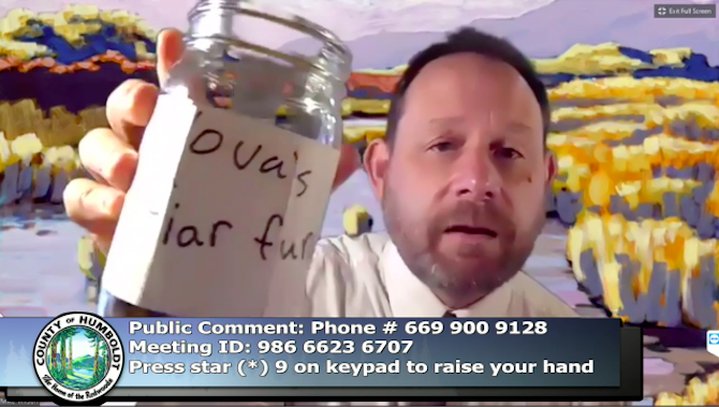
Screenshot from Tuesday’s meeting.
###
The other supervisors — particularly Fennell and First District rep Rex Bohn — were skeptical about Wilson’s electric-bike proposal. Fourth District Supervisor Virginia Bass called it “an interesting concept” but said she’d be uncomfortable adding it as a condition of approval.
Bohn promoted a more market-driven approach, saying that if there’s sufficient demand for electric motorcycles then organizers will hold such events. He also called the motives of the opposition into question. “I truly believe this is being driven by another faction,” though he didn’t elaborate.
Bohn was clear about his support for the permit. “I would move staff’s recommendation right now if I could — and I will,” he said.
Wilson quickly seconded the motion, but he had a few more questions. For example, he asked whether the permit would allow for multi-day music festivals at the fairgrounds. Planning and Building Director John Ford said it would. Wilson expressed some reticence about that prospect, saying festivals have a “totally different vibe” than single concerts. He suggested requiring a special permit to hold concerts that extend for more than a day.
The board quibbled for a while about both multi-day concerts and electric motorcycle requirements before finally settling on the details of a modified motion. As noted above, the supervisors agreed to allow a second day of racing if the bikes are all electric, though there can be no more than four days of motorcycle races per year, regardless of whether they’re gas- or electric-powered.
As for live music, the board settled on a limit of two days per event, with performances still limited to the time window of noon and 10 p.m.. Events longer than that will require a special permit. Both concerts and races will be monitored with acoustic tools to ensure that they don’t emit sustained volumes above 65 decibels.
The motion passed unanimously.
MURALED! This Large Piece in Henderson Center is Full of Eureka Easter Eggs
Stephanie McGeary / Tuesday, Nov. 10, 2020 @ 2:49 p.m. / Art
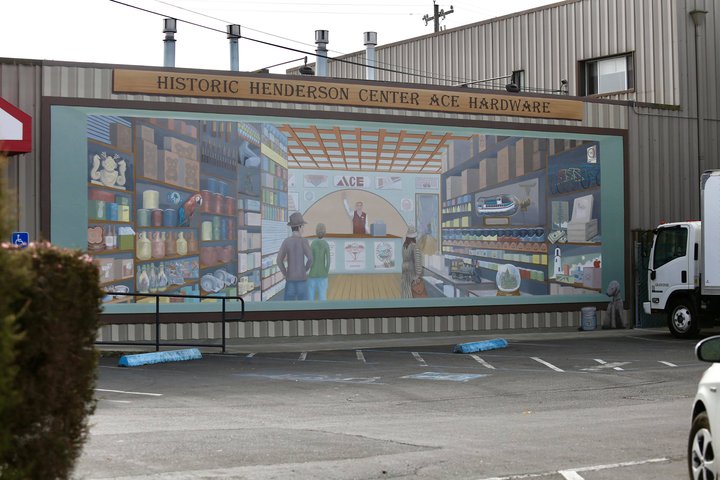
Ben Goulart’s “Historic Henderson Center Ace Hardware” mural in Henderson Center | Photos by Andrew Goff
If you fancy yourself a Eureka expert or a “Where’s Waldo” master, you might want to treat your eyes to a scavenger hunt of local imagery in the large mural on the side of the Henderson Center Ace Hardware, recently completed by Bayside-based artist Ben Goulart.
Goulart started the mural during this year’s Eureka Street Art Festival — which invited a batch of artists to beautify Eureka’s Henderson Center — and after two and a half months and over 500 hours of work, he just recently finished up the project. And it’s not surprising that it took Goulart a while to complete his mural — not only is it the largest work from this year’s festival, it is also filled with over 50 smaller images related to local businesses and Eureka icons.
“Eureka has some amazing and rich history, with timeless icons and local legends,” Goulart wrote in an email to Outpost. “I really wanted to capture some of this local magic in a mural centered around Henderson Center…This mural also has a ‘find Waldo’ style scavenger hunt of Eureka icons, businesses and hidden images to find.”
Some of the images are literal, while others seem to be more of a symbolic representation of a certain person or business. Some notable Eureka figures included in the mural are the Carson Mansion, the Madaket and Eureka cheerleader and past city council candidate Jeannie Breslin. Goulart also gives a nod to another local mural artist Duane Flatmo, and even included a shout out to the Lost Coast Outpost with the famous LoCO lighthouse in the bottom right corner. (We’re blushing!)
You can scroll down to find the a key of all the images provided by the artist (we cut the image in half to make it more readable.) But to see all the details, you’ll need to visit the mural in person at Shaefer’s Ace Hardware on the corner of Henderson and E Streets.

Closeup showing “the Madaket” in a bottle

Ace Hardware Owner Jack Rieke’s grandchildren depicted in the background. In the foreground is an image of Jeannie Breslin in her famous hat.
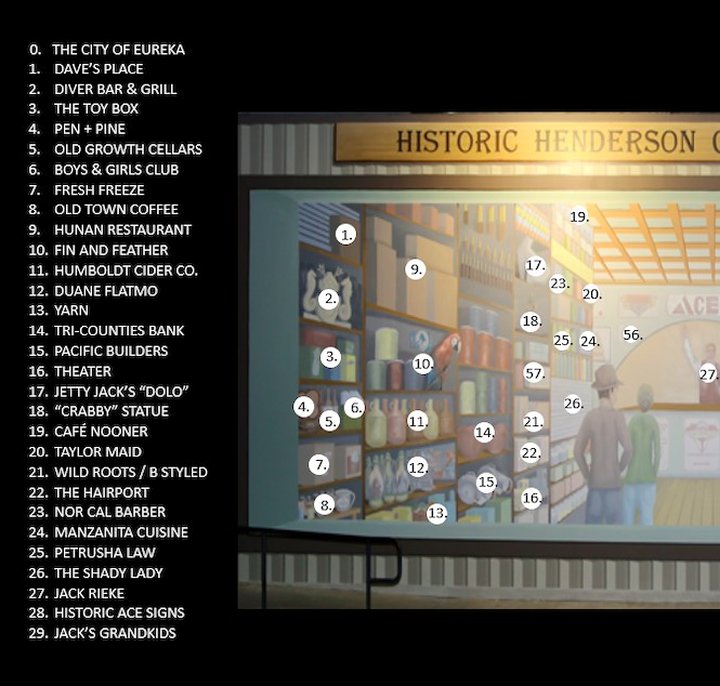
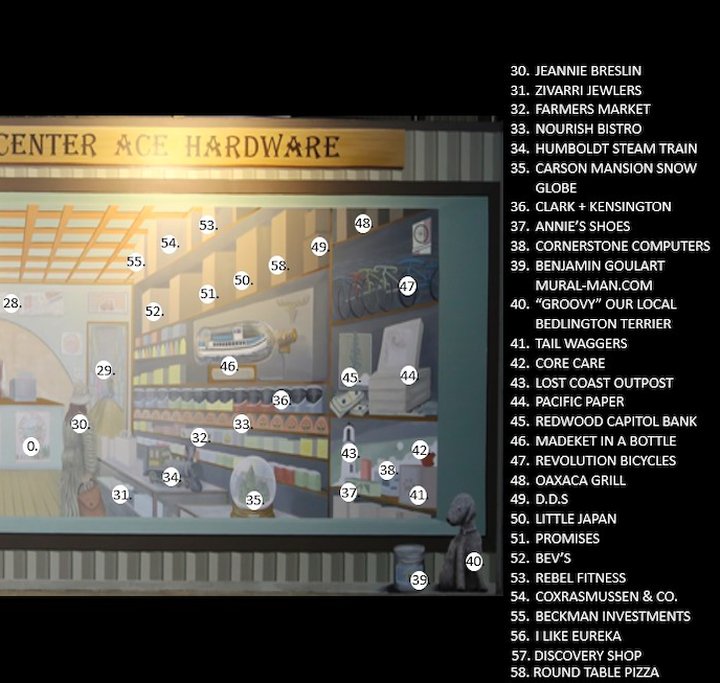
Mural key provided by Ben Goulart
That Big Onshore Fish Farm on the Samoa Peninsula is Moving Forward, and Developers Are Having a Virtual Meeting About it Tonight
Hank Sims / Tuesday, Nov. 10, 2020 @ 2:38 p.m. / Business

Computer-generated photo illustration showing how the proposed recirculating aquaculture system (RAS) facility would look on the Samoa Peninsula. | File image via Nordic Aquafarms.
###
You haven’t forgotten, right? Just about a year and a half ago, Nordic Aquafarms, a Scandinavian company, first put forward the idea of building a large-scale onshore fish farm on the Samoa Peninsula, at the site of the old Pulp Mill currently owned by the Harbor District.
We’ve had a lot of coverage of this proposal over the intervening months — see below for a list — but you might not know, since the onset of sheltering in place, that Nordic is still moving forward. They’re currently in the process of acquiring state and local permits to start construction.
To that end, the company is hosting a virtual Town Hall on Zoom at 6 p.m. today. If you’re interested in the project — either as a booster, a critic or just a curious citizen — you might want to tune in. There’ll be a question and answer period at the end.
Press release from Nordic Aquafarms:
Public Information Meeting and Q & A Session with Nordic Aquafarms
- When: 6 p.m. to 8 p.m. Tuesday, November 10, 2020
- Where: Zoom
- Log-In Information: https://us02web.zoom.us/j/83592185856
- Meeting ID: 835 9218 5856
- One tap mobile: 1-669-900-6833
Nordic Aquafarms is in the process of preparing and submitting permit applications and related studies to the Water Quality Control Board, California Coastal Commission and Humboldt County Planning Department.
The community is encouraged to attend this Town Hall meeting to learn more about Nordic Aquafarms permit process, hear application and study highlights, and receive a general project update regarding Nordic’s planned aquaculture facility for the Samoa Peninsula. At the end of the presentation, Nordic will also welcome questions from the audience.
For more information or support in logging into the meeting, please contact Lynette Mullen at lynette.mullen@gmail.com or call 707-845-0467.
###
PREVIOUSLY
- Massive New Fish Farm in the Works for Samoa Peninsula; Harbor District Expected to Bless Project Helmed by Norwegian Firm at Special Meeting Monday
- Norwegian Fish Farm Says Its Samoa Operations Will Create 80 Jobs, Produce 50 Million Pounds of Salmon or Steelhead Per Year
- Humboldt Baykeeper Says: Samoa Fish Farm Proposal Looks Good So Far, But the Devil Will Be in the Details
- Harbor District Agrees to 30-Year Lease for Massive, Land-Based Fish Farm on Samoa Peninsula
- Let’s Take a Closer Look at This Big Fish Farm Proposal for the Samoa Peninsula
- Nordic Aquafarms, the Company Planning a Massive Land-Based Fish Farm in Samoa, Will Hold a Public Forum to Talk About the Idea Next Week
- Nordic Aquafarms Set to Ask County for ‘Financial Incentives’ Before Committing to Indoor Fish Farm Project
- County Agrees to Pursue Infrastructure Funds in Hopes of Landing Fish Farm on Samoa Peninsula
- PETA Buys Bus Ads Opposing Fish Farm on Samoa Peninsula: ‘You Can’t Be a Fish-Eating Environmentalist’
- Due Diligence Complete, Nordic Aquafarms Decides to Move Forward With Aquaculture Facility on the Samoa Peninsula
- Nordic Aquafarms, Which Now Has a Local Office and is Recruiting Employees, Will Host a Community Meeting Tonight
- Nordic Aquafarms Hires Idaho Native as First Cali-Based Exec, Signs Contracts for Permitting, Engineering
- Nordic Aquafarms Terminates Humboldt-Based Exec After Seeing Photo of Him Posing With a Lion He’d Killed
- Bohn and Berkowitz Trade Jabs During Lunchtime Candidate Forum at the Eureka Elks Lodge
- A Delegation of Norwegians is on a Whirlwind Tour of Humboldt, Scoping Green Economic Development Opportunities
- COVID Has Hit the Local Economy Hard, But Officials Say There’s Still Cause for Optimism
- Nordic Aquafarms Expands Aquaculture Facility Plans, Releases Images Showing What the Fish Farm Would Look Like
- County Receives $300K in EPA Funding to Continue Toxic Cleanup and Development on the Samoa Peninsula
- Nordic Aquafarms Submits Discharge Permit Application for Land-Based Fish Farm on Samoa Peninsula
- Nordic Aquafarms Hosting Public Zoom Meeting Wednesday to Answer Questions, Present Study Results for Proposed Land-Based Fish Farm on Samoa Peninsula


