
Cost of Fighting COVID in California: $12.3 Billion
Barbara Feder Ostrov / Monday, July 12, 2021 @ 7:09 a.m. / Sacramento

Photo by Claudio Schwarz on Unsplash.
###
Fighting COVID-19 in California has cost taxpayers at least $12.3 billion since the start of the pandemic.
That’s more than the gross domestic product of 50 nations. More than the value of the Dodgers, Yankees and Giants combined. Almost double General Motors’ profits last year. Enough to give $313 to every single Californian.
And that doesn’t include $110 billion from the feds to boost unemployment checks, and billions more in federal stimulus money, rent aid and loans to businesses shuttered for much of last year.
State finance officials added up the government costs from about 40 categories and came up with the $12.3 billion estimate for “total direct pandemic emergency response” between 2020 and 2022.
What did our federal and state tax dollars buy?
Truckloads of N95 respirators and surgical masks desperately sought by health care workers in the early days of the pandemic, purchased through a controversial $1.4 billion contract.
Hundreds of millions of gowns and plastic gloves.
Extra beds in hospitals.
Medical interpreters to handle hundreds of languages.
Laptops for students suddenly thrust into remote learning.
Temporary workers to trace contacts of infected people and answer hotlines swamped by unemployed Californians seeking benefits.
One of the biggest price tags was for state prisons, where 227 infected prisoners have died and combatting COVID-19 has cost nearly $1.6 billion. Other big price tags: Testing for the virus, at more than $1.8 billion, and $1.1 billion in lab equipment for overloaded public health labs.
The $12.3 billion may sound like a lot for a single state. But University of Southern California economist Adam Rose spells out the high stakes: He estimates that the cost of lives lost to COVID-19 in the United States could top $6.2 trillion, with another $5 trillion in overall impact. The economic burden of the pandemic far exceeds that of the Great Recession, Rose said.
More than 63,000 Californians have died from COVID-19.
“If you save 1,000 lives, that’s $10 billion that you save. If you did nothing at all, the situation would be much worse,” said Rose, who studies the economics of disasters. “You’re going to pay one way or another.”
Much of the money spent in California has come — or is forthcoming — from the federal government. To put that in perspective, Congress approved more than $5 trillion in COVID-19 related relief spending — more than all federal spending in 2019.
Hiring and training new case investigators and contact tracers cost $233 million in government funds. Some of that money went to Allison Busch-Lovejoy, a Caltrans analyst, who said she was “voluntold” last year to help trace COVID-19 cases in the Los Angeles region as part of a $8.7 million training program, run by UCLA and UCSF health experts, to aid overwhelmed county health departments.
“It challenged me as a human being,” said Busch-Lovejoy, who lives in Humboldt County. “It was difficult work to talk to people who were very ill, sometimes in hospital, always a challenge to honor the person you were speaking with.”
Nearly $1.4 billion of federal and state funds supported California’s massive vaccination campaign, which after a rocky rollout has seen more than 20 million Californians fully immunized.
Early on, that money financed the operations of mass vaccination clinics that could serve thousands in a day and the $50 million problematic MyTurn appointment and vaccine tracking system.
Yet vaccine progress has been uneven across the state, with lagging vaccination rates in rural counties, lower-income communities and among Black and Latino Californians. Now, federal and state money is being used to reach people who’ve been hesitant or unable to access the vaccine, through door-to-door vaccination drives, phone-banking and special events.
This month, state and local health officials staged a vaccination pop-up clinic and festival before a soccer match at the PayPal Park stadium in San Jose. The first 155 people immunized received a free pair of tickets to an exhibition match between two popular Mexican soccer teams.
The event drew Rosa Vargas and her boyfriend, Isidro Velazquez, all the way from Madera in the San Joaquin Valley. Velazquez, who already has been vaccinated, said they saw it as a good opportunity for Vargas to finally get immunized — and also get two free tickets to the sold-out match.
Dr. Gerardo Solorio Cortes, a Gilroy-based primary care doctor overseeing the pop-up clinic, considered the funds for the festival well-spent because it attracted hundreds of people, nearly all Latinos. “What better way to get people vaccinated?” he said.

A vaccination pop-up clinic sponsored by the California Department of Public Health was held before a soccer match at PayPal Park on July 7, 2021 in San Jose. Photo by Anne Wernikoff, CalMatters
California’s food banks have received about $230 million in state and federal cash grants as well as USDA boxed food deliveries. It was a much-needed boost for the Second Harvest of Silicon Valley, which saw demand for its food double early in the pandemic.
“We had to extremely quickly increase the food and infrastructure,” said Tracy Weatherby, the food bank’s vice president of strategy and advocacy.
The food bank used the money to buy 15 tractor trailers and lease another warehouse, and started a home food delivery program, Weatherby said. Soon the food bank was providing about 500,000 people with fresh produce, meat, milk, rice, beans and other foods, up from 250,000 pre-pandemic.
Government officials also funded 140 National Guard members and 100 San Jose Conservation Corps members to assist the food bank’s staff as volunteers stayed home.
“Double the people, double the food,” Weatherby said. “That’s what we’ve been dealing with.”
Before the pandemic, government grants made up 5 to 6% of the food bank’s budget, with other support from corporate, nonprofit and individual donations. Last year, that support doubled to about 12%, Weatherby said.
Weatherby says the food bank anticipates continuing its doubled distribution.
“We’re not seeing that need go down yet and we expect it not to go down for years,” Weatherby said. “People are in a very, very deep hole.”
###
CALmatters.org is a nonprofit, nonpartisan media venture explaining California policies and politics.
BOOKED
Yesterday: 3 felonies, 8 misdemeanors, 0 infractions
JUDGED
Humboldt County Superior Court Calendar: Today
CHP REPORTS
1 Mm162 E Men R0.00 (HM office): Assist with Construction
ELSEWHERE
RHBB: Planning for Sea Level Rise Splits Humboldt Commission
RHBB: Burning Starting Today on Vegetation Management Project West of Redding
MONDAYS WITH MICHAELE: To the Trees!
LoCO Staff / Monday, July 12, 2021 @ 7 a.m. / Mondays With Michaele
We can have nice things! Your President of Positivity is among the many who are just giddy about the Sequoia Park Zoo’s new Redwood Sky Walk. Eureka’s new attraction is drawing many a local star up into the redwood canopy and, in this week’s episode, Michaele can’t help serving up a helping of Monday mirth to each and every one of them. Ciao Bella!
# # #
Perhaps You’d Like to Explore Previous Mondays With Michaele For Some Reason!
OBITUARY: Clifford Eugene Viale, 1949-2021
LoCO Staff / Monday, July 12, 2021 @ 6:56 a.m. / Obits
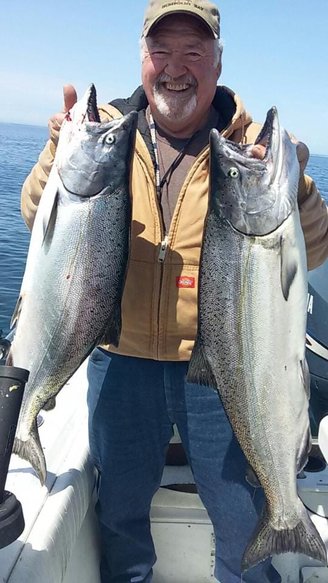
It is with deep sorrow that we announce
the passing of our loving husband, father and papa, Clifford Eugene
Viale, who passed away at St. Joseph Hospital on June 30, 2021 from a
progressive lung disease.
Cliff was born in Eureka at the Old St. Joseph Hospital to John and Shirlene Viale and was 72 years old at the time of his death. Cliff’s earlier years were spent in the Blue Lake, Old Arcata Road and Freshwater areas of Humboldt County where he enjoyed fishing and swimming in nearby rivers and creeks. His love for the outdoors continued throughout his life with fishing, hunting and cutting fire wood which he truly enjoyed.
Cliff attended Blue Lake, Freshwater and Lafayette Elementary Schools as well as Eureka Jr High. He graduated from Eureka High School in 1967 and attended College of the Redwoods.
As a lifetime resident of Humboldt County, Cliff belonged to various organizations, including the local chapter of DeMolay International. He was an Honorary Member of the Humboldt County Sheriff’s Marine Posse during Gene Cox’s tenure, a past member of the Moose Lodge, Native Sons of the Golden West-Ferndale, Redwood Coast and Lost Coast Corvettes, and a current member of the Elks Lodge 652 and Teamsters Local 137.
Cliff had a long and storied work history beginning at Eureka Fisheries while in high school where he stayed on while attending college in the late 60’s. He was drafted in 1968 during the Vietnam War and wanted to serve his country, but was sent home due to hearing loss. Cliff worked in the local timber Industry until the Redwood National Park Expansion. After receiving his Class A license, Cliff spent a large portion of his working years driving truck, including hauling logs for Sierra Pacific Industries and long haul for both Nielsen and Delta Freight Lines. Following deregulation of the trucking industry, he worked at both Simpson and L-P Pulp Mills until their closures.
Cliff was a County of Humboldt Transport Driver for 15 years prior to his retirement in 2010, receiving several awards for his dedication to safe driving standards while maneuvering through the many twists and turns of Humboldt County’s back roads. After his retirement, Cliff continued to work as an extra-help driver for the County, specifically asked to come out of retirement for his heavy equipment transport expertise.
Cliff was a beloved husband, father, grandfather, great-grandfather, neighbor, and friend, who enjoyed making memories with his family and helping out his community. Some of those special memories of Cliff’s life that we wanted to share include:
- Dressing up as Santa, cutting Christmas trees, and building playhouses for other families, including those in need
- Working on movies, such as Blue Skies II (1987), Outbreak (1994), and The Lost World: Jurassic Park (1997) through Teamsters Local 137
- Backpacking trips to the Trinity Alps with friends, and fishing trips on the Sacramento River with his son, AJ and family friend Brian Goodman
- Participating in (and finishing!) the Tough Mudder Endurance Event in 2013 with childhood friends, Bill Beauchamp and Larry Castle
- Taking the Corvette to Scottsdale Arizona for Giants’ Spring Training in 2016 following his wife, Diane’s retirement
- Many summers spent in the trailer at Cabana Holiday/Redwoods River Resort with Family and Friends
- Cutting Christmas trees on South Fork Mountain each year with Family
- Cooking the Thanksgiving Turkey each year at his brother Joe’s House in Fortuna
Cliff is survived by his loving wife Diane of 46 years; sons David (Humboldt County), Anthony “AJ” (Leilani) of Rohnert Park and daughter Angela Viale (Greg Allen) of Eureka; granddaughters Lauren Miller (Kyle), Jordyn and Morgan Viale, Sophia Bates and great-grandchildren Kinley, Reid, and Baby Girl Miller (due in late August). Cliff, being the eldest of six boys, is also survived by his brothers Jarl, Ed (Dallas), John, Joe and Jeff, and their families, as well as numerous nieces, nephews, and cousins. Also surviving Cliff are his uncle, Dale Callihan (Jacquie); aunt, Pam Wells; brother-in-law, Dave Startare (Tamara) and families.
Cliff is preceded in death by his parents, father-in-law William J. (Bill) Startare (Joyce), mother-in-law Mary Lou McCauley (Jack), brother-in-law Dennis Startare, grandparents Cliff and Sue Viale, Doris Wells, Shirley and Helen Callihan, aunt Elve Cotton and special cousins, Diane Viviani and Janine Cotton.
The family would like to thank Humboldt Bay Fire, City Ambulance, St. Joseph Hospital and Caleb and Staff at Sanders Funeral Home for their care and support.
Services were held on Wednesday July 7, 2021 at the Sunset Memorial Park Mausoleum. A celebration of life is being planned for early August here locally. Please email quicksilvervette@suddenlink.net for details.
###
The obituary above was submitted on behalf of Cliff’s loved ones. The Lost Coast Outpost runs obituaries of Humboldt County residents at no charge. See guidelines here.
(AUDIO) HUMBOLDT HOLDING UP: Eureka City Councilmember Natalie Arroyo on Those Parking Lot Housing Plans, the Investigation into EPD Officers’ Hateful Texts and Her Service as a Coastie
LoCO Staff / Sunday, July 11, 2021 @ 7:15 a.m. / Humboldt Holding Up
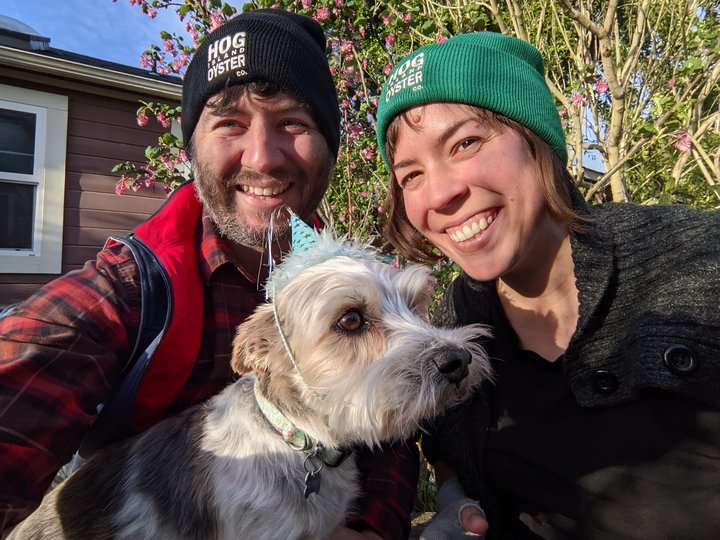
Natalie Arroyo (right), and her hubby celebrate their pup’s birthday
It’s hard to decide exactly where to begin while introducing this week’s guest on Humboldt Holding Up, because this gal just does so damn much in our community!
We’re talking about Natalie Arroyo — a Eureka city councilmember, ensign for the U.S. Coast Guard, senior planner with the Natural Resources Division of the Redwood Community Action Agency (RCAA), a Rutabaga Queen, roller derby player and probably other stuff we’re forgetting — who was kind enough to join the Outpost and talk about many topics, including:
- Does Arroyo plan to run for the Humboldt County Board of Supervisors?
- The Eureka City Council’s first in-person meeting, after more than a year on Zoom
- The City’s controversial plan to build housing on parking lots
- The ongoing investigation of hateful texts sent by Eureka Police officers
- Arroyo’s role as an ensign with the U.S. Coast Guard
- What the heck does the RCAA actually do?
- Arroyo’s band Blood Gnome and what will be cute in the future
- How she ended up in Humboldt and what is good about her home state, Florida
Click the audio player above to hear Arroyo’s jam-packed chat with the Outpost’s Andrew Goff and Stephanie McGeary! And if you enjoy that, then you might also enjoy scrolling through past episodes below.
PREVIOUS HUMBOLDT HOLDING UP GUESTS:
- #58 Wiyot Cultural Center Manager Marnie Atkins
- #57 Humboldt County Growers’ Alliance’s Natalynne DeLapp
- #56 RREDC Executive Director Gregg Foster
- #55 Dell’Arte’s Michael Fields
- #54 Llama Wrangler Keagan Trischum
- #53 Crabs President David Sharp
- #52 Ferndale Organic Dairy Farmers Kristina Radelfinger and Dorice Miranda
- #51 Former Arcata Mayor Alex Stillman
- #50 Cooperation Humboldt’s David Cobb
- #49 Ink People Center for the Arts’ Libby Maynard
- #48 Humboldt Bay Social Co-Owner Amy Cirincione O’Connor
- #47 Musician Lyndsey Battle
- #46 Mad River Brewing CEO Linda Cooley
- #45 LoCO Editor Hank Sims
- #44 Humboldt Republic’s Jason Brandi
- #43 Table Bluff Farmer Hannah Eisloeffel
- #42 Logger Bar Owner Kate Martin
- #41 Teacher/Rapper Zach “Zigzilla” Lehner
- #40 Madaket Captain “Zippo” Libby Tonning
- #39 Event Planner Alegria Sita
- #38 Food For People’s Anne Holcomb
- #37 AHHA President Nezzie Wade
- #36 Performance Artist Noël August/Tucker Noir
- #35 Eureka Mayor Susan Seaman
- #34 Eagle House Owner Jennifer Metz
- #33 Absynth Quartet Drummer Mike “Tofu” Schwartz
- #32 HACHR Executive Director Lasara Firefox Allen
- #31 Alchemy Distiller Owner Amy Bohner
- #30 Eureka City Councilmember Kati Moulton
- #29 Eureka City Councilmember Scott Bauer
- #28 Ungraceful Ager Barry Evans
- #27 Arcata City Councilmember Sofia Pereira
- #26 HumBrews Music Booker Laurel Weston
- #25 Eureka City Councilmember Kim Bergel
- #24 Film Commission’s Cassandra Hesseltine and Nate Adams
- #23 Marble Maker Topher Reynolds
- #22 Arcata Playhouse Director Jacqueline Dandeneau
- #21 Humboldt Political Junkie Eric Kirk
- #20 Rio Dell Mayor Debra Garnes
- #19 Second District Supervisor Estelle Fennell
- #18 Arcata Food Aficionado Jada Calypso Brotman
- #17 Body Piercer Jackie Silva
- #16 Dick Taylor Chocolate’s Adam Dick
- #15 FUHS Teachers Mark Thom and Inma Thompson
- #14 Eureka City Manager Miles Slattery
- #13 Savage Henry Co-Founder Chris Durant
- #12 Eureka Street Art Festival Organizer Jenna Catsos
- #11 SCRAP Humboldt Founder Tibora Bea
- #10 Gym Owner Tyler Parr
- #9 Six Rivers Brewery Co-Owner Meredith Maier
- #8 Multicultural Skincare Therapist Levia Love
- #7 Annie’s Cambodian Server and Social Worker Joshua Coppock
- #6 Eureka City Councilmember Austin Allison
- #5 HSU Professor Deidre Pike
- #4 Pastor Bethany Cseh
- #3 Singer/Songwriter Chris Parreira
- #2 Eureka City Councilmember Leslie Castellano
- #1 Arcata City Councilmember Paul Pitino
GROWING OLD UNGRACEFULLY: Psychedelics Redux?
Barry Evans / Sunday, July 11, 2021 @ 7 a.m. / Growing Old Ungracefully
“Do you see the world as a prison or a playground?”
— Matt
Johnson, mental health researcher, quoted in Michael Pollan’s How
to Change Your Mind.
###
PREVIOUSLY:
###
When medical trials of psychedelic substances to alleviate depression and addiction came to an abrupt halt in the 1960s, largely because of the excesses of the psychologist Timothy Leary (“the most dangerous man in America” according to Richard Nixon), a promising area of research closed off. The last ten years, however, have seen a reemergence of that research. Barring a new Tim Leary to screw things up, mental health professionals in the future will almost certainly have psychedelics as resources to draw upon.
Right now, treatment options for the mental problems that afflict nearly half of Americans at some point in their lives — depression, addiction, anxiety, bipolar, obsessive-compulsive disorder, schizophrenia, etc. — are few and of limited effectiveness. The promise of Prozac and other serotonin-boosting brain drugs—which perform barely better than placebos — has pretty much run out of steam; talk therapy and 12-step programs kinda-sorta work (most AA participants relapse); and it’s getting worse. Just one data point: in 2021, 9.7% of youth in the U.S. have severe major depression, compared to 9.2% in 2020. This should be enough to shout from the roof tops, “We need to do something different!”
That “something different” may well be the addition (after a 40-year hiatus) of “psychedelic-assisted therapy” to the tool chests of mental health workers. I’ve been reading Michael Pollan’s 2018 book How to Change Your Mind, a very readable account of how psychedelics, in particular psilocybin (which doesn’t carry the same political baggage as LSD), are showing terrific promise. (Here’s a worthy review.) Pollan devotes considerable space to psilocybin’s potential in treating depression, dementia and substance addiction, and in alleviating the fear of death in terminal cancer patients. The underlying idea is to “escape the prison of self,” as he puts it. I think anyone who has dropped acid or ingested shrooms (psilocybin mushrooms) will recognize this metaphor.

Psilocybe semilanceata aka magic mushrooms/shrooms. Photo: Arp, via Wikimedia. Creative Commons license.
Incidentally, Bill “W”
(Wilson), founder of Alcoholics Anonymous, wanted to introduce LSD
therapy into the organization in the 1950s, his own sobriety having
resulted from a mystical experience he’d had on belladonna (a
hallucinogenic) in 1934. Pollan writes of AA, “…the whole idea of
a spiritual awakening leading one to surrender to a ‘higher
power’…can be traced to a psychedelic drug trip.”
While the trials, mainly at NYU and Johns Hopkins, are preliminary and necessarily involve small numbers of volunteers, the results are, in a word, spectacular. For instance, 80 percent of cancer patients showed “clinically significant reductions in standard measures of anxiety and depression,” not just immediately after psilocybin sessions, but for months afterwards.
Or consider treatment for smoking, one of the hardest addictions to break, harder, perhaps, than heroin. Six months after a single psilocybin session, 80 percent of the volunteers — smokers who wanted to quit, but had been unable to do so — were abstinent. Quoting one, “The universe was so great and there were so many things you could do and see in it that killing yourself seemed like a dumb idea. It put smoking in a whole new context. Smoking seemed very unimportant; it seemed kind of stupid, to be honest.” Another put it even more succinctly: “Smoking became irrelevant, so I stopped.” According to one of the researchers, “The [psilocybin session] allows them to get some distance and see the bigger picture and to see the short-term pleasures of smoking in the larger, longer-term context of their lives.” Another says, “psychedelics open a window of mental flexibility in which people can let go of the mental models we use to organize reality.”
It’s early days, and the results of psychedelic-assisted therapy are preliminary, tentative and perhaps over-optimistic (plenty of people have taken psilocybin and still smoke!). But given the marginal effectiveness of the current options for treating mental disorders, we might be on the verge of a whole new world of alternatives.
Here’s how Imperial College (London) neuroscientist and psilocybin researcher Robin Carhart-Harris puts it: “A happy brain is a supple and flexible brain…depression, anxiety, obsession and the cravings of addiction are how it feels to have a brain that has become excessively rigid or fixed in its pathways and linkages — a brain with more order than is good for it.” Are psychedelics the answer to free up those brains? Maybe. Quoting yet another researcher, “The psychedelic journey may not give you what you want, but it will give you what you need.”
ECONEWS REPORT: Clam Beach Pollution Mystery Solved?
The EcoNews Report / Saturday, July 10, 2021 @ 10 a.m. / Environment
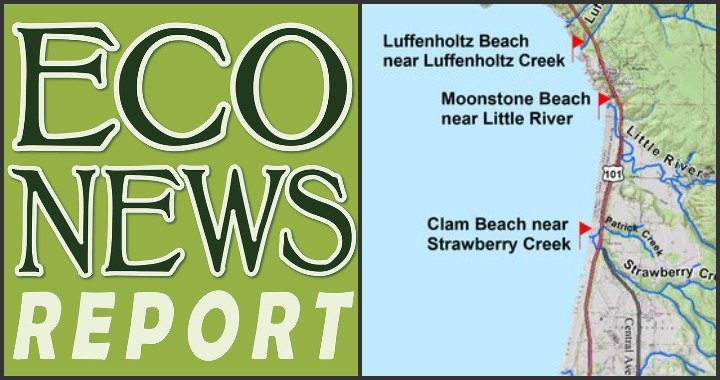
Image from the 2015 edition of Heal the Bay’s annual Beach Report Card, on which Clam Beach is perennially ranked among the top “Beach Bummers.”
###
Clam Beach landed on Heal the Bay’s list of California’s most polluted beaches yet again this year, getting an ‘F’ for water quality on the 2021 Beach Report Card. Today our guest is Dr. Jeremy Corrigan, who has worked for years to answer the burning question: why does Clam Beach have such high levels of fecal indicator bacteria? Dr. J is the Lab Manager at the Humboldt County Dept. of Public Health, and recently published a paper based on genetic analysis of the most likely sources. His findings point to birds as the main influence at Clam Beach, while cattle appear to be the biggest source of bacteria pollution in the Strawberry Creek watershed. Tune in to find out what this means for surfers and other beachgoers.
AUDIO:
“The EcoNews Report,” July 10, 2021.
FOR THOSE INCLINED TO DO A DEEP DIVE:
- Microbial Source Tracking Approach to Investigate Fecal Waste at the Strawberry Creek Watershed and Clam Beach, California, USA by Jeremy A. Corrigan et al. 2021
- Heal the Bay’s 2020-21 Beach Report Card
- Regional Water Board’s 2016-18 research on Pathogens in Coastal Streams
- Humboldt Baykeeper’s Water Quality Program features research involving volunteers, student interns, and local water quality experts
Two Big Cell Towers Proposed for Arcata Bottoms, Including One Disguised as a Rustic Water Tower
Stephanie McGeary / Friday, July 9, 2021 @ 4:38 p.m. / Infrastructure
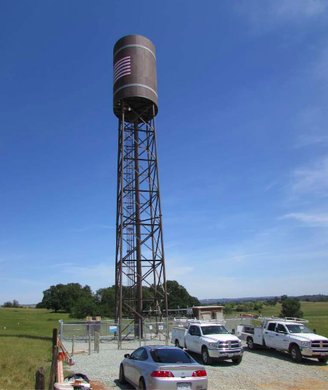
Photo of a ‘faux water tower’ cell tower, similar to the one proposed | Images from the Humboldt County Planning Comission staff report
The Arcata Bottoms near Foster Avenue may soon be home to a new 100-foot-tall water tower. Except it wouldn’t actually be a water tower. It would be a 100-foot cell tower designed to look like a water tower, camouflaged to match its charming rural backdrop.
The faux water tower is one of two cell tower designs proposed for the area along Foster Avenue. The Humboldt County Planning Commission will consider both proposals at its next meeting on July 15. Planning staff is recommending that the commission approve only one.
From the staff report:
Planning staff believes that the wireless needs of Humboldt County citizens can be met with a single facility in this area capable of co-locating different carriers. Staff recommends that the Commission review the two proposed projects, consider public testimony, and determine which proposed facility would be less likely to adversely affect the various users of the Arcata Bottoms area, including off-site residences and recreational users of the Bottoms area.

AT&T plans for the 100-foot faux water tower
The first proposal — submitted by an AT&T Mobility Company, New
Cingular Wireless PCS — includes construction of a 100-foot tall
“freestanding faux water tower,” on the north side of Foster Avenue,
about 100 feet east from the intersection of Foster and Janes Road. The
design includes a 76-foot lattice base topped by a 24-foot tall and
17-foot wide faux water tank that would be constructed of a
“rustic-finish” wood siding. A total of 24 wireless facility antennas
would be mounted inside of the fake water tank. The project would take up an approximate 40 by 50 square foot ground area and would be surrounded by a chain link fence. The tower would be able to host up to two wireless carriers.
Planning staff supports the use of the faux water tower design, which is “intended to better blend with the general agricultural setting by attempting to blend in as an accessory agricultural structure,” the staff report states.
The second tower proposal for the area does not include any faux elements, but would simply be a 130-foot tall lattice tower atop a concrete foundation with ground-mounted equipment. The tower would be located on the east side of Foster Avenue, approximately 100 feet east from the intersection of Foster Ave and Dolly Vardon Road and would be able to host up to four different wireless carriers. The project would take up approximately 50 by 60 feet of ground area and would also be surrounded by a chain link fence. This proposal was submitted by Eureka-based company, PWM Inc.
Given the height and design of the second proposed tower, planning staff seems more concerned about potential visibility and recommends that the tower be either manufactured or painted to by off-white or grey in color to match the “predominant open sky background.” To address the height concerns, PMW Inc. submitted several photographic simulations depicting visibility of the tower from various locations. The photos even point out an existing PG&E pole to give a sense of perspective.
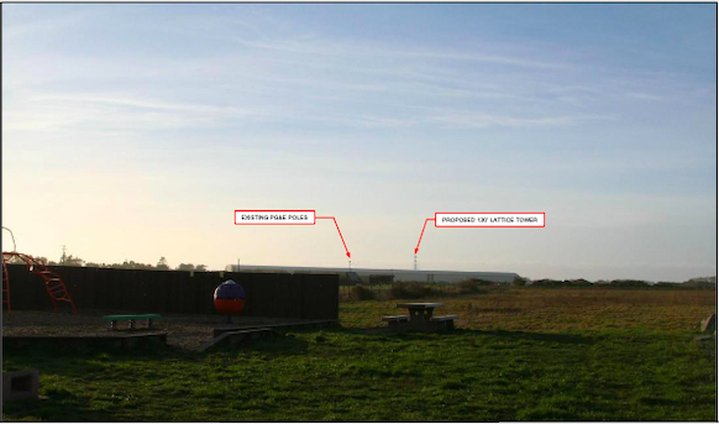
Photo simulation showing the view of the proposed tower (right) and an existing PG&E pole, from the end of Stewart Ave in Arcata
###
Some neighbors are not too happy with the proposals and one nearby resident expressed her concern to planner Brian Miller in an email included in the staff report.
“As I said on the phone, I am adamantly against these, or any towers going up out here,” neighboring resident Ramona Fair wrote in the email. “I’ve talked to neighbors, numerous people walking/jogging/etc. by here, the schools nearby,etc. — Nobody is ok with cell towers going up out here…There is No need to put those things out here. Cell service is great. They will be an eyesore. And a hazard— it’s proven that the EMF radiation Is harmful to people, especially constant exposure as those would be causing.”
Note: the American Cancer Society has said that there is currently “no strong evidence that exposure to [radio frequency] waves from cell phone towers causes any noticeable health effects.”
The Humboldt County Planning Commission will hold a public hearing on combined cell tower proposals at its next meeting on July 15 at 6 p.m., after the hearing was postponed from its original July 1 date. The agenda has not yet been posted, but you can review the full staff report from the July 1 meeting here.
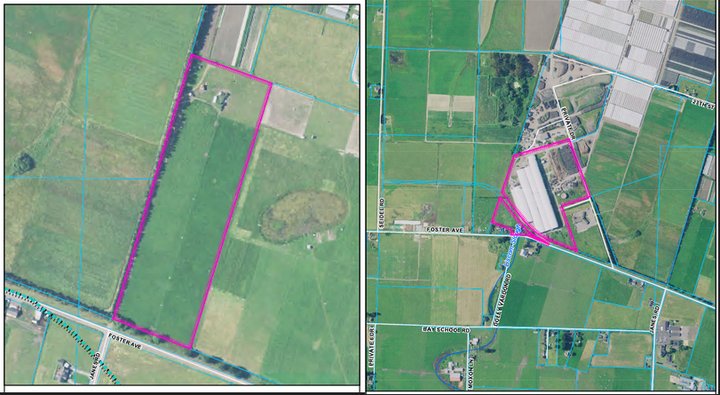
The proposed project areas for both towers. AT&T faux water tower project area on the left. PMW Inc. lattice tower project area on the right.


