On October 29th , 2021 agents with the Humboldt County Drug Task Force (HCDTF), with the assistance of
the Humboldt County Sheriff’s Office (HCSO) served a search warrant on a travel trailer parked in the
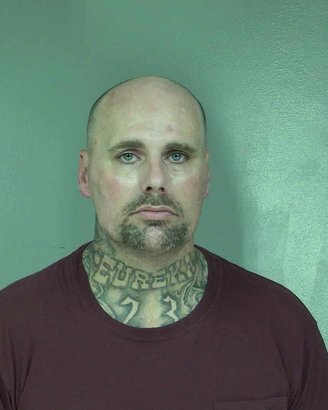
Ferndale Fairgrounds RV Park. Agents had been investigating the owner of the travel trailer, Nick
Deremer (41 years old), for dealing fentanyl in Humboldt County.
During the service of the search warrant agents attempted to detain Deremer as he entered the public
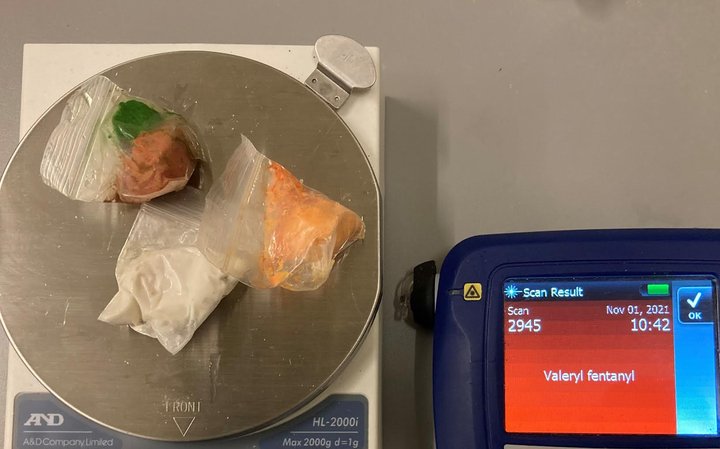
restrooms at the fairgrounds. Deremer attempted to flush a plastic bag containing approx. one ounce of
fentanyl down the toilet. Agents were able to retrieve the fentanyl from the toilet. Deremer was then
detained without incident.
Agents conducted a search of Deremer’s trailer and located three occupants who were actively smoking
fentanyl upon agents’ entry. The three occupants were detained without incident. Agents located two
small bags of methamphetamine in the trailer as well as other evidence of fentanyl sales.
Deremer was transported to the Humboldt County Jail where he was booked for the following charges:
H&S 11351 Possession of fentanyl for sale
H&S 11366 Operating or maintaining a drug house
Anyone with information related to this investigation or other narcotics related crimes are encouraged to
call the Humboldt County Drug Task Force at 707-267-9976.
[CORRECTION: The press release below initially said southern Eureka was among the regions experiencing unusually high COVID cases in recent weeks. The Outpost noticed that the zip codes listed in the release don’t include any in southern Eureka. We asked the county to clarify and learned that was indeed a mistake; southern Eureka should not have been included. The post has been updated to reflect that.]
###
Press release from the County:
Humboldt County Public Health issued an alert this morning to medical providers in the southern Eureka/greater Fortuna area cautioning that COVID-19 contact tracing and investigations show an unusually high number of schools, facilities, businesses and youth sports leagues reporting cases over the past several weeks. The alert outlines for providers the importance of vaccination, testing and what steps to follow if a resident tests positive for COVID-19 on an at-home test.
Analysis by Public Health’s Epidemiology Program has shown that the following zip codes, 95540, 95547, 95528, 95562, and 95565, which include southern Eureka, Fortuna, Rio Dell, Scotia, Hydesville and Carlotta, have been experiencing higher than usual cases, hospitalizations and deaths during the Delta surge starting in June.
Over the past two months, there have been 60% more cases in these zip codes compared to the rest of the county. Further analysis shows that while the COVID-19 case rates are declining countywide, in this geographic area the rates are declining at half the rate seen in the rest of the county. Analysis of COVID-19 hospitalizations and deaths for these zip codes show that both were higher than the countywide numbers, with a 48% increase in hospitalizations and 28% increase in deaths.
Because of the high COVID-19 case rates and lower vaccination rates in these areas, Humboldt County Public Health is encouraging everyone who takes an at-home test that is positive to follow CDC isolation instructions and contact their medical provider for medical guidance immediately. Public Health further recommends that people who have positive home tests also have a PCR test through a medical provider’s office, a local pharmacy or at a county-sponsored testing site. PCR testing after a positive at-home test is best done within 24-48 hours after the positive test.
Humboldt County Public Health continues to monitor for disease outbreak in the county as part of its ongoing work in Communicable Disease.
Press release from the Humboldt County Sheriff’s Office:
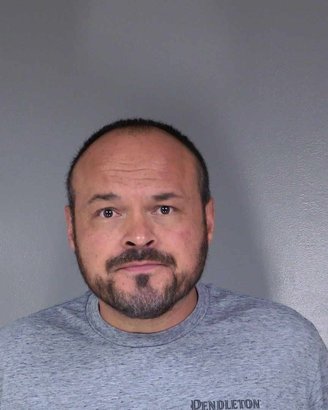
On Oct. 29, 2021, at about 7:38 a.m., Humboldt County Sheriff’s deputies responded to a residence on the 200 block of North Westhaven Drive in Trinidad for the report of a stolen trailer found at that location.
McCloskey
Deputies arrived at the residence and located the trailer, which had been stolen earlier that morning from a construction business in Eureka. While outside the residence, deputies also located numerous items which appeared to have been stolen. At the residence, deputies contacted and detained 39-year-old Allen Don McCloskey. Based upon their investigation and the presence of additional suspected stolen property, deputies obtained a search warrant from the Humboldt County Superior Court to conduct a search of McCloskey’s residence.
During a search of the property, deputies located approximately $6,000 worth of lumber and other construction items which were confirmed to have been stolen from the construction business, approximately $2,400 worth of decorative trees which were confirmed to have been stolen from a McKinleyville golf course, burglary tools, two loaded firearms and ammunition.
McCloskey was booked into the Humboldt County Correctional Facility on charges of possession of a stolen vehicle (PC 496D(A)), possession of stolen property (PC 496(A)), convicted felon in possession of a firearm (PC 29800(A)) and person prohibited in possession of ammunition (PC 30305(a)).
Anyone with information about this case or related criminal activity is encouraged to call the Humboldt County Sheriff’s Office at (707) 445-7251 or the Sheriff’s Office Crime Tip line at (707) 268-2539.
Press release from the Humboldt County Sheriff’s Office:
On Oct. 30, 2021, at about 8:57 a.m., Humboldt County Sheriff’s deputies were dispatched to a residence on the 500 block of Phillipsville Road in Phillipsville for the report of a burglary in progress.
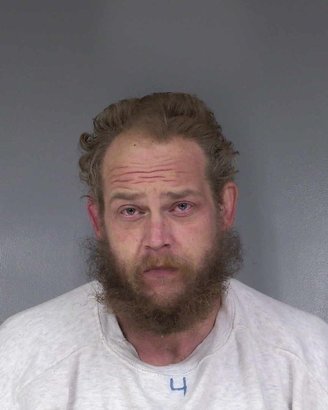
The California Highway Patrol (CHP) responded to assist due to deputies’ extended response time. CHP Officers arrived at the residence and located a male suspect, 37-year-old Ross Blain Hoon. Hoon was taken into custody after a brief struggle with officers.
Deputies arrived on scene and located evidence of forced entry into the residence, as well as unauthorized access into a detached garage on the property. Hoon was found to be in possession of items stolen from the residence.
Hoon was booked into the Humboldt County Correctional Facility on charges of first-degree burglary (PC 459/461(a)), resisting a peace officer (PC 148(a)(1)) and being under the influence of a controlled substance (HS 11550(a)), in addition to warrant charges of vandalism (PC 594(b)(1)).
Hoon was also booked on charges of second-degree burglary (PC 459/461(b)) as a result of an investigation into a burglary committed at a Phillipsville business earlier that morning.
Anyone with information about this case or related criminal activity is encouraged to call the Humboldt County Sheriff’s Office at (707) 445-7251 or the Sheriff’s Office Crime Tip line at (707) 268-2539.
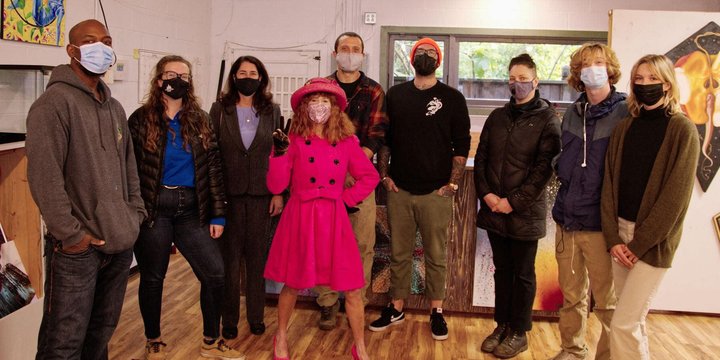
In addition to being the President of Positivity, Michaele is also a connoisseur of fine local art. So it was her great honor to stop by The Arcata Gallery, the newly opened spot on H Street which now features some of Humboldt’s up-and-coming visionary artists. Check ‘em out in this week’s clip. Ciao Bella!
Fun in The Arcata Gallery with Ceak Kytrell, Arcata City Council Member Sarah Schaefer, Arcata City Manager Karen Diemer, Michaele Whitely, Elijah Grannis (owner), Mat Henderson (owner), Noelle Cox, Rowan Auckland and Freya Nutter | Photo: Matt Filar
San Francisco State University student Marissa Ledesma at her home in Bakersfield, where she attends class remotely on Oct. 27, 2021. Ledesma returned to San Francisco State University after taking two semesters to attend Berkeley City College during the pandemic. Photo: Larry Valenzuela for CalMatters.
###
After her freshman year at San Francisco State was cut short by the COVID-19 pandemic, Marissa Ledesma fled from the campus vowing never to return.
It wasn’t just the fast-spreading coronavirus that poisoned the well. Her whole first year was a bust, from an emotionally trying saga with her roommate to paying a lot to live on a campus that she called “an unhappy place.”
When classes remained virtual for all the 2020-21 school year, Ledesma instead enrolled at a community college online while living at home in Bakersfield to, as she said, “lay low while the world was figuring itself out.”
But after a yearlong absence she’s again a San Francisco State student this fall — and a success story that the school, and the entire 23-campus California State University system, hopes to replicate by the thousands.
San Francisco State is an exemplar of a systemwide plan to bring back as many students as possible who dropped out during the pandemic. Cal State Chancellor Joseph Castro last month named re-enrollment as one of the key pillars to meet the system’s ambitious 2025 graduation goals. He wants campuses starting in the spring to target students who stopped attending classes, with an emphasis on students of color and those who are low-income.The system has increased its six-year graduation rates considerably — in the past six years, it’s climbed from 57% to 63%, with a goal of 70% by 2025. But COVID-era dropouts could sink those painstaking gains.
Another pillar to boost graduation rates: overhauling large vital courses where a higher percentage of low-income students and students of color receive Ds and Fs. That idea isn’t without controversy, raising concerns in some corners that professors and lecturers may be pressured to become easier graders.
Finally, campuses will provide every student with a digital degree planner.Each addresses reasons a student might not graduate: dropping out despite having good grades, failing a key class as a freshman or sophomore that craters their confidence, or wasting time and money by taking the wrong classes for their degrees.
The chancellor of the country’s largest public university system signaled that the task is huge: “Make no mistake,” Castro said, “this work will be among the most challenging of our careers.”
Early success in bringing back students
Starting this February, San Francisco State launched an outreach campaign to bring back 302 students in good academic standing who enrolled in 2019 but dropped during the pandemic. So far 60 have come back — a 20% return rate — beating the campus’s modest goal of re-enrolling goal of 10%.
“Honestly if they never called me, I probably wouldn’t have come back,” said Ledesma, who’s still on track to graduate in four years.
The campus is now applying the lessons it’s learned for an even bigger campaign: re-enrolling 15% of the 1,500 students who were attending class last spring.
“Honestly if they never called me, I probably wouldn’t have come back.” — Marissa Ledesma, San Francisco State student
Nationally, the percentage of freshmen who return for their second year of college declined by an “unprecedented” level during the pandemic, according to a July 2021 report from the National Student Clearinghouse Research Center that tracks national enrollment trends. While in the past few years around 75% of students returned, just 73% of students came back in 2020 — the steepest drop in a decade — the center found.
Other Cal States see a similar trend. “We’re seeing slight decreases across the board in first-year and second-year retention,” said Jeff Gold, an assistant vice chancellor at Cal State’s chancellor’s office. Official data for students who started in fall 2019 won’t come out for a few weeks.
San Francisco State’s retention actually rose slightly during the pandemic, but the school wants to bring back as many students as it can anyway in hopes of reaching its 2025 graduation goal, said Katie Lynch, a vice president managing enrollment at San Francisco State.
Why two students came back
Students got emails, phone calls and text messages from an academic advisor or someone at either the financial aid or admissions offices. Because 15 students had financial holds on their accounts — ranging from $700 to $7,600 in tuition and fee debt — financial aid staff called them to work out a repayment plan. That included monthly installments, a search for grant aid or, for five students, helping them take out federal loans to cover what they owed.
In other cases, students who were gone for two semesters had to re-apply for admissions — a campus rule that affected Ledesma — so admissions officers reached out promising to waive application fees, allow for late admissions and clear other hurdles.
The emails and calls made Ledesma feel wanted, “like, hey, I’m not just another person on a mass spam send-out email,” she said.
That personal touch also drew Amanda Cangelosi back to San Francisco State.
Though she earned straight As in her first year at the university, the shift to online and her parents’ home took an emotional toll on Cangelosi her sophomore year. She thrives on validation from her classmates and professors to stay motivated. Online, though, she got little human interaction as most students kept their cameras off during classes and much of her instruction was pre-recorded.
Worse, her hometown friends near Los Angeles were in other states where they were allowed to live on campus while taking classes online. Feeling alone, anxious and depressed, she dropped-out spring term and took a job as a barista at a Barnes & Noble bookstore because she was starved for human interaction.
“I got used to the anxiety hole that I created for myself,” she said, “I became comfortable in it.”
“I got used to the anxiety hole that I created for myself. I became comfortable in it.” — Amanda Cangelosi, San Francisco State student
When San Francisco State representatives called and emailed her with promises of early registration to snag the hard-to-get classes for this fall, she was sold.
She’s now living on campus, taking a full course load and is on pace to graduate in 2024 — too late to boost San Francisco State’s four-year graduation rate but within the window to prop up its six-year graduation rate.
Fewer Ds and Fs
One tell-tale sign that students may drop out is if they earn a D or F in two or more early classes, said Gold of Cal State. Analysts at the university system found that to be especially true for low-income students and students of color.Cal State last fall had 686 courses, each with at least 100 students, in which more than 20% earned a D, F or withdrew, according to EdSource.
To turn things around at San Francisco State, more than 80% of faculty since 2019 has been trained in redesigning their courses to boost student grades. The topics ranged from developing students’ study skills to avoiding prejudiced or racist assignments or student interactions.
Professors, especially those who teach writing-intensive and math courses required for all students, are encouraged to take the training and receive up to $1,250 each, stipends funded by federal COVID relief dollars.
San Francisco State is still crunching numbers to see whether students earn higher grades in classes taught by professors who went through the training, said Maggie Beers, a vice president for teaching and learning at the campus. Still, a March survey showed that 82% of professors feel confident that what they’ve learned is making a difference.
Some Cal States are seeing the rate of Ds and Fs drop by offering more tutoring, tweaking the curriculum or changing grading policies to accommodate students who have packed schedules as parents or full-time workers. Others use early signs of struggle to refer students to academic advising.
At Cal State Dominguez Hills, the rate of students earning a D or F at an introductory course in chemistry declined from 51% to 25% in two years. The class, Chemistry 108, is a requirement for many science majors.Much of the improvement is due to increased tutoring, said chemistry department chair Kenneth Rodriguez. The college began hiring students who previously did well in chemistry to tutor current students and guide group sessions. Now upper-division chem classes are using the same strategy. A faculty member also keeps a weekly hour open for students to ask questions or seek help.There were curriculum tweaks as well, Rodriguez noted, such as removing lessons on gasses that they’d learn in the next course to focus more on algebraic concepts and chemical nomenclature — parts of the curriculum that faculty found tripped students up in more advanced courses.
The economics department at San Francisco State tried something similar, with positive results for its introductory economics courses that 1,000 students take each semester.
Before spring of 2020, about 20% of students earned a D, F or withdrew from those courses. Since the overhaul, that dropped to 15%.
The changes gave students more opportunities to prove what they know, said Veronica Sovero, an assistant professor of economics at San Francisco State who teaches intro courses. For one, professors of those two economics courses issued more frequent assignments that each counted less toward a student’s grade instead of relying on a few exams.
So did the rigor of the courses slip? Rodriguez and Sovero insist the answer is no. Nor did faculty oppose the reforms, Rodriguez said. Sovero added that she uses the same homework assignments she’d issued in past classes and said her tests are largely unchanged compared to previous years.
Lecturers, who teach a large share of Cal State courses, in particular feel pressure to give students higher grades than they may deserve, said Meghan O’Donnell, a lecturer at Cal State Monterey Bay and a representative for lecturers in the statewide faculty union.
Though she hasn’t experienced it, she said other lecturers have expressed “a sense of some pressure to move students forward to support the Graduation Initiative,” especially in classes where the rate of Ds and Fs are high. Because they lack the job security of tenured faculty, lecturers may fear negative student evaluations if they grade too harshly — evaluations that may determine whether they’re rehired or not.
But students who get Ds and Fs are typically those who don’t turn in their work or show up to class, said Rey Hernández-Julián, a finance professor of Metropolitan State University of Denver who has studied grade inflation. “If a student doesn’t turn in the work, you can’t inflate that.” And if students are getting more tutoring and sympathy on missed assignments, that may have the appearance of grade inflation even though it’s not, he said.
“The work of improving student learning outcomes challenges us to reimagine how we teach and support our students without compromising academic rigor,” said Gold, the vice chancellor. “Research has shown that implementing project-based activities, collaborative learning, and enhanced student support such as supplemental instruction are ways to do just that. This work is happening in academic departments across the CSU.”
In Sovero’s view, being mindful of students’ busy lives as full-time workers or parents can ultimately help them.
During her first semester at San Francisco State, Sovero scheduled office hours on days when class wasn’t in session. No one showed up. So she began holding office hours on days when classes were taught. “These are commuter students and I didn’t realize that they …. only come to campus on the day they have classes, so they need to schedule their office hours the same day,” she said.
Keeping students on track
Cal State San Marcos began rolling out an online visual tool known as a degree planner in 2014 and today about 95% of its undergraduate students use the tool, said Regina Eisenbach, dean of academic advising..
It warns students that a course they plan to drop will delay their graduation because it’s a requirement for several other courses but is only offered once a year. The degree planner can also visualize for students the packed semester that lies ahead if they plan to take a lighter load first — and warn them that it will delay graduation.
San Francisco State is newer to the idea; about two-thirds of undergraduate students have used it this term, said campus registrar Margo Landy.
The tool clears the way for meaningful conversations with the often hard-to-schedule academic advisor.“The less that students need to work through the nuts and bolts … of earning their degree, the more they can talk with advisors about their academic interests, possibly their career interests,” Landy said.
It’s another way to make sure students are persisting and getting the degrees they need for the life they want.
###
For the record: This story has been corrected to note that San Francisco State overhauled 64 other courses last spring in an attempt to reduce the number of students receiving D and F grades.
###
CALmatters.org is a nonprofit, nonpartisan media venture explaining California policies and politics.
If you’re someone who lives for the month of October, Halloween is your holy day, you love covering your house in fake spiderwebs and you shriek with glee whenever those big, orange gourds start to appear on grocery store shelves, then this very special Halloween episode of Humboldt Holding Up — the Lost Coat Outpost’s spooky podcast — is for you! And if you’re not one of those people, then get out of here! Go twiddle your thumbs until it’s time to put up Christmas decorations, ya’ filthy animal!
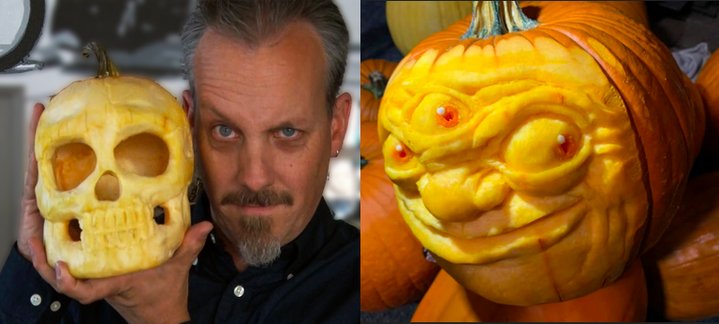
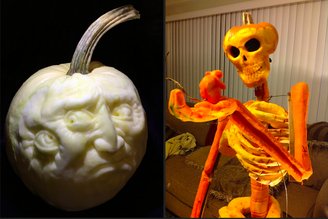
More creepy Craghead creations
Possibly no one in Humboldt looks forward to the Halloween season as much as expert
pumpkin carver Mike Craghead, who joins us on this week’s episode to
discuss his particular style of pumpkin sculpture (he doesn’t make just
your usual jack-o-lanterns), how he developed a love for this unusual
hobby and how it landed him a spot competing on season seven of Food Network television series Halloween Wars. You can see more about Craghead’s journey in the video below.
Craghead also talks a little bit about his book Pumpkin Skulls and Other Silly Things, which provides instructions and tips on how to carve pumpkins and even a few other types of produce! If you’re into it, you can find Craghead’s book on his website or in some local bookstores.
So, get into the spooky spirit by clicking the audio player above to hear Craghead chat with LoCO’s Andrew Goff and Stephanie McGeary about all things pumpkins!
Happy Halloween!
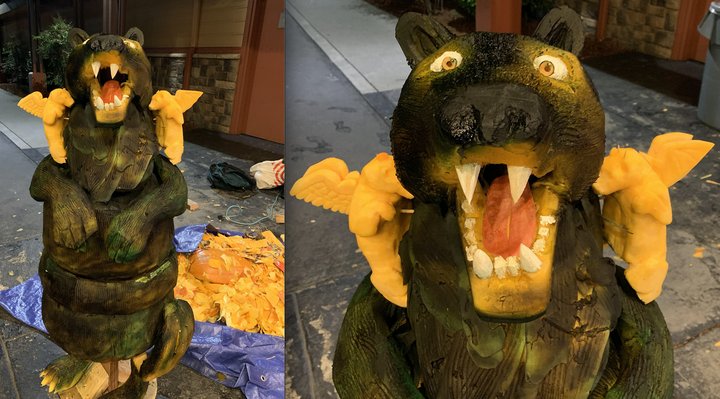
On Saturday Mike carved these event-appropriate shoulder friends at Bear River Casino’s “Angels and Demons” party