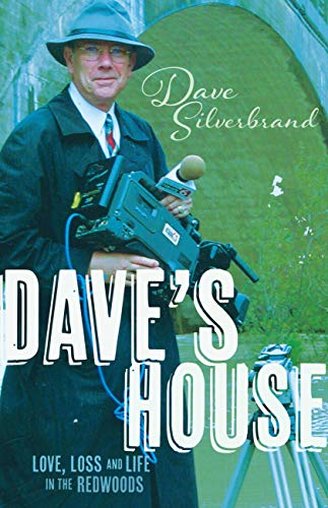
If you’ve been near a television in Humboldt County anytime in the past few decades, there’s a good chance you’ve seen Dave Silverbrand peering back at you at one point or another. Over his lengthy career, Dave has carved out a niche locally as a trusted voice, a beloved personality and a collector of everyday peoples’ stories.
Last year though, Dave decided to share some of his own story with the release of his book Dave’s House: Love, Loss and Life in Redwoods. In it, he discusses how he overcame the loss of his longtime wife Nina, who was struck by a vehicle while walking in the crosswalk in front of their house.
“If you fill your soul and your mind with happiness and joy [they don’t] really have as much room for bad feelings to get in there,” Silverbrand told the Outpost. “I actually learned that overnight after my wife passed away in 2013. Obviously it was a very sad time, — I still feel sad about it — but I also say that life is short and I have the resources to be joyful, no matter what. I know it sounds cliche but it has worked for me. And it’ll work for me today — I’ll probably get in the car and go down to the fair because there will probably be some person down there that I’ll want to meet and I don’t even know who it is! And I’ll probably have a heckuva time!”
Click the audio player above to hear Silverbrand’s chat with LoCO’s Stephanie McGeary and Andrew Goff. Topics include:
What motivated his decision to offer his services as a wedding officiant (either in English or in Spanish)
Pursuing untraditional stories and the importance of listening to people
Forgiving the young man who stole his car
His view on the state of the world and what he learned during multiple visits to Cuba
Choosing joy
More!
Spend some time with Dave and also consider scrolling our list of past Humboldt Holding Up guests below.
“So
what is the appeal of self-help books,” I asked. I’d just
come from Eureka Books, where I innocently inquired if self-help
books were still being published. In my naivety, I assumed they’d
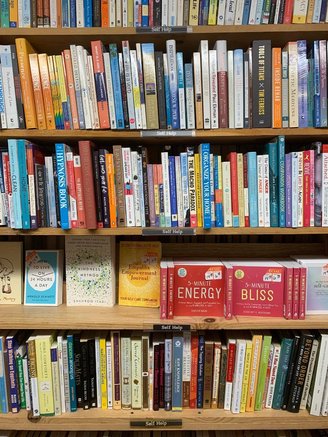
gone the way of hula hoops and pet rocks. My disillusion complete —
see photo — I was soon in conversation with my pal as we
tried to understand their continued attraction (Amazon lists over
100,000 books under the “self-help” category.)
Photo: Barry Evans.
“Yeah,
if they actually worked, why are they still selling?” pondered my
skeptical friend. “It’s not like they’re fresh on the scene.”
We agreed that if it’s happiness you’re after — presumably the
bottom line — then the world’s best-seller, the Bible, can
certainly lay claim to being an early self-help book (although it has
the good sense to guarantee happiness, not now, but in the next life,
assuming you play your cards right). Speaking of the Bible,
that’s the only book that Samuel Smiles’ classic Self-Help, “a
collection of inspirational stories about hard working men rising
through the ranks,” didn’t outsell in 1859, the year of its
publication (—also the year of Charles Darwin’s Origin of
Species). By the time of Smiles’ death 45 years later, his book
had sold over a quarter of a million copies. It’s available
on Project Gutenberg.
Probably
the next Big Thing in self-help books was How to Win Friends and
Influence People by farmer-turned-public-speaker Dale Carnegey,
later Carnegie (in honor of Andrew Carnegie). It came out in 1936,
and has sold over 30 million copies (including 17 editions the year
it was published!). I treasure one of Carnegie’s insights and only
wish I faithfully followed through on it: “Remember that a person’s
name is, to that person, the sweetest and most important sound in any
language.”
Back
to our coffee-shop musing on why, if self-help books worked, were
they still sell in astronomical numbers? “Maybe we’re looking at
this the wrong way,” I said. “We’re thinking in terms of, ‘Have
readers’ lives gotten better after reading one of them?’ What
about the enjoyment of the actual process of reading, never mind what
happens afterwards?”
Does
this make sense? When we read a self-help book, we’re imagining a
future in which we’re happier/richer/healthier/slimmer/better
parents/sexier lovers/more disciplined writers. Etc, etc. Which feels
great, right? The simple act of reading is a joyous experience as you
or I fantasize about our Better Life Ahead. Out of the gate come the
reward chemicals — dopamine, serotonin, norepinephrine and all the
rest — and we’re (deep breath) happy. At this point,
there’s no motivation for actually doing what the book says
(assuming it’s any good, which is questionable): you’re already
blissed out! And — this is the genius of the genre — there’s
always another when we’ve finished this one. It’s brilliant, and
risk-free (other than the cost of the book itself). So long as we
don’t have to prove that we’re capable of making the changes the
book encourages, we can’t fail. This approach, it turns out, has a
name: The Inspirational Life.
I
know whereof I write. I bought myself a keyboard a few months ago,
deciding that it was time, well into my seventies, that I learned how
to play. And I can’t start to tell you the pleasure I’ve been
having watching YouTube videos aimed at beginners who, purportedly,
want to learn piano. Every one of these brings me joy as I imagine
myself dancing merrily through Erik Satie’s Gymnopédies,
impressing all those who marvel at my finger dexterity and soulful
understanding of the music. All without actually sitting down and
playing! (Full disclosure: I can manage the first six or eight
bars of the first one, played very slowly.)
But
suppose you do get up from the couch and decide to act on what you’ve
just read by the self-help guru-de-jour? Bottom line: Change is
hard! Change can lose us friends and family. Change can mean
giving up that evening glass of beer or wine (reward for a hard day’s
work). Change can lose us jobs, spouses, freedom. It’s usually
uncomfortable and it hurts.
And
for what? Dan Gilbert, whose job title should be “happyologist”
(he’s a psychology professor at Harvard who studies happiness for a
living — check out his 2006 book Stumbling on Happiness) sums
up the entire “my life will be better in the future if I do this
now” paradox. He writes, “We treat our future selves as though
they were our children, spending most of the hours of most of our
days constructing tomorrows that we hope will make them happy.” A
Scientific American reviewer completed the thought: “But the
children turn out to be ingrates, complaining that we should have let
them stay in the old house or study dentistry instead of law…Like
the fruits of our loins, our temporal progeny are often thankless.”
It
was time to get ourselves second cups of coffee and resume our
joy-filled kvetching.
While some finishing touches are still being applied, the 2021 Eureka Street Art Festival is mostly in the books, meaning the city has a bunch of new colorful walls for you to peruse (if you haven’t already). Plan to take a walk, maybe. It’s a mostly good time to be outside.
The event was another exercise in learning to adapt. For the second straight year the COVID-19 pandemic caused organizers to dash plans for their wrap-up community block party, among other adjustments. But as numerous other local events canceled in the face of rising infection rates, ESAF benefitted from being both outside and spread out which allowed art-seeking attendees to safely take small group strolls and appreciate the work of this year’s mostly local crop of talent. A few artists noted that they had to contend with smoky, orange-tinged lighting while mixing their paints, but they made it work.
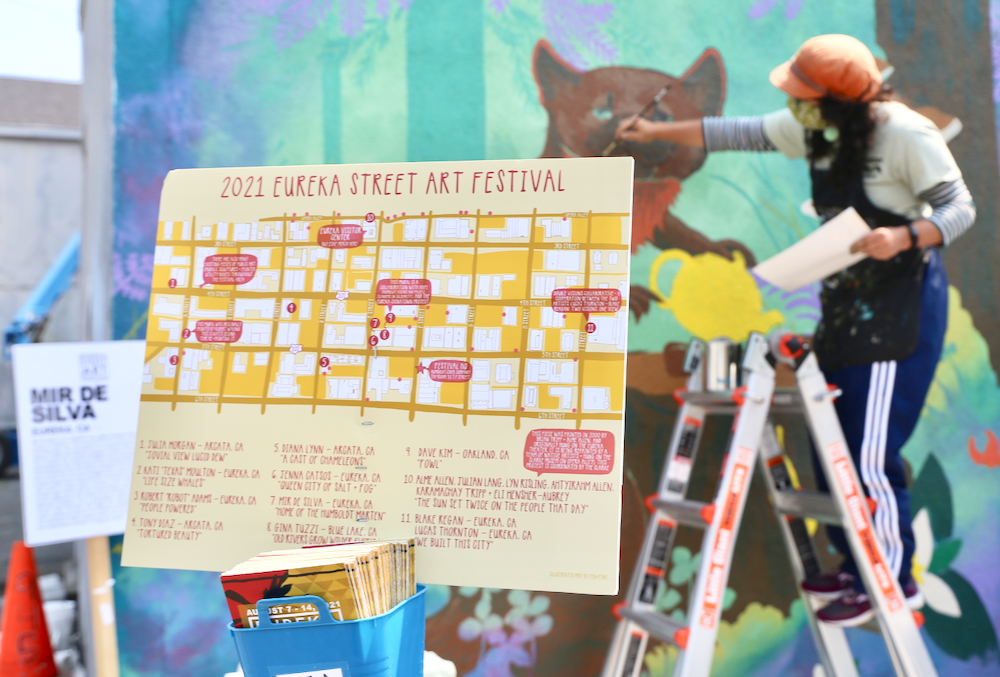
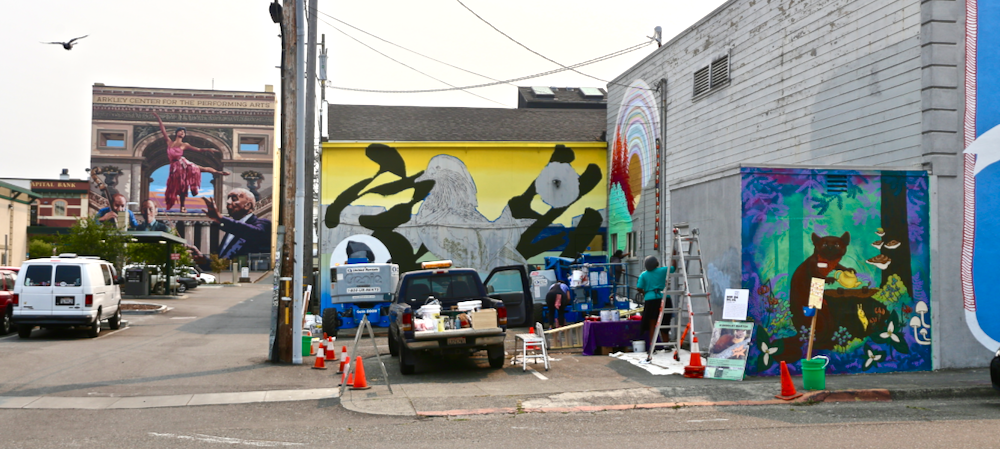
Centered mostly around Eureka’s Fourth and Fifth streets corridor, 11 new works were approved for downtown walls this year in a process that pairs artists with local property and business owners. While that’s the fewest number of murals completed during any of the previous individual events, this year’s festival covered more square footage than any of its predecessors, according to organizer (and participating artist) Jenna Catsos.
“We realized from an organizing perspective that working with larger murals is less work on our part but a bigger impact,” Catsos told us. “So it kind of just makes sense.”
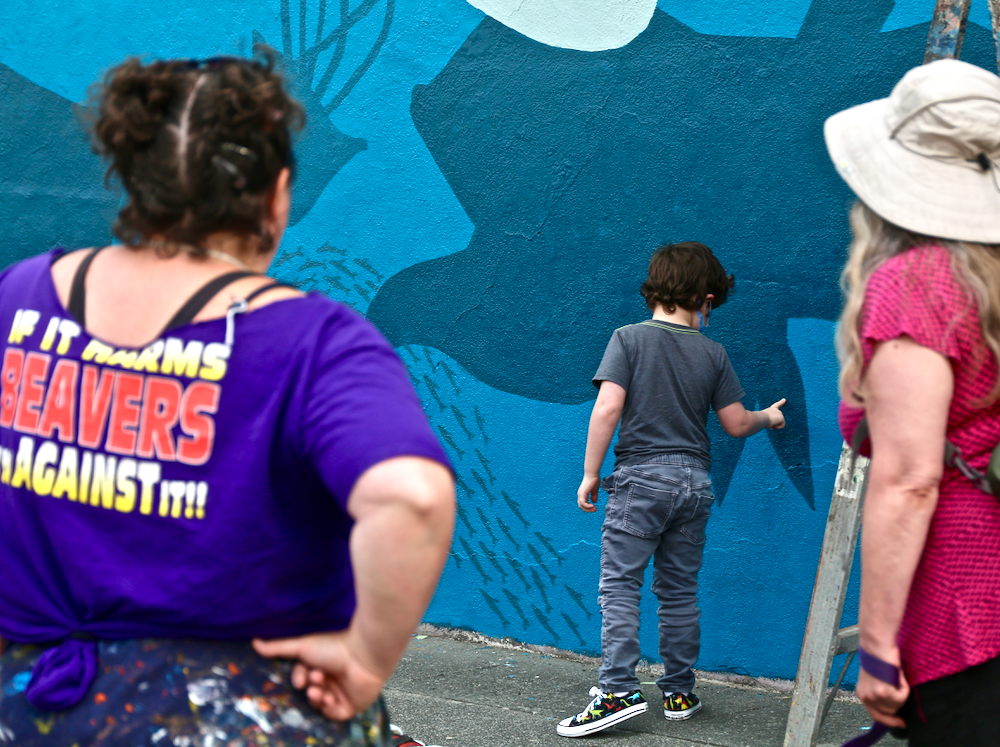
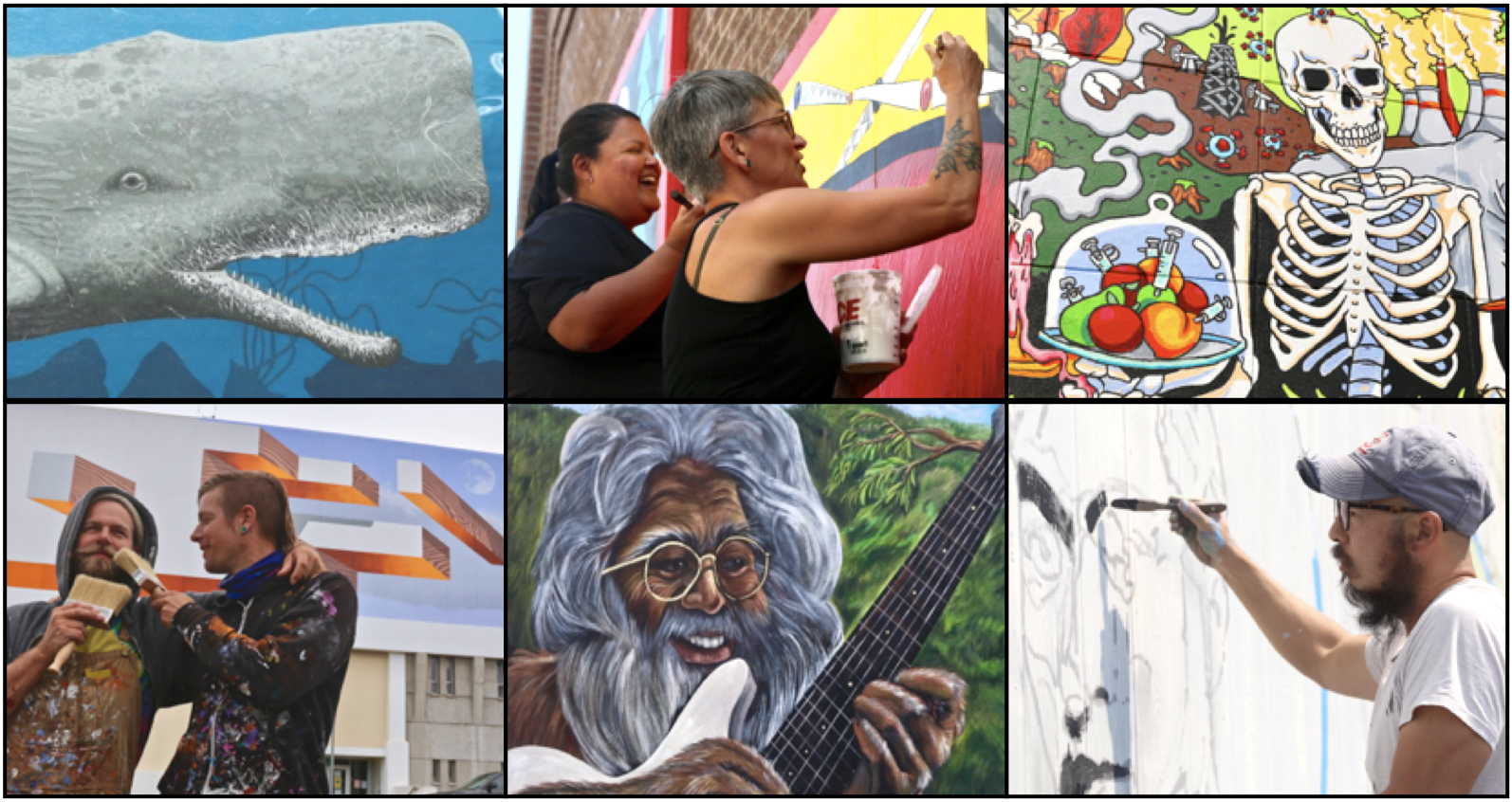
Another new approach this year: The festival launched its Mural Apprentice Program “designed to help aspiring Humboldt County mural artists gain experience, network, and build their resumes.” Thus, several of this year’s muralists were assisted by paid aspiring muralists, many of them, as Catsos wanted to acknowledge, people of color or members of the LGBTQ+ community.
The Outpost took a few walks around the festival as it was happening and took a few pictures, as we do. So, without further delay, below you will find your 2021 Eureka Street Art Festival artists and their entries. Enjoy.
###
-ALME ALLEN-
McKinleyville
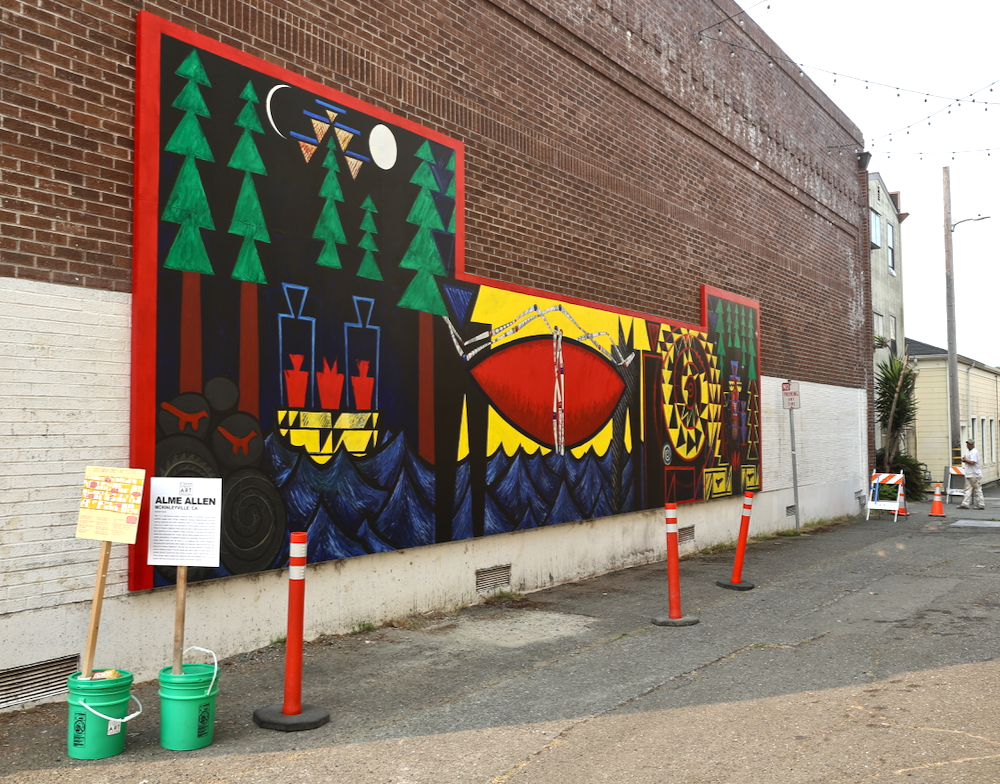
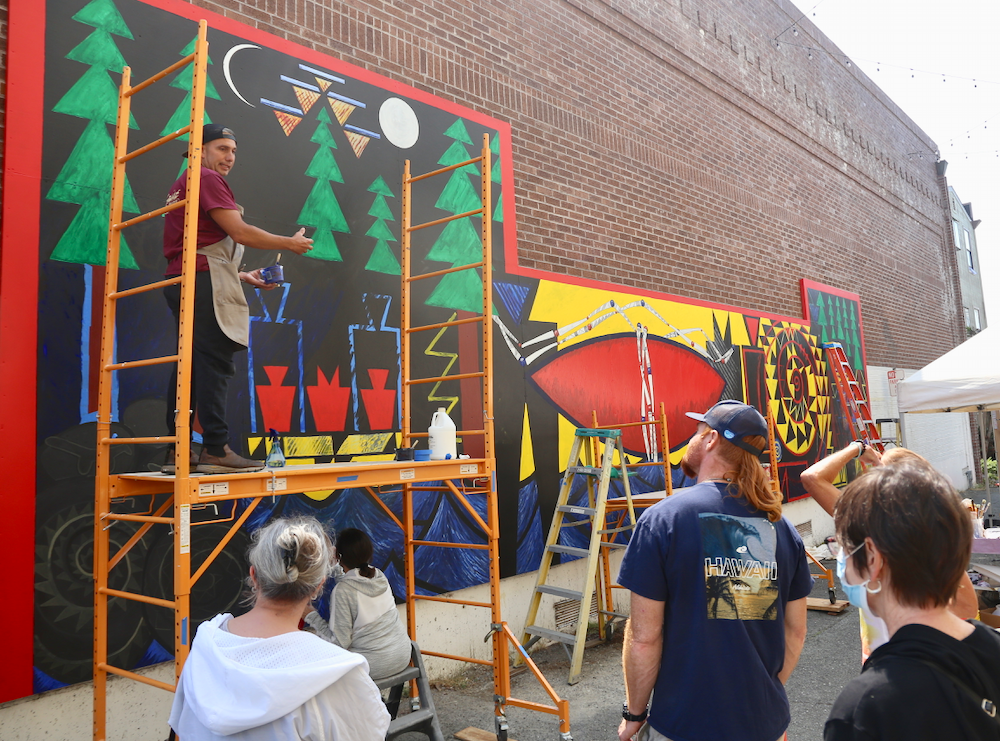
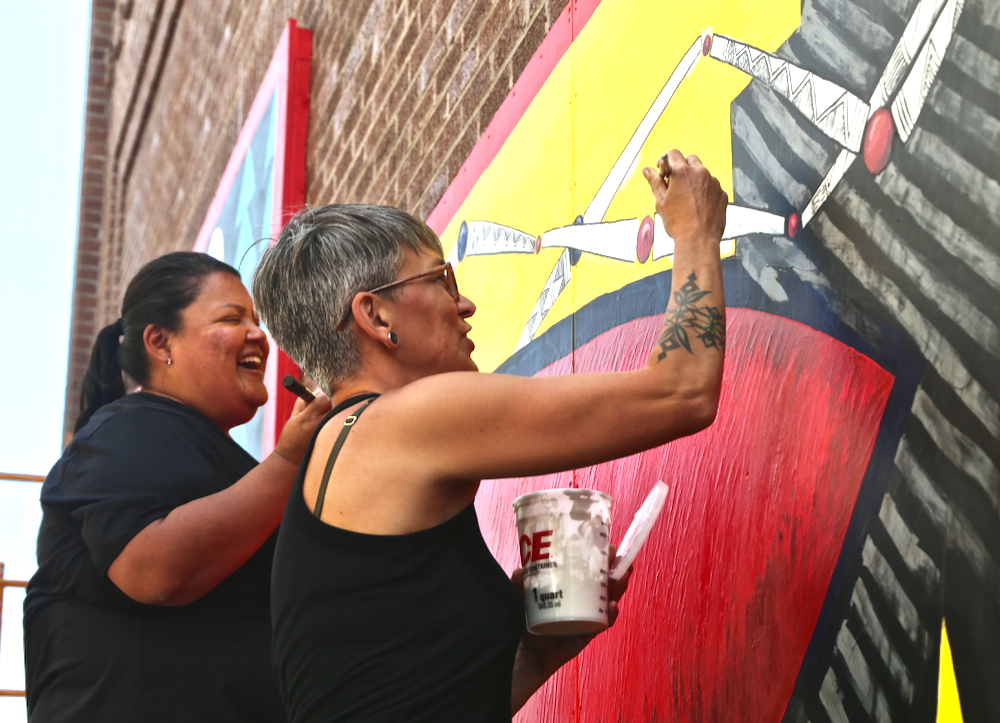
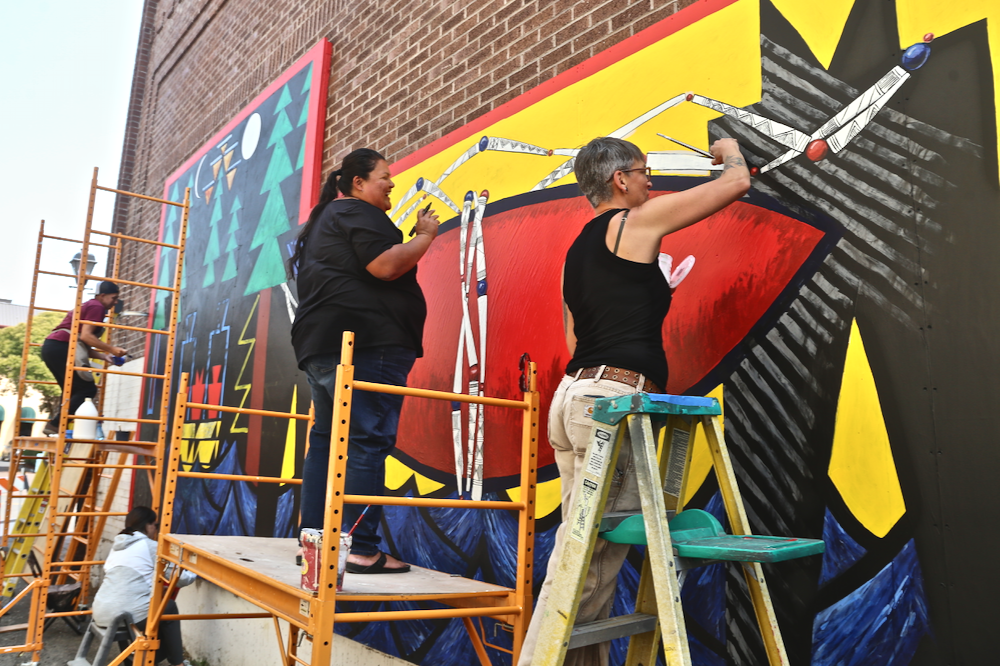
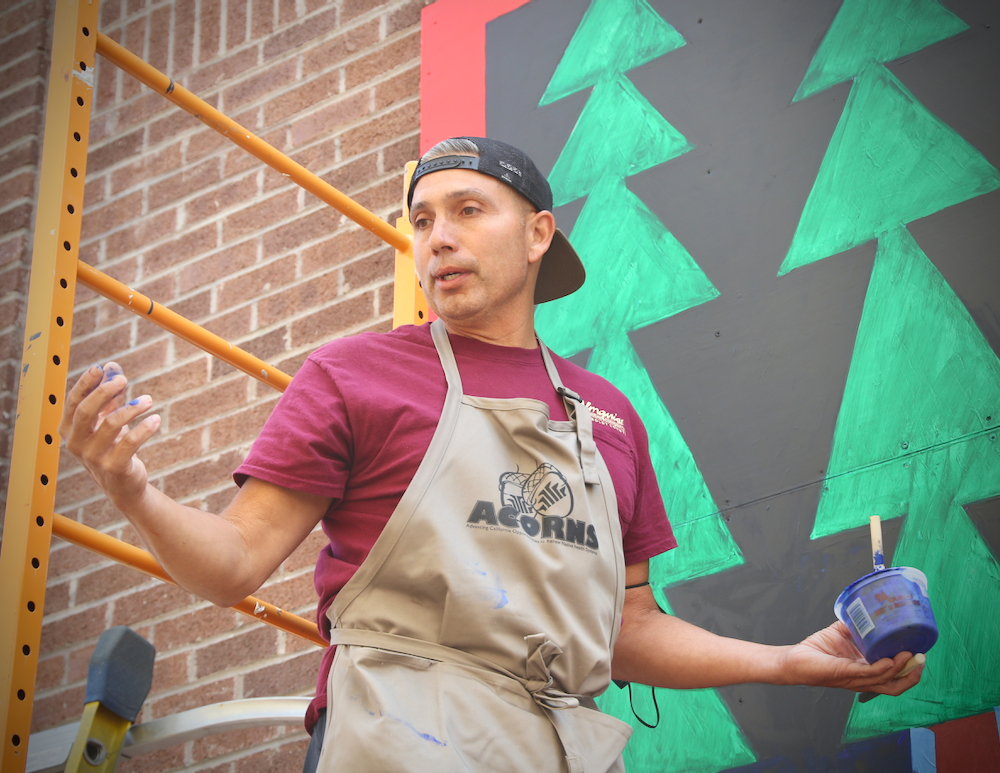
“The Sun Set Twice on the People That Day” is a mural first painted by Native artist Brian Tripp over two decades ago which was moved to its new home on the side of the Clarke Museum for this year’s festival. Alme Allen, who assisted in its initial creation, was aided by family members in restoring it and Tripp himself, who is currently in hospice care, made it to the mural’s dedication to again sign his work.
The piece takes its name from a line in a poem written by Tripp about the 1860 massacre on Tuluwat Island.
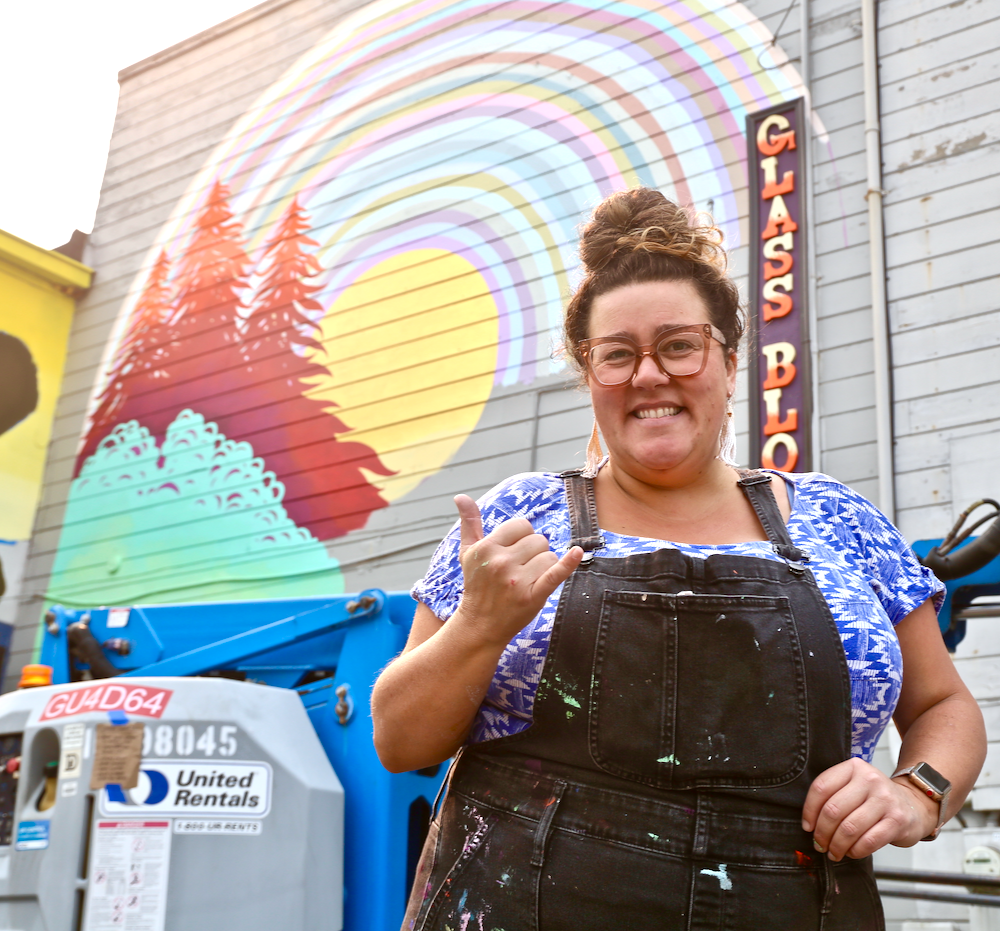
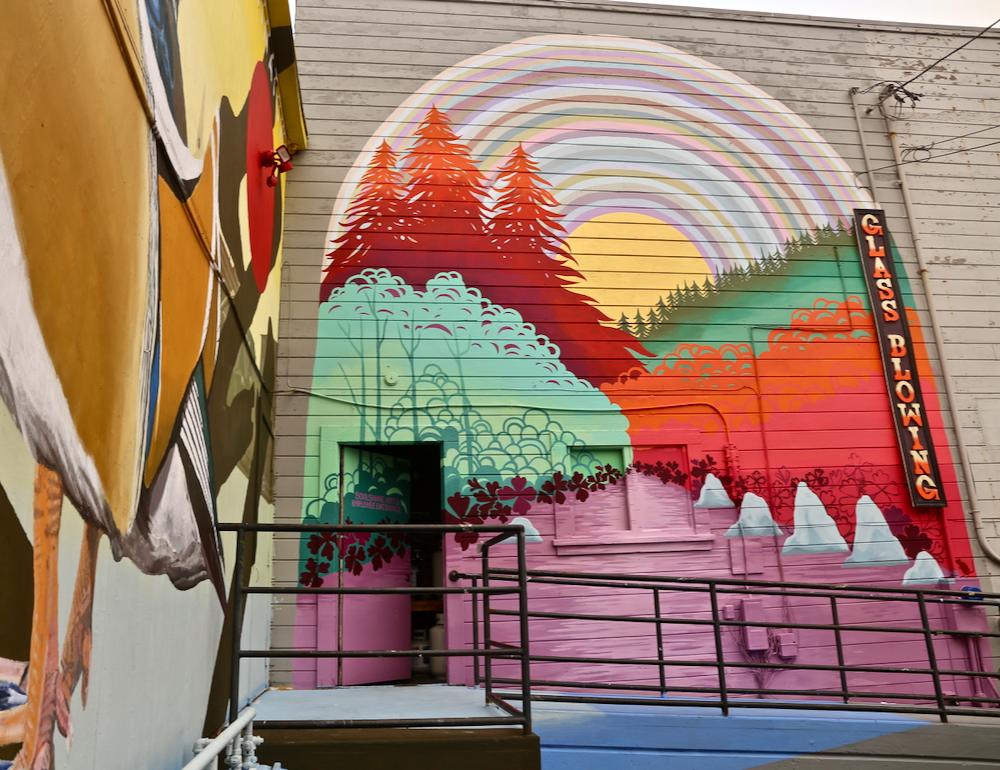
Returning festival artist Gina Tuzzi decided to celebrate one of her favorite outdoor spots in this colorful mural located in the alley behind Soulshine Arts Glassblowing Studio on Fifth Street. The scene depicts a section of the South Fork of the Trinity River which was burned by wildfire as part of the August Complex in 2020.
“My friends and I have been camping out there for almost 20 years now,” Tuzzi said. “It’s our sanctuary. It’s our safe space.”
###
-TONY DIAZ-
Arcata
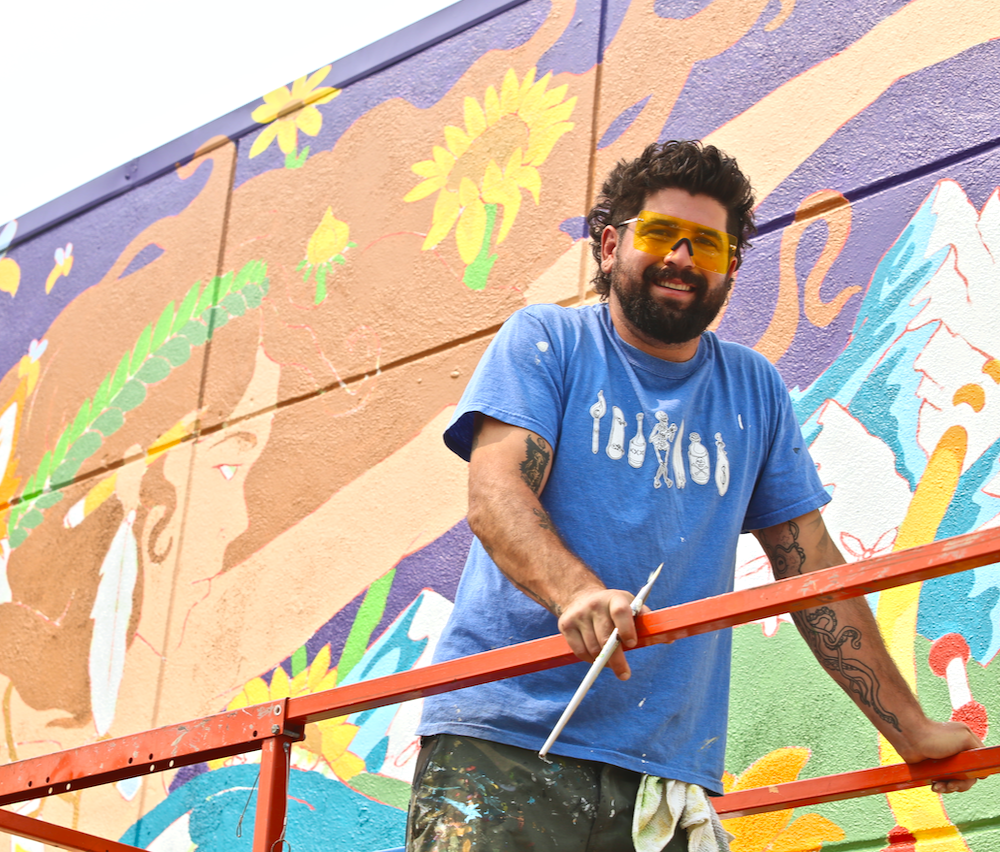
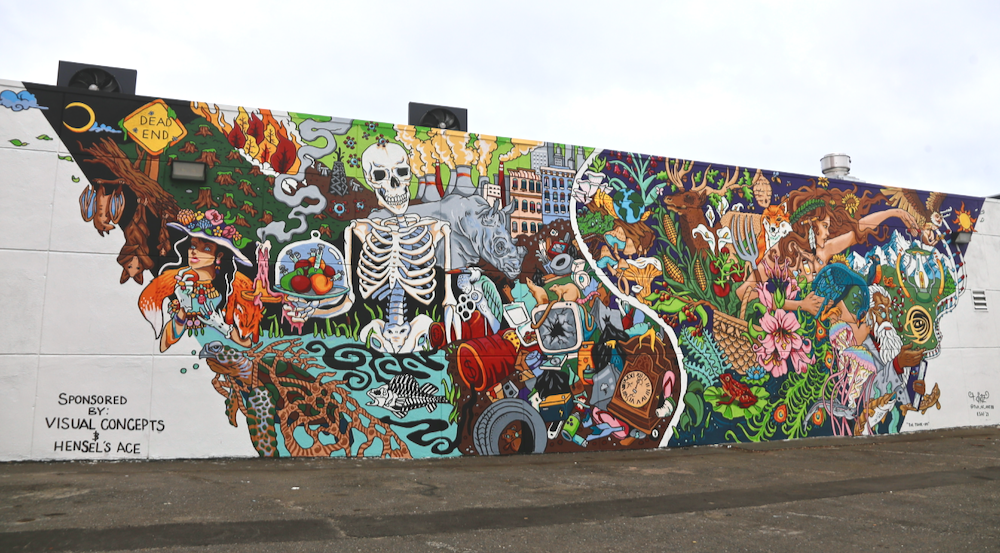
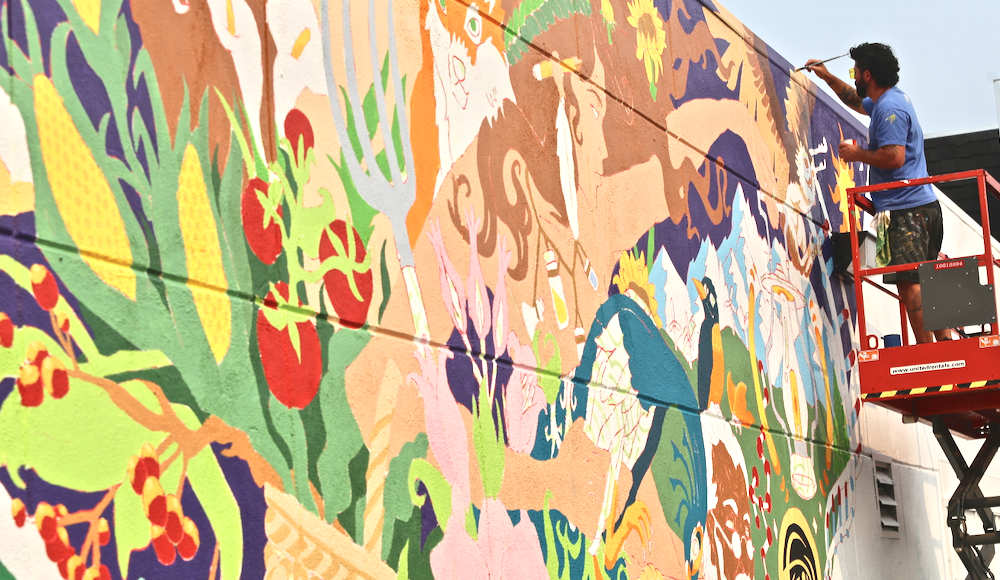
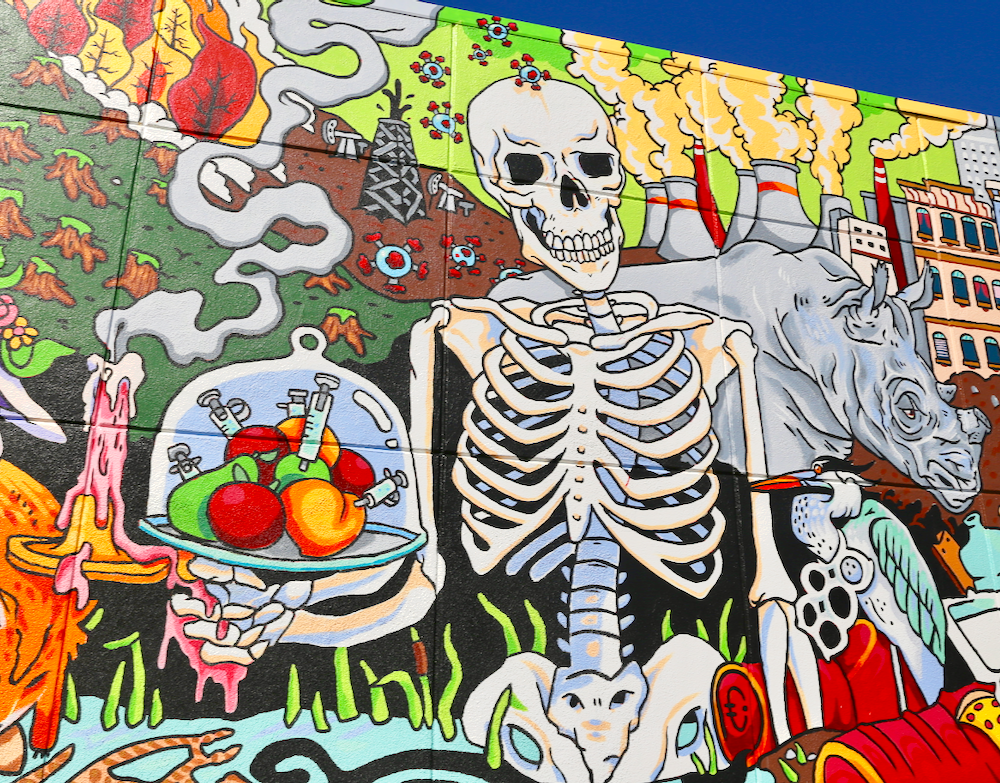
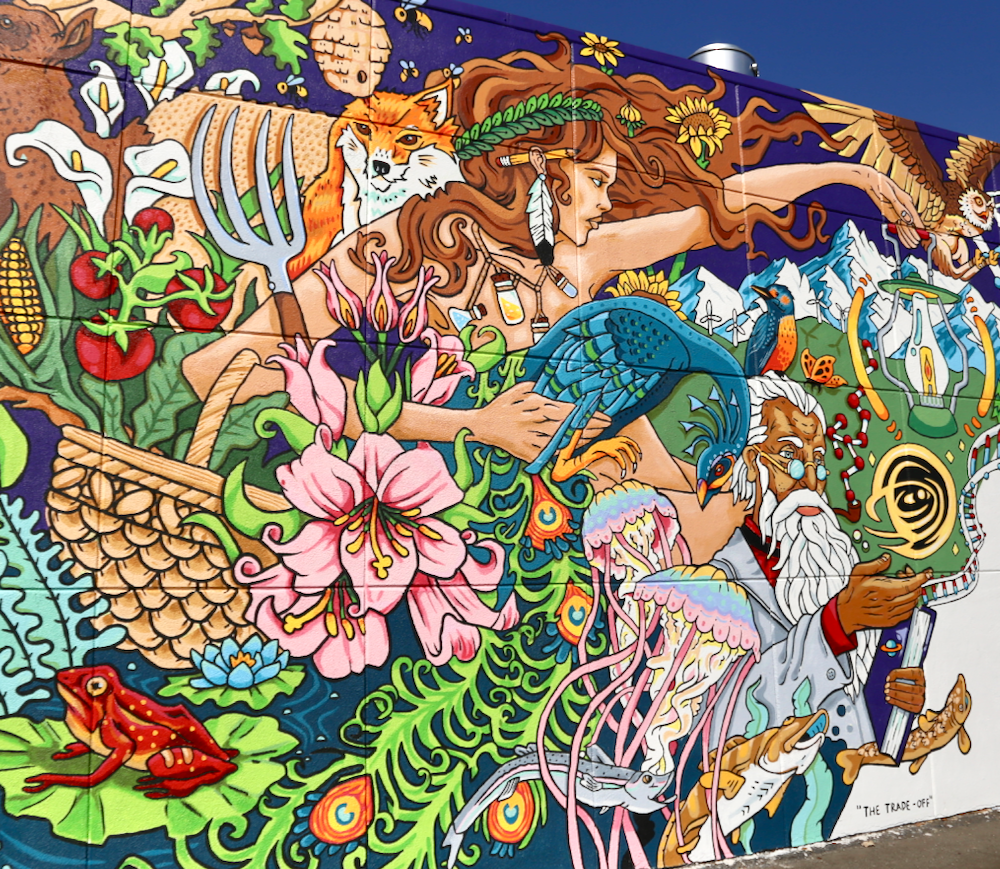
Another artist returning to the festival this year is Tony Diaz, whose work you may recognize from the back of the Arcata Theatre Lounge (or if you’ve happened to take a trip to New Zealand). This new eye-grabbing piece, titled “The Trade Off,” now adorns a building near the corner of C and Fifth streets.
Tony had little time to celebrate the completion of his latest work — he was scheduled to start another piece in Portland directly following this year’s fest.
###
-KATI TEXAS-
Eureka
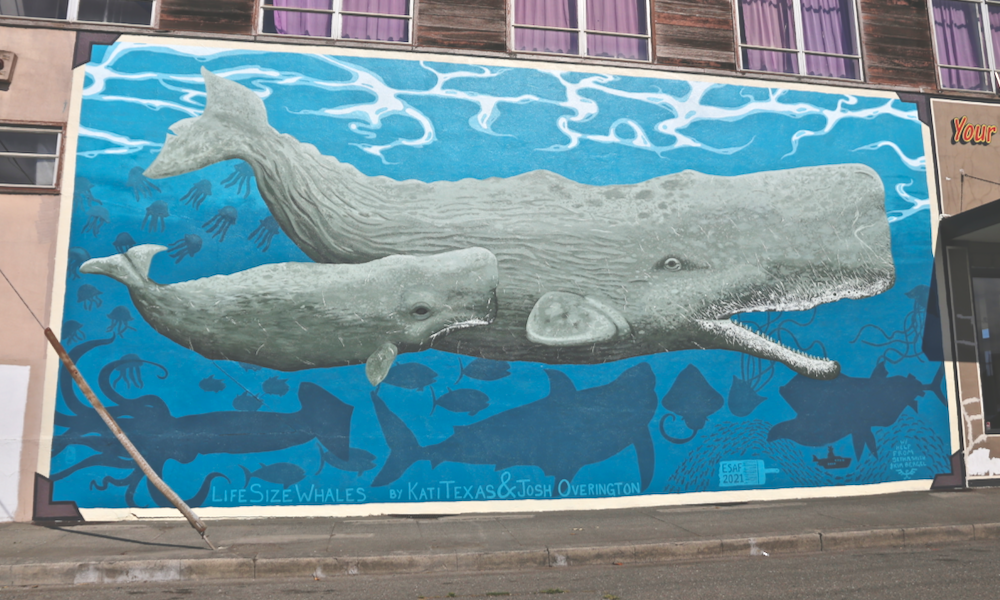
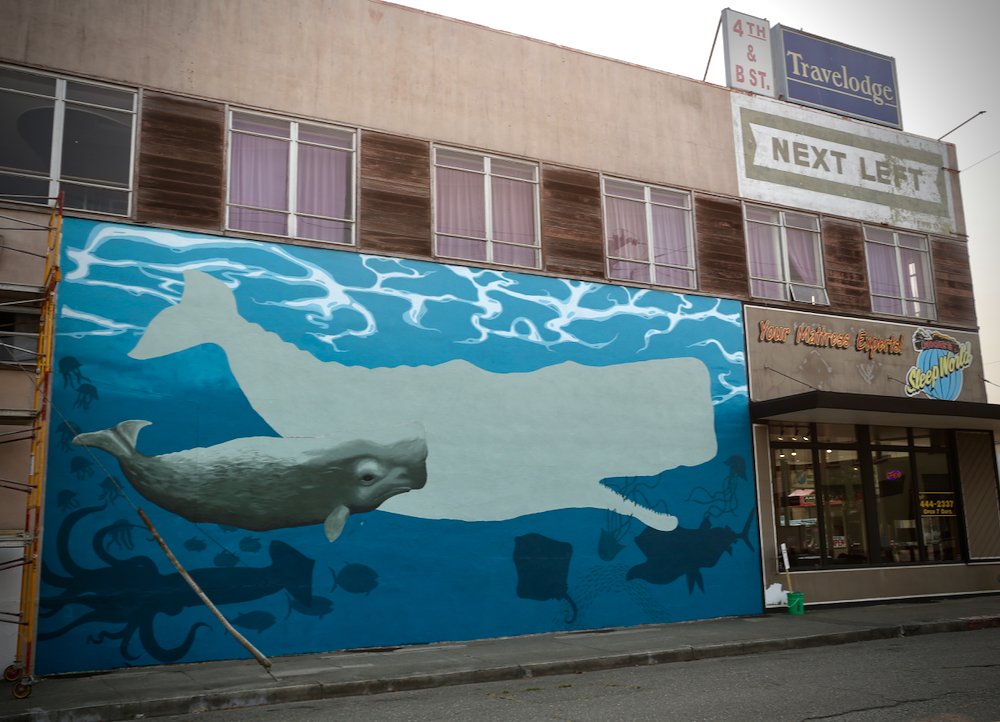
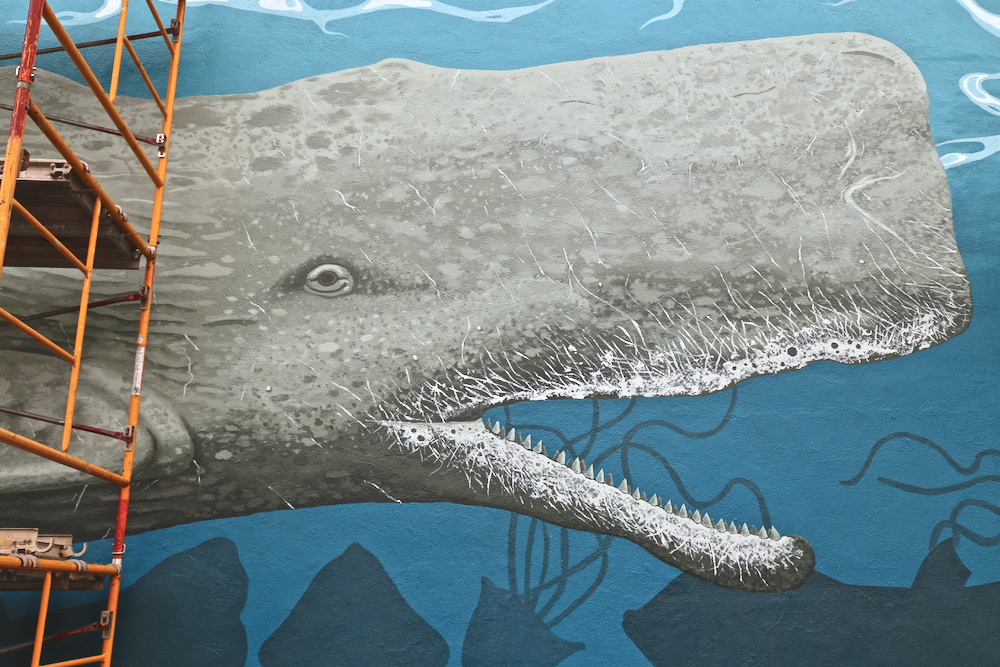
Current Eureka City Councilmember and forever Rutabaga Queen Kati Texas (AKA Kati Moulton) took on the task of refurbishing a mural of a sperm whale mother and calf that has long-adorned the wall at the corner of Fourth and A streets. This is actually the second time Kati has been called upon to touch up this piece — she first tackled the job right after she moved to town almost two decades ago.
###
-JULIA MORGAN-
Arcata
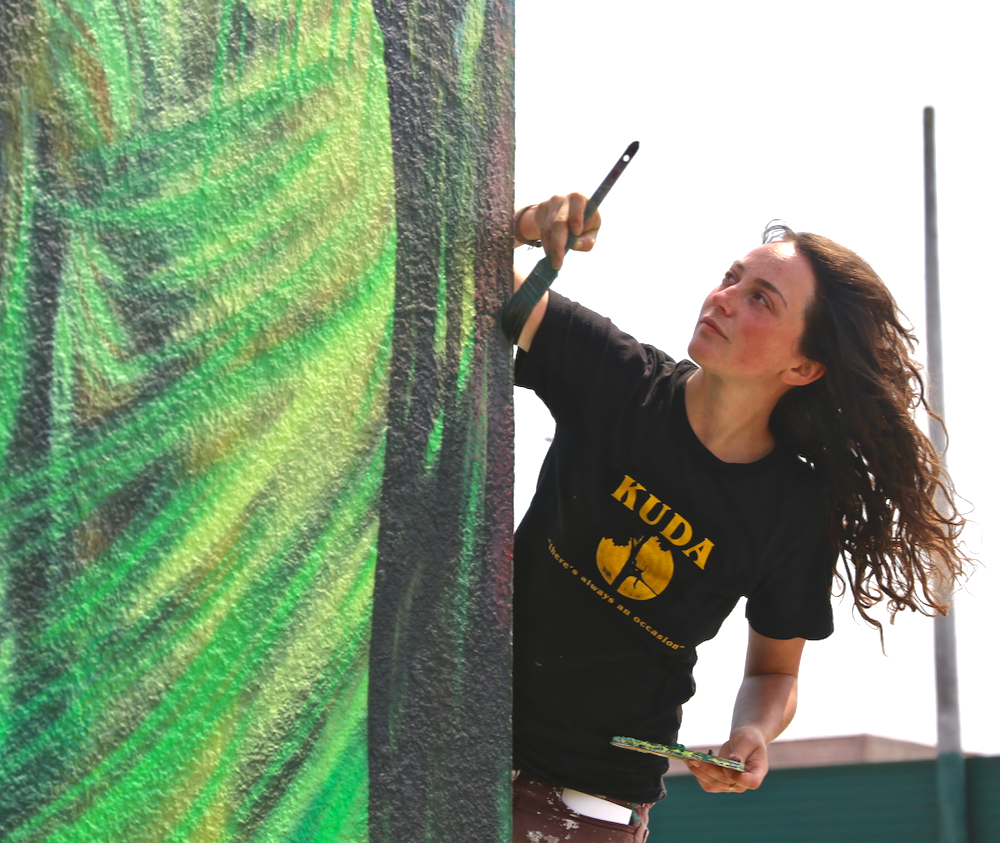
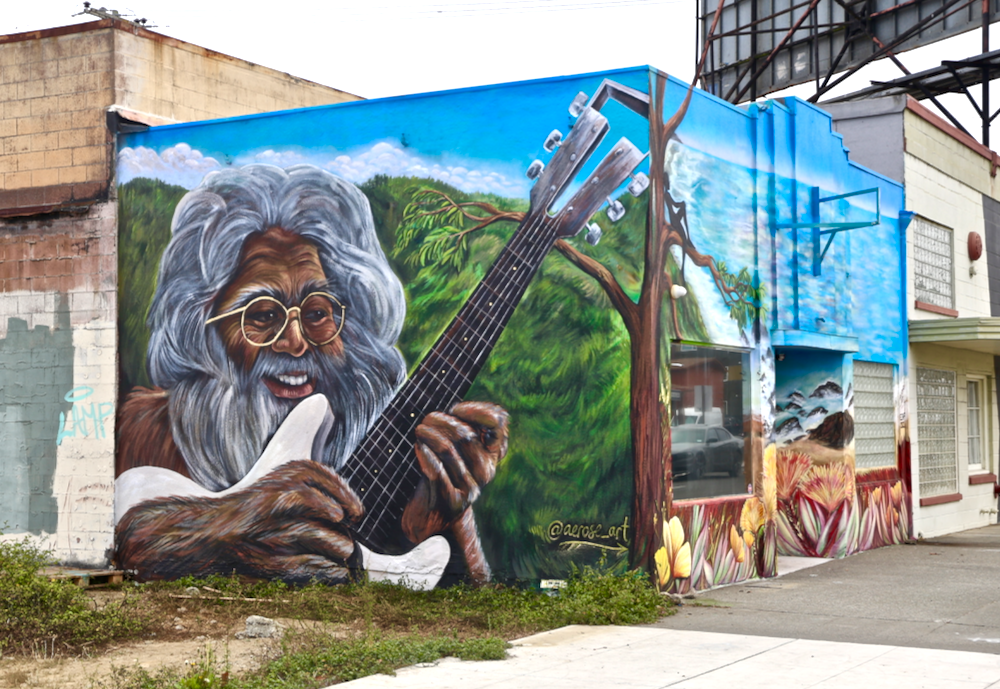
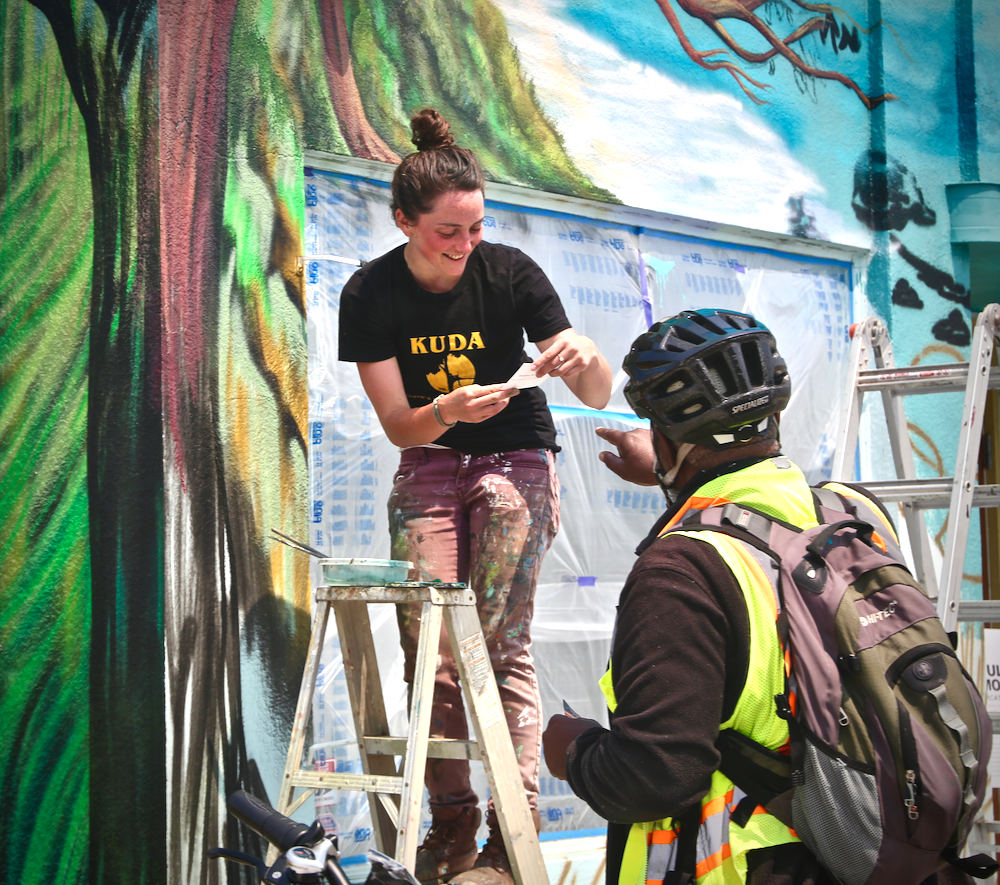
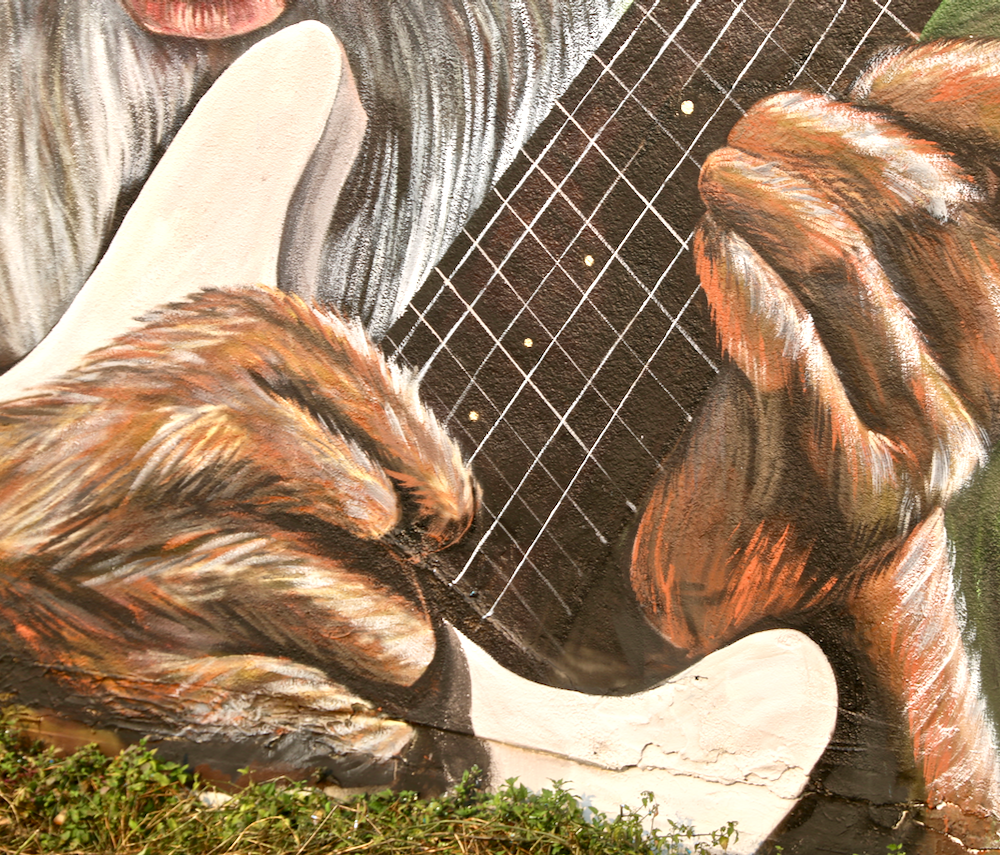
Combining two figures beloved in Humboldt, Julia Morgan’s Fourth Street piece on the side of the building that will soon be home to Kuda, a cannabis distribution company, was not the design officially approved for the festival, but she got permission from the building’s owners last minute to expand her piece. Thus, “Hairy Garcia” was born. Long may he keep truckin’.
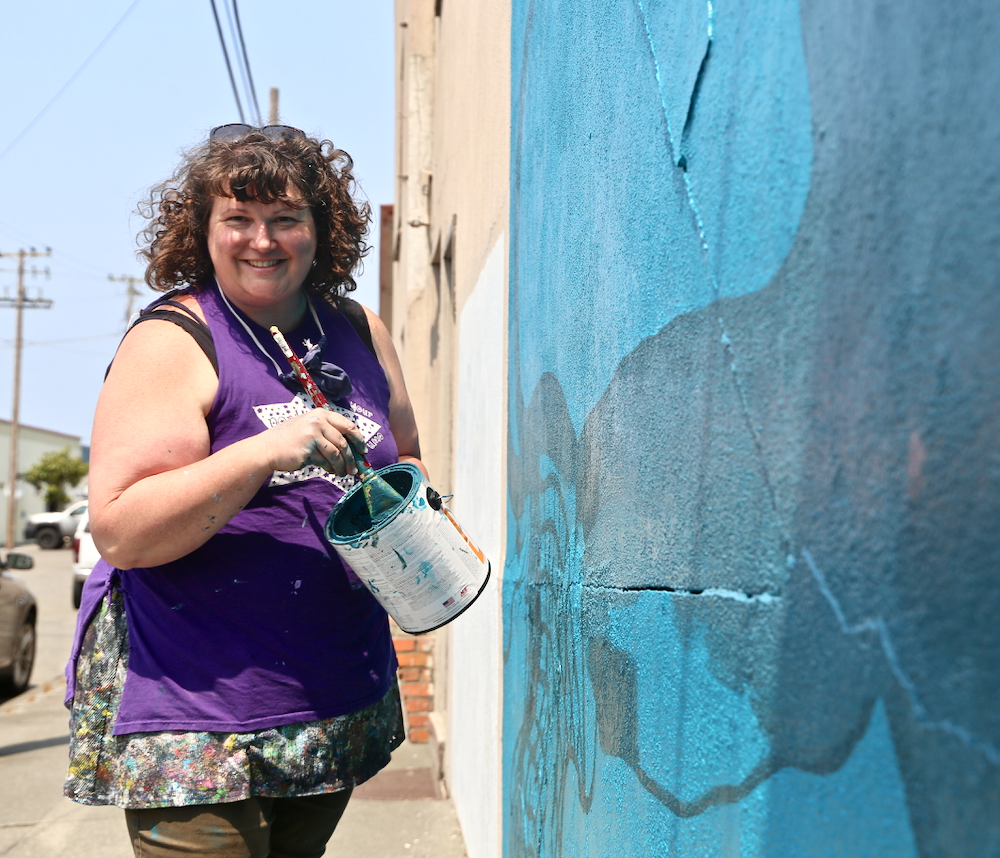
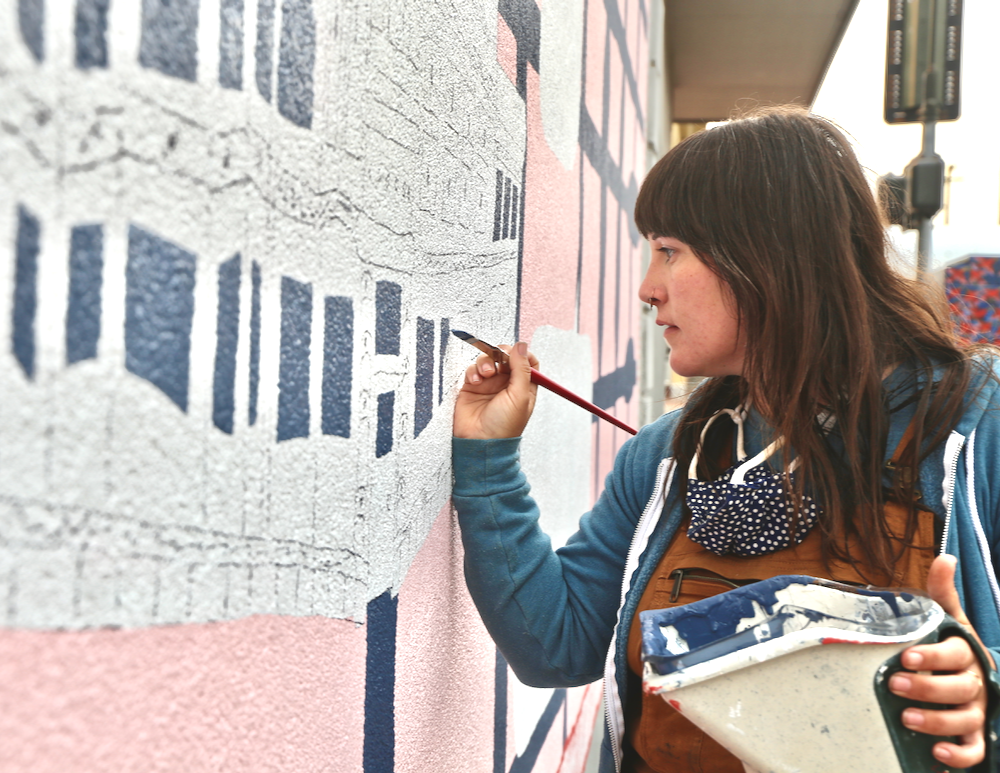
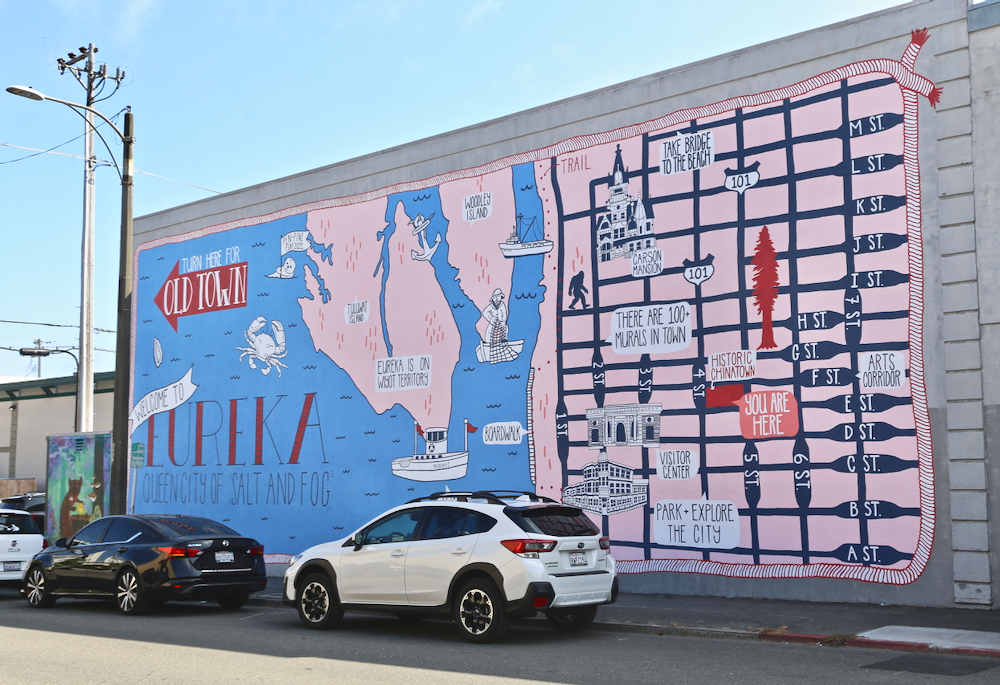
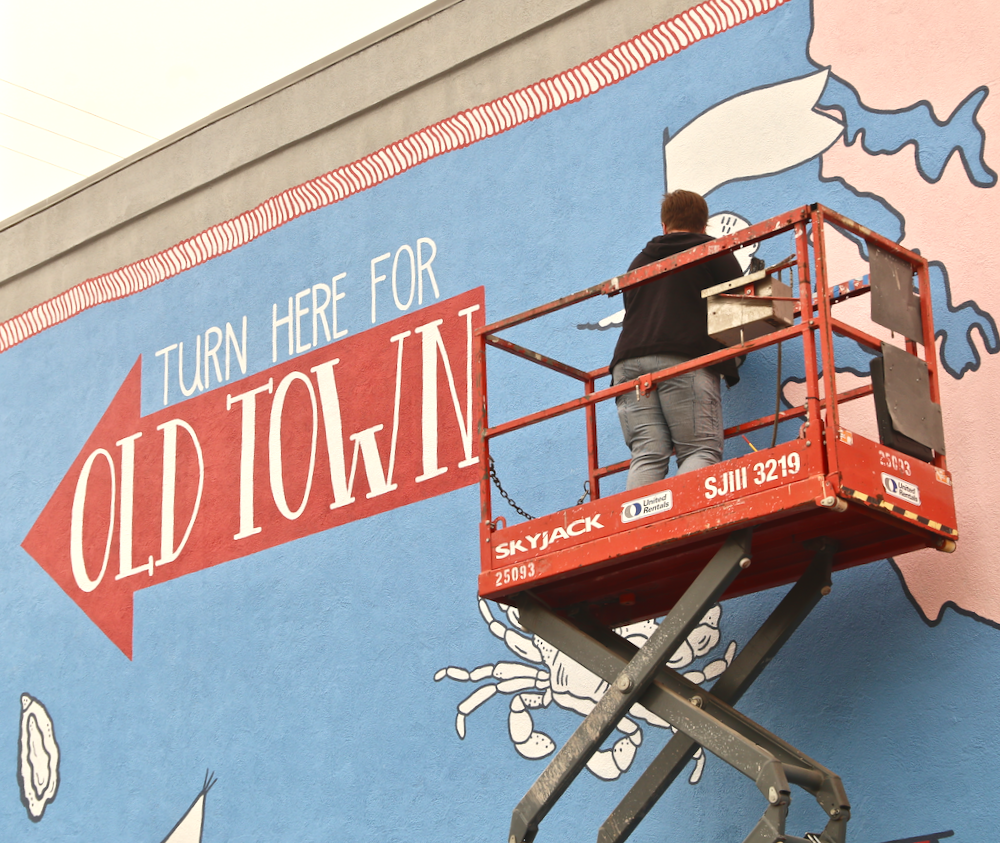
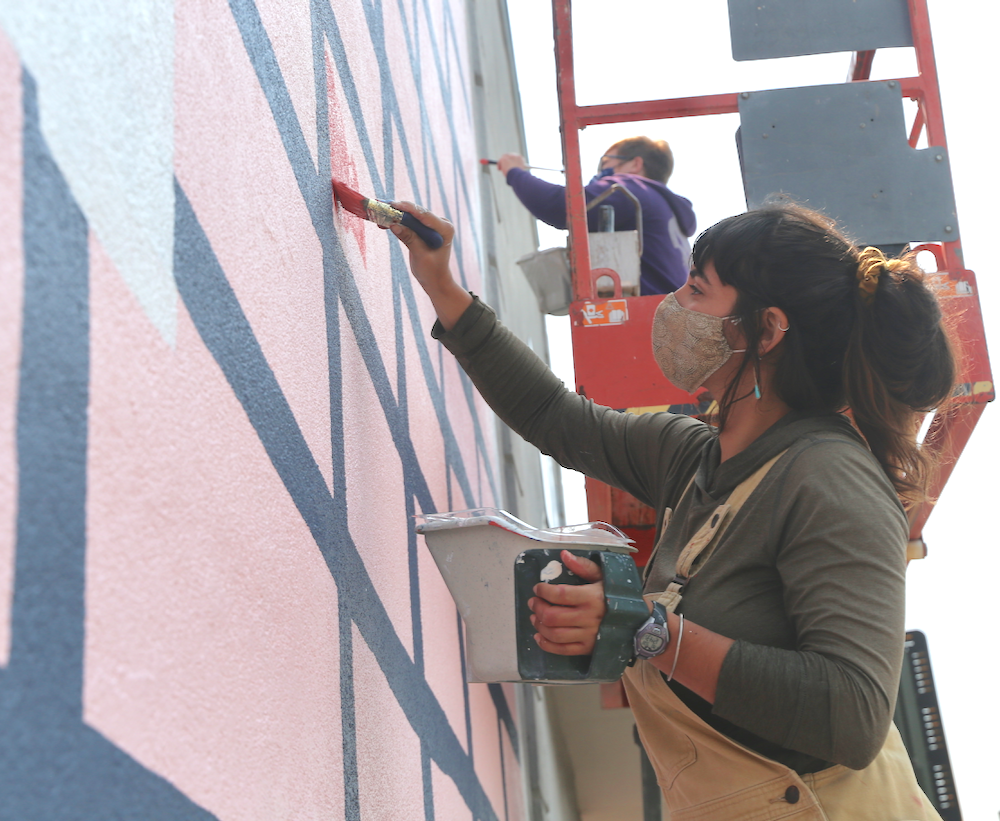
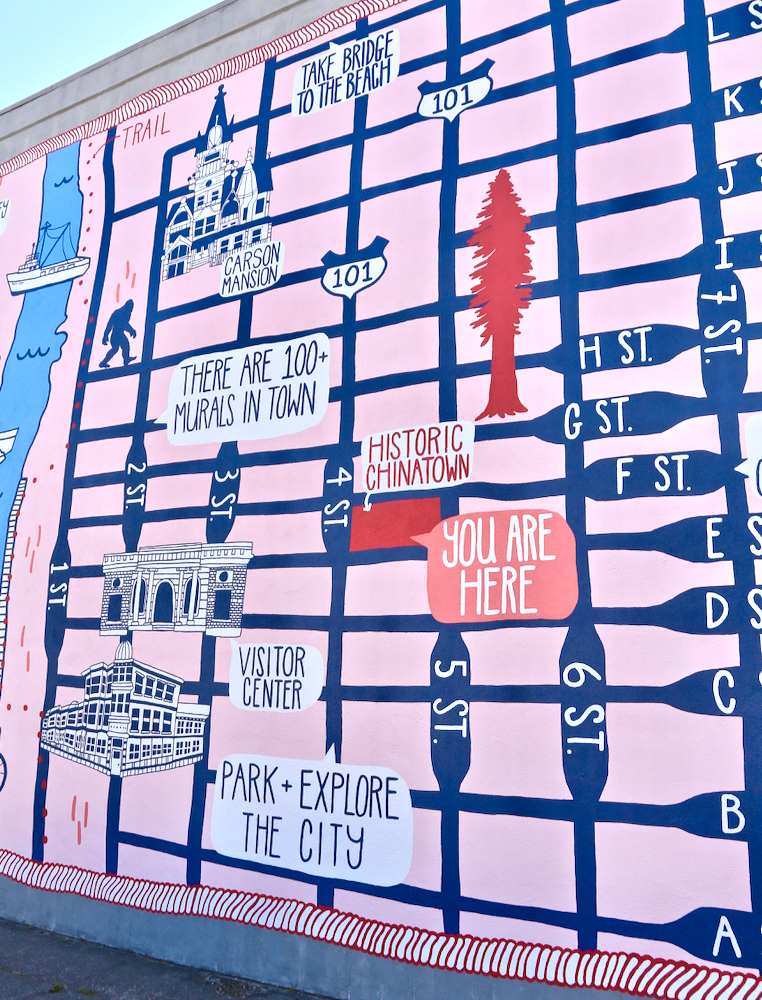
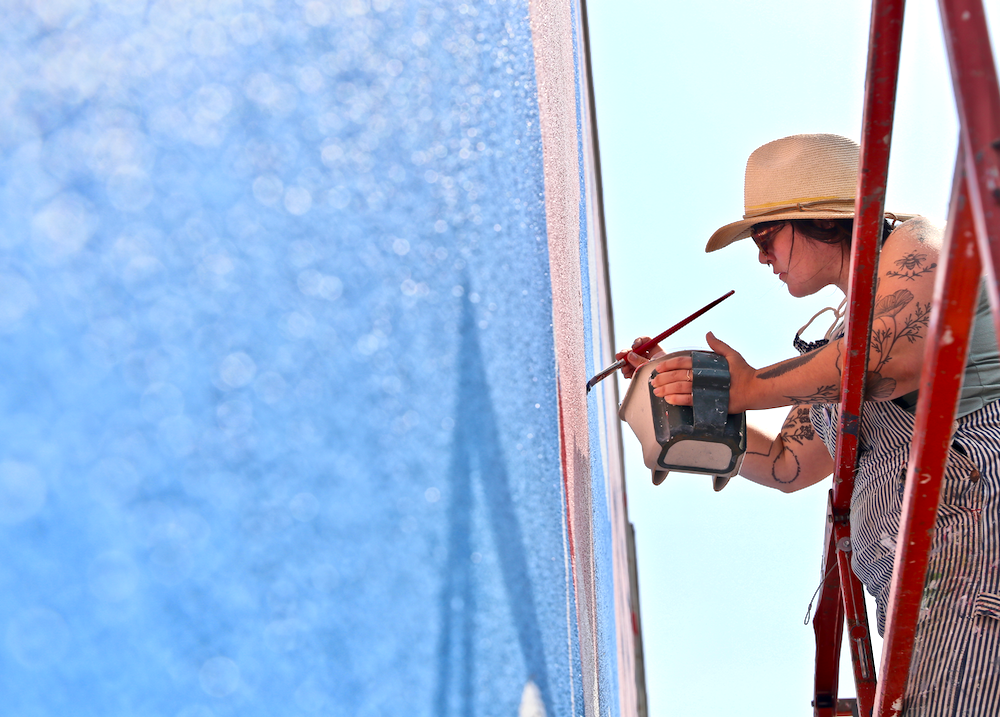
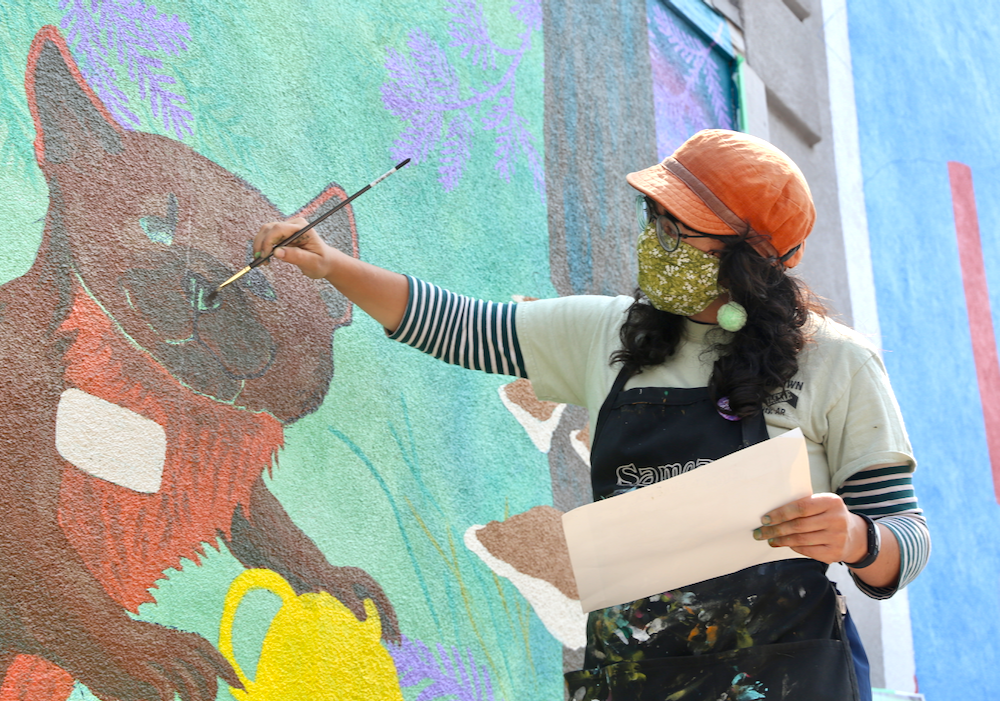
Gettin’ her hands dirty! Eureka Street Art Festival founder Jenna Catsos opted to take up brush as a fest participant for the first time this year for this map-based mural located on the Ellis Art and Engineering building at the corner of E and Fifth streets. Assisted by a team of the aforementioned mural apprentices — including Tess Yinger and Kayla Lopez, pictured below — the piece encourages travelers to “Turn Here for Old Town,” a solid suggestion.
###
-MIR DE SILVA-
Eureka
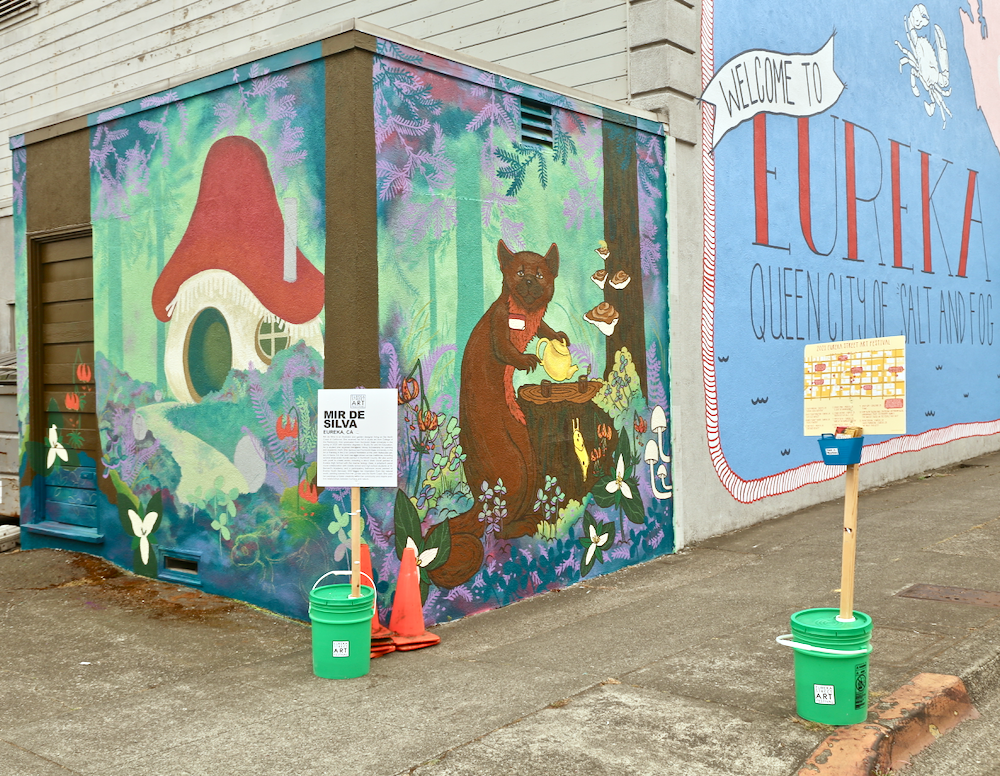
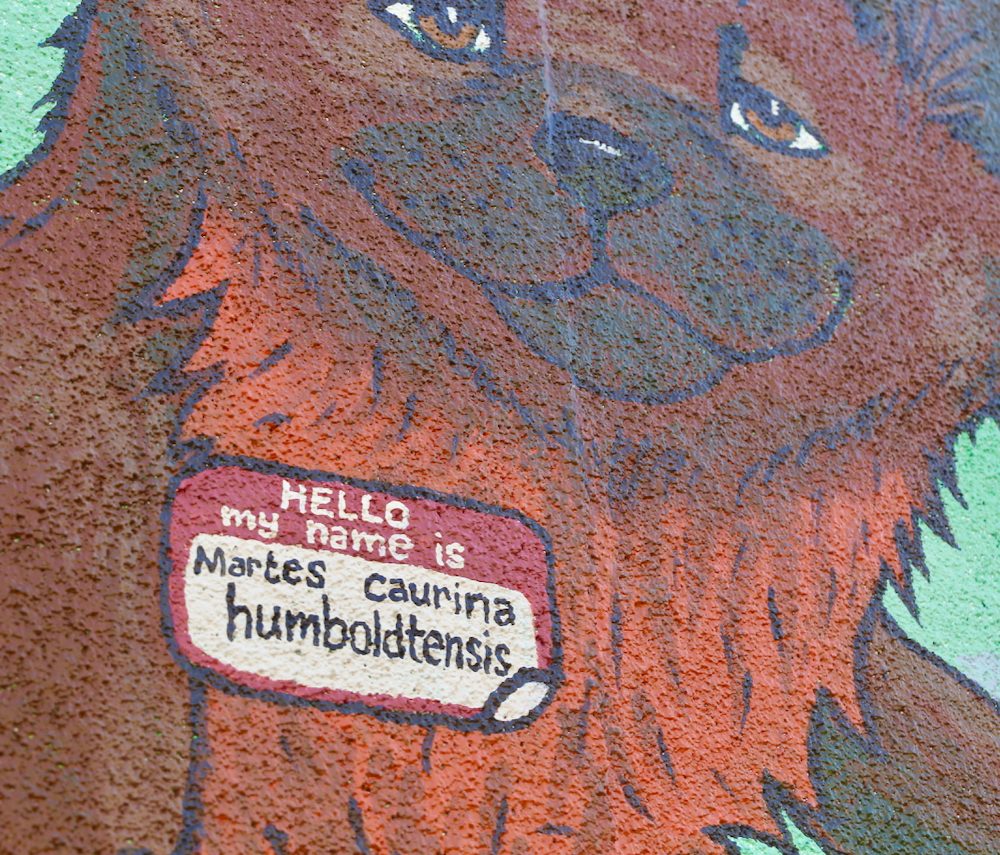
Returning festival artist Mir de Silva invites you to have a cup of tea with a friendly and hospitable Humboldt marten in this piece on E Street between Fourth and Fifth streets. So speedy was Mir in getting her piece up that she got permission to double its size and wrap it around the side of the building.
###
-DAVE KIM-
Oakland
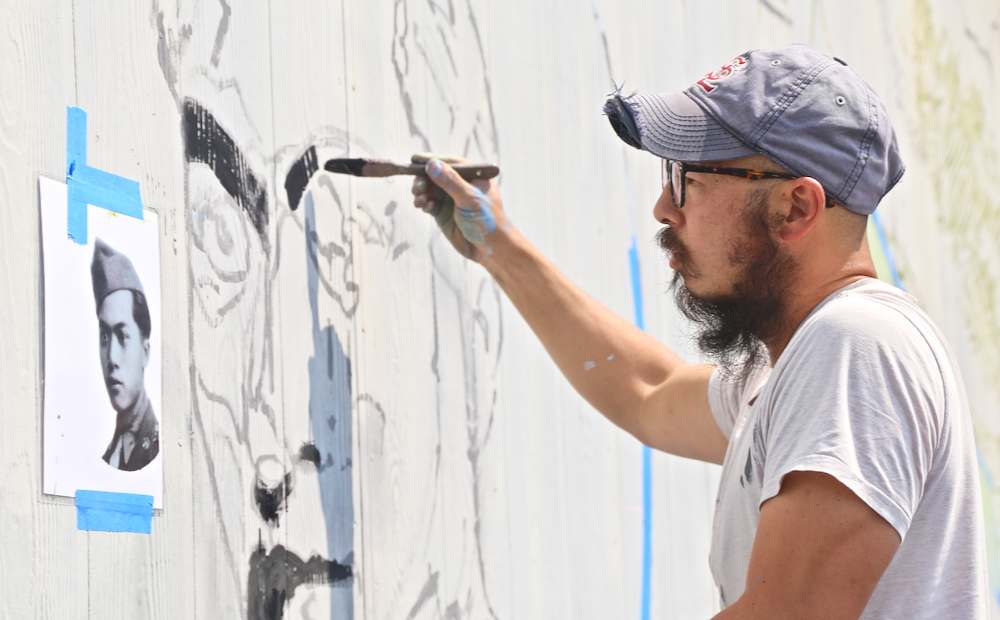
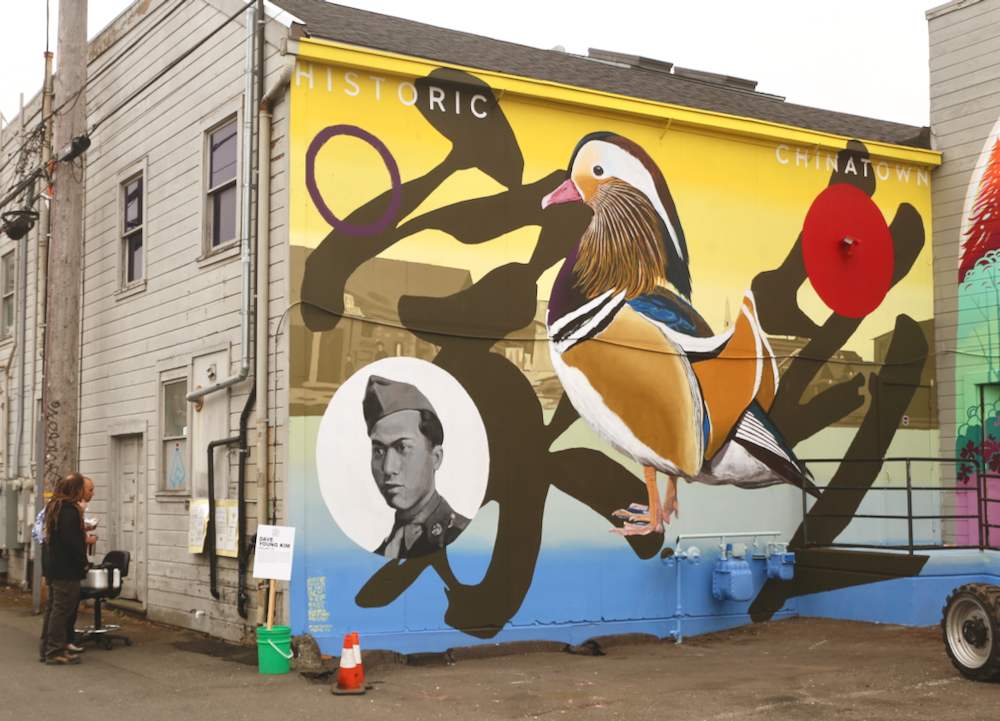
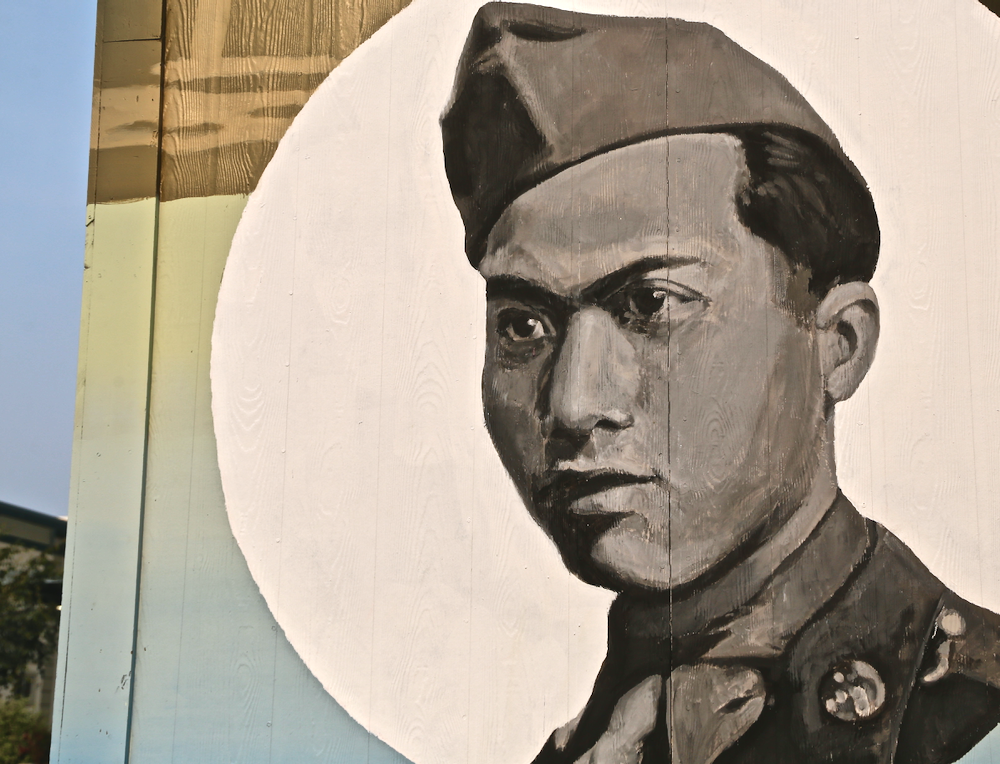
The Eureka Chinatown Project is an attempt to highlight a historic local injustice: the expulsion of Chinese people from Humboldt back in 1885. With that aim in mind, artist Dave Kim was commissioned to paint this piece, titled “Fowl,” which contains a portrait of Ben Chin, who was the first Chinese immigrant to move to Eureka in 1955 after it was again legal to do so.
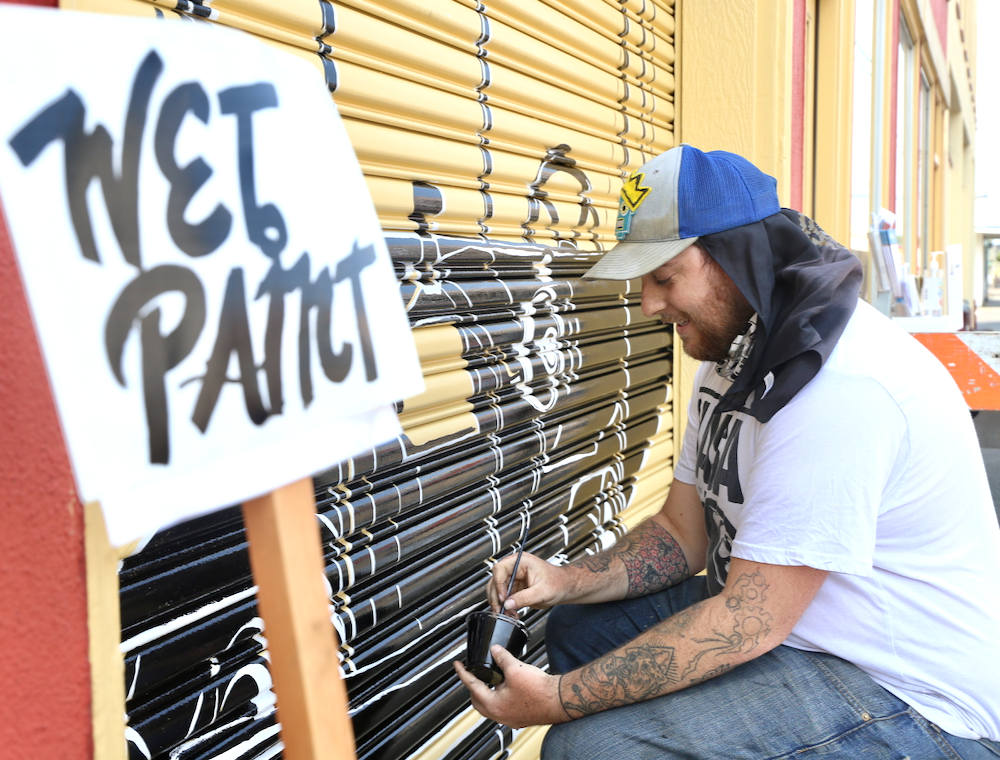
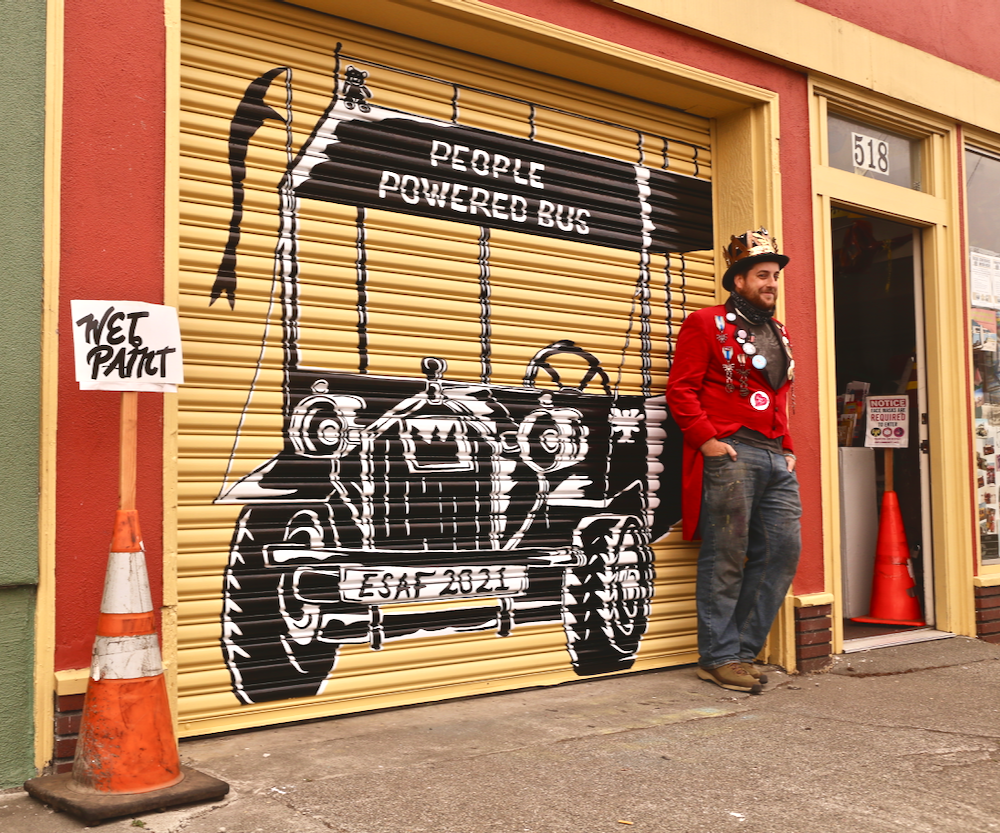
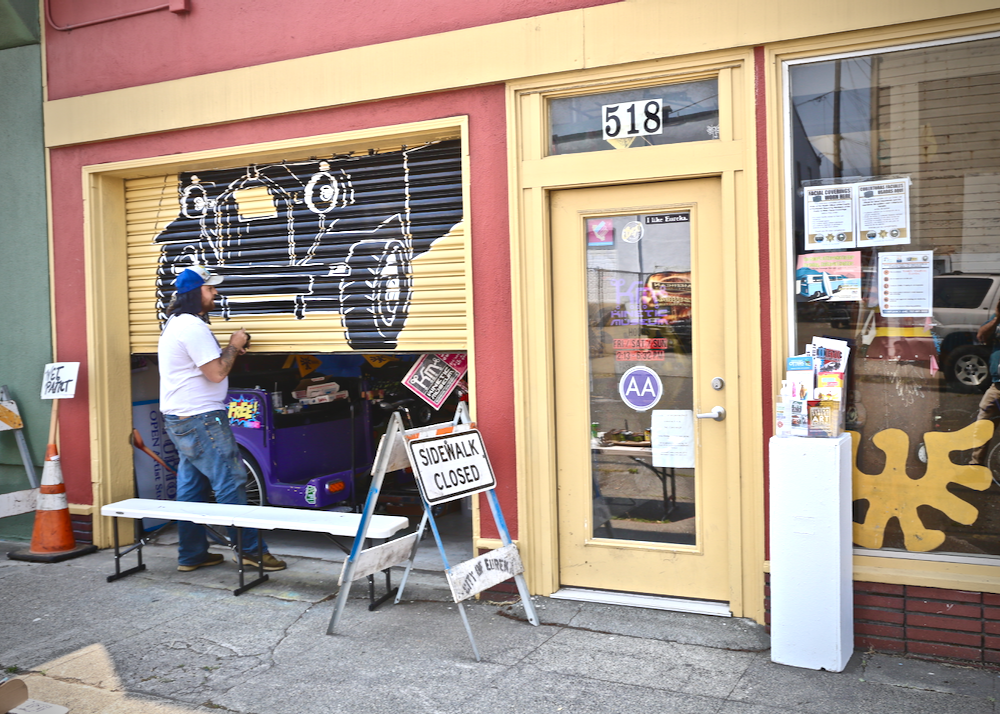
Longtime fans of the Kinetic Sculpture Race will recognize the contraption depicted in Robert “Robot” Adams’ piece on the difficult-to-paint-on corrugated metal door at the Kinetic Museum. That’s glorious kinetic founder Hobart Brown’s People Powered Bus, of course. For the glory.
###
-LUCAS THORNTON and BLAKE REAGAN-
Eureka
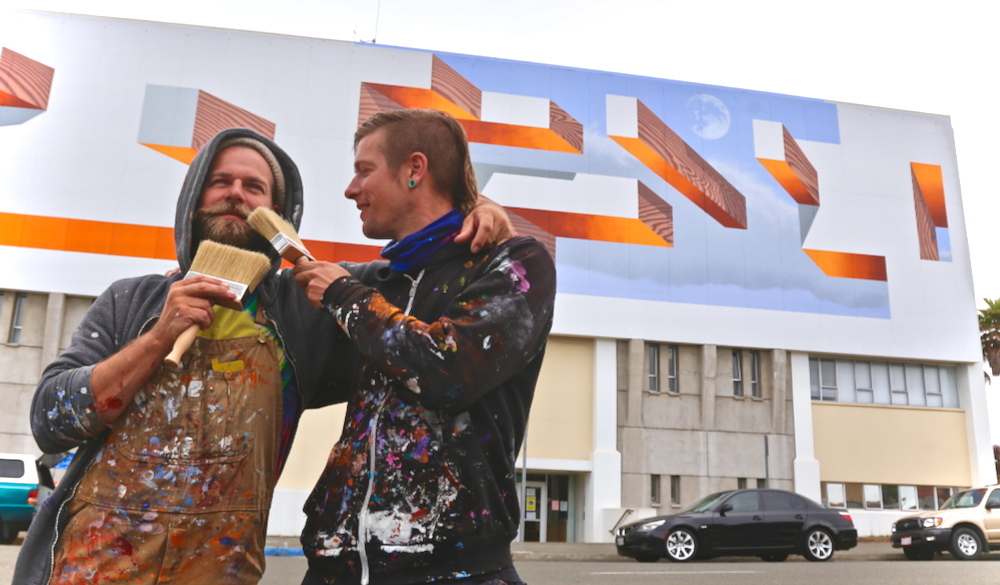
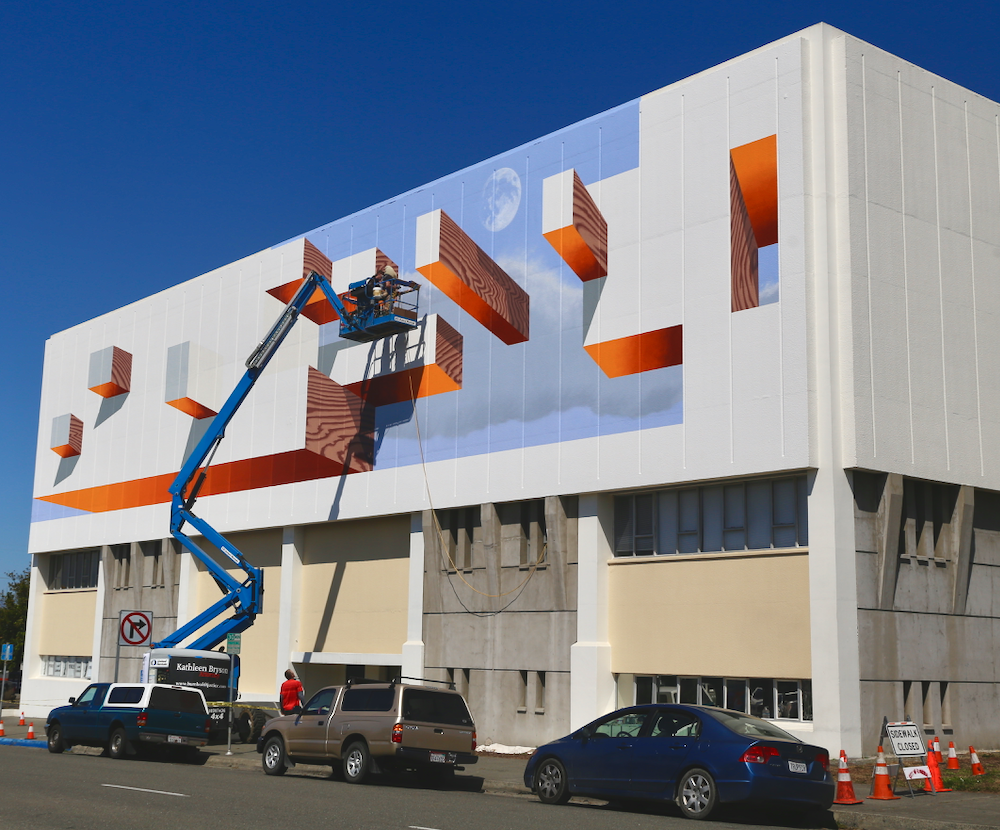
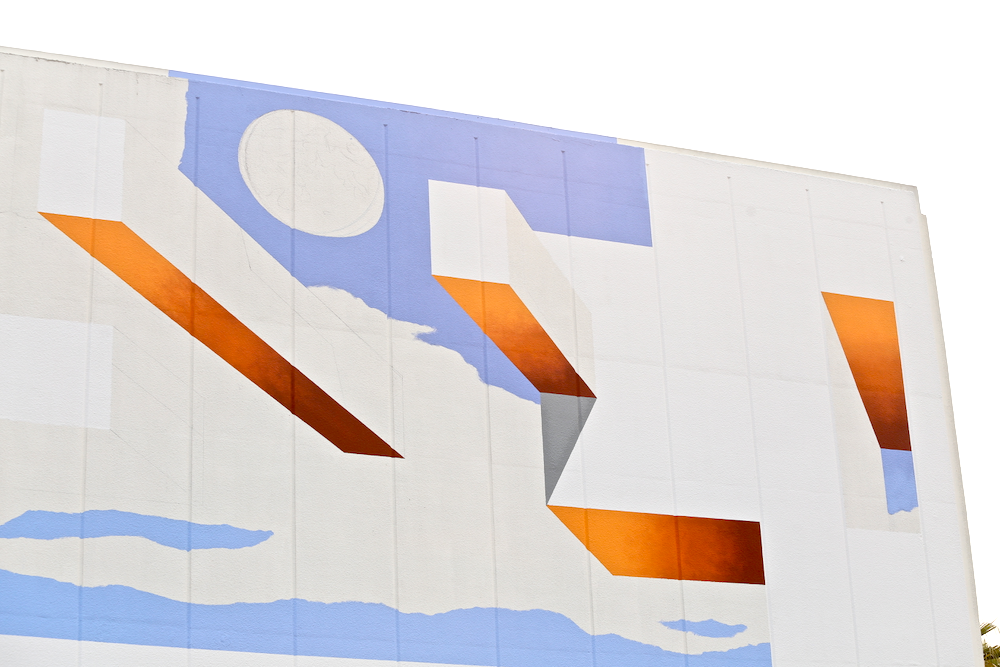
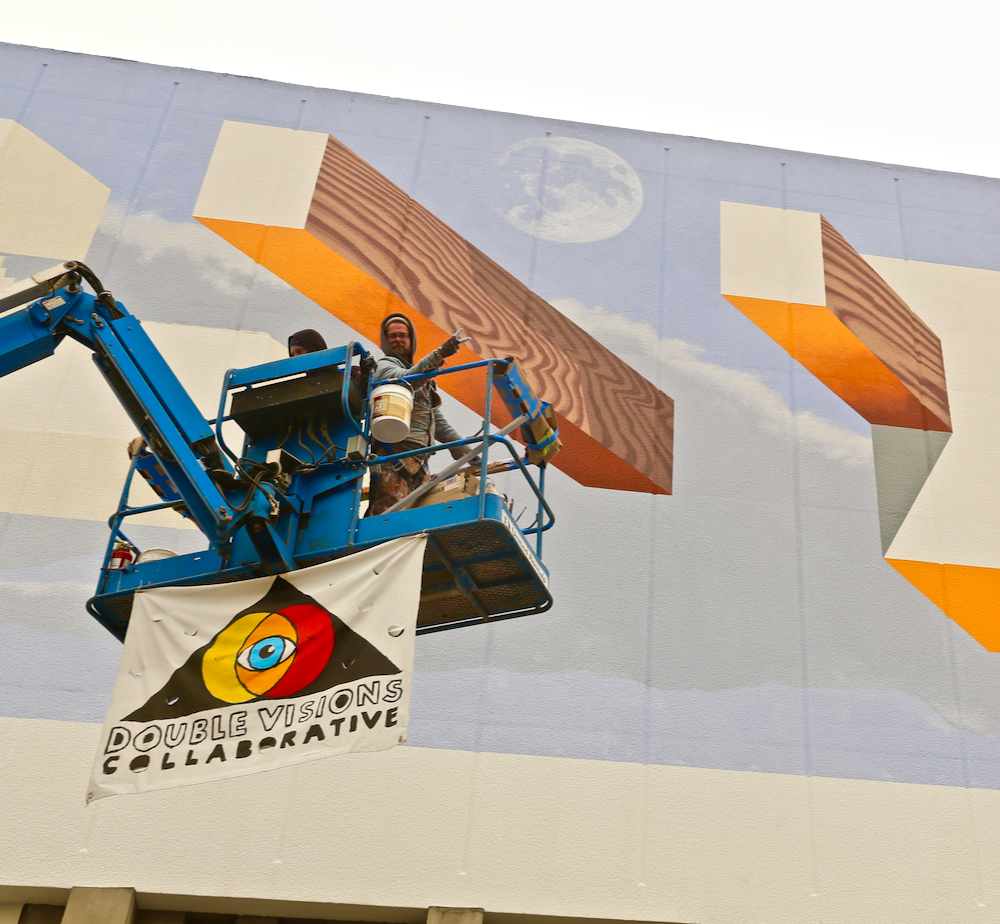
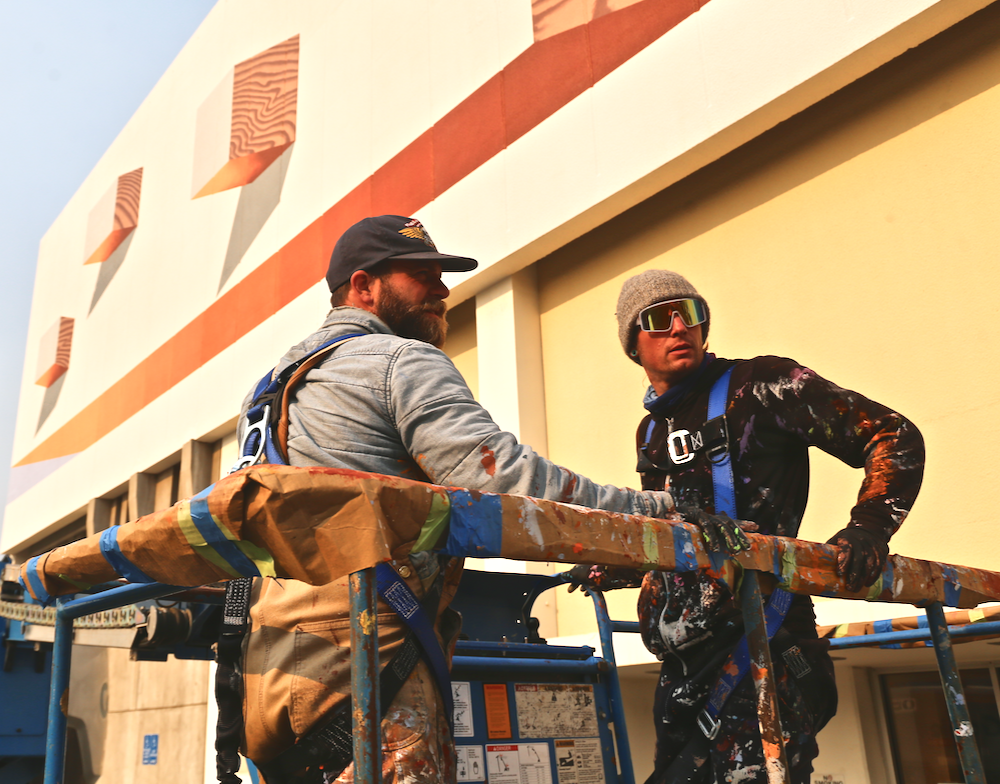
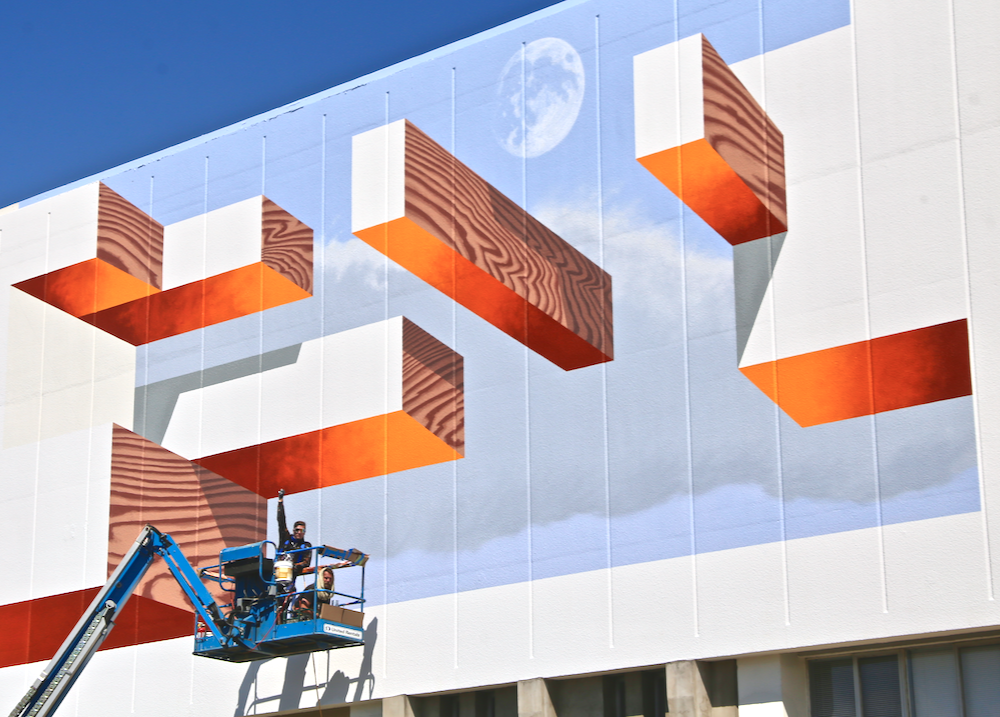
While it may not be another mural depicting redwood trees — a fact that seemed to confuse a few bored online critics — it is the largest mural in the history of the Eureka Street Art Festival. “We Built This City” by Lucas Thornton and Blake Reagan measures 30 feet by 127 feet and now adorns the gargantuan wall on the I Street-facing side of the Humboldt County Courthouse. Deal with it.
(Note: An eleventh mural by Diana Lynn and Calder Johnson that is slated to be affixed to the side of the North Coast Repertory Theatre is being produced offsite. LoCO will photograph it and add it here whenever we finally encounter it.)
The Intergovernmental Panel on
Climate Change’s most
recent report
is clear: the climate crisis is here and humans are causing it. Gang
Green break down the major conclusions of the report and have a mild
on-air existential crisis. The threat of climate change is immense
and our collective response has been flaccid. Can we change the
trajectory in time to avoid run-away warming? And how can Humboldt
respond as a county?
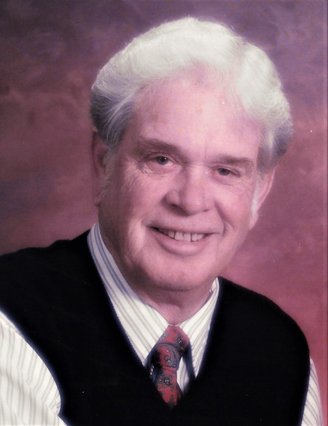
Bennie N. Gill was born in
Hollister, Oklahoma on May 10, 1928. He passed away Aug 11, 2021, holding the hand of his
wife of 71 years.
He
was the second of eight children born to Bennie Gill Sr. And Alyce
Pemberton Gill. In the spring of 1930, the family moved to Bethany, Oklahoma. His father worked long hours in the oil fields, and his mother
ran a small store out of the front of their house. In November of
that year, a powerful tornado decimated the small town of Bethany,
including the Gills’ home. His mother, older brother Johnny Glen
(4), Bennie Jr. (2 1/2), and Bobby Wayne (4 weeks) were carried away by
the tornado. All were seriously hurt, all survived, except for Bobby
Wayne.
Bennie
and his now six
siblings attended grade school in Oklahoma. In 1942, when Bennie was 14,
the family moved to California to escape the storms, and for more
opportunities for work. Bennie gave his entire savings of $125 to his
father to help with the move. He had earned the money shining shoes.
The
family of nine packed
into a 1932 Ford delivery van, with a total of $600, and made their
way to El Centro, Calif.
Bennie Jr., his brother John, and his father briefly worked at a
carrot packing house. Bennie’s job was gluing the labels on the
boxes. Ben Sr got a job in the oil fields and the family moved to
Avenel, Calif.
Bennie Jr., attended Avenel High School. He followed in his father’s
footsteps and worked in the oil fields before moving to northern
California.
Bennie
worked for Hunter and Foland at the whaling station in Fields
Landing. He was the head flenser at just 10 years old. While working at
the whaling station, he lived in a boarding house in Fields Landing.
Around
this same time, he met the love of his life, Vivian Harper, at a
dance. They married in 1950, and just celebrated 71 years together in
July. The newly married couple purchased a small cabin on a bit of
land in the Ridgewood area. Ben, with the help of family and friends
moved and enlarged the original cabin to accommodate his growing
family.
In
1964 the family moved to Goleta, Calif. where Ben managed the Santa
Barbara Fisheries. He loved everything fishing, so in 1969, he and
his sons built a fishing boat. He named it the Kay-Lynn after his
daughters.
The
summer of 1970 the Gill’s returned to Eureka to the home he built
and where he lived until his passing.
Ben
was a salmon and crab fisherman out of Humboldt Bay. He later worked
for the Hunter family on a drag boat.
In
the early 1970’s, Ben and Vivian purchased and opened the Fields
Landing Market. Vivian ran the store, and later they opened the first
“restaurant” venture. Gill’s Grill, a walk-up hamburger stand
located beside the market.
In
1979, the Gills purchased Herman’s Club. It was a beer bar in
Fields Landing (that original old boarding house). It was in rough
shape, but Ben was a visionary even when the rest of us just shook
our heads in disbelief. He turned that 100-year-old run-down building
into “a fancy dinner house.” Ben was always grateful to the many
craftsmen that he called friends, that helped make the Whaler’s Inn
exactly what he dreamed it could be. The names of those dear friends
are burned into the large beams in the dining room of what was once
the Whaler’s Inn. He was so proud of that place, as we all were. He
could see potential in that dark old building that the rest of us did
not.
In
1990, Ben’s oldest son Curtis was driving around looking for a place
to eat his sack lunch when he drove into King Salmon. He arrived at
in the gravel lot of what had been Pat’s Place and The Capt’n’s Pier.
Now it looked abandoned. It had been flooded, and most of the windows
were broken out. It was in sorry shape, but what a location! He
showed it to his dad, and the rest is history. He renovated the café,
adding the amazing gardens full of roses and godetias, which were his
favorites, and are still a hallmark of Gill’s by the Bay.
Bennie
was a simple genius. The only work he knew was hard work. He was
patriotic and strong beyond his years (He hung sheetrock into his
80’s!). He knew how to do most anything. He taught us all so much.
Starting as a poor farmer’s kid in Oklahoma, to a fisherman,
carpenter, business owner, husband, father, grandfather, great-grandfather, brother and uncle. Thanks, Dad.
Bennie
is predeceased by: his parents; brothers Bobby Wayne Gill, and Johnny
Glen (Rose) Gill; sisters Ruth Massey, Phyllis (Wayne) Thompson,
Joanne Massey; brothers-in-law Marvin Harper and Ernie Rippetoe; in
addition to many great friends.
He
is survived by his wife Vivian Gill. Sisters June Ann Rippetoe, and
Joy Beth (Johnny) Haro. Children: Curt (Anne) Gill, Kevin (Linda)
Gill, Denise Gill, Lynnette (Mike) Freitas. Grandchildren: Travis
Gill, Kristen Gill, Amy (Garth) Gunderson, Benjamin Gill, Brad Gill,
Tyler (Karissa) Goldsam, Emilie Goldsam, Brent (Crystal) Freitas,
Wesley Freitas. Great-grandchildren: Makenna Gunderson, Garren
Gunderson, Hadley Gunderson, and Wyett Freitas. He loved and was
loved by his numerous nieces and nephews. He was especially close to
his nephew Matt Thompson.
A
private family service will be held August 25. A celebration of life
will be held in the near future.
###
The obituary above was submitted on behalf of Bennie Gill’s loved ones. The Lost Coast Outpost runs obituaries of Humboldt County residents at no charge. See guidelines here.
Wesley Alan Anderson,
born Oct. 15, 1940 in Fortuna, left us on
July 23, 2021. Wes passed peacefully at home on the ranch
he dearly loved.
A graduate of Fortuna
High School, Wes went on
to earn a Bachelor of Science in Animal Husbandry
from Cal Poly in San Luis
Obispo. While at Cal Poly
he met and later married
Suzan Bradsberry, his wife
of 58 years.
Just out of college, Wes
took a position managing
the Lebec Oaks Ranch
which was situated right on
the top of Tejon Pass. The
ranch was known for its
Suffolk
range rams and
registered quarter horses.
Wes loved the wide open
spaces and mountain trails,
Sue hated the isolation. After a period of time Wes
applied for a job with the
Department of Agriculture,
writing agricultural and
HUD loans in the central
valley. Wes managed offices in Visalia, Oroville, and
Hughson for 12 years.
He started the local 4-H
Chapter in Hughson, California, was leader of the local horse project and convinced friends to lead other
projects. While in Hughson
he built a six horse trailer
just so he could take his 4H kids packing in the
Sierras. One day while
home for lunch in Hughson
Wes received a letter from
his folks saying they were
retiring and were going to
sell the ranch. Wes told Sue
he really wanted to go
home and run the ranch, so
after a lot of soul searching
(and a few tears) theypacked up their two kids
(Chris and Brad), two horses, a mule and a pony and
a small herd of registered
Shorthorns. After all, Sue
felt she owed Wes for giving up his mountain wilderness job when they were
first married. Once home in
Loleta, again Wes established a 4-H chapter, where he
led the horse, dairy, and
beef projects for 14 years.
He even convinced Grandpa to lead a woodworking
project for a few years. Initially, Wes ran the family
dairy for 12 years, but in
1987 the Milk Market crashed and Wes “put pen to paper” and said they should
avail themselves of the government buyout program.
Before they sold out, Wes
had a plan and he talked to
the IRS and then wrote up
an escrow contract between the Humboldt Auction and the family for a
like exchange, dairy cattle
for beef cattle. Lee Mora
liked the idea so well that
he asked Wes if he could
share the document with
other folks. A generous
man by nature, Wes was
happy to oblige. Wes had
gotten a lot of practice writing procedures for the government.
After the dairy cows were
sold in 1989, Wes managed
his cow/calf operation and
worked with Dick Hackett
to get his real estate appraiser’s license. He started
out doing both home and
ranch appraisals, but eventually specialized in just
ranch appraising; retiring
from appraising in 2017
and ranching in 2019.
While ranching and appraising Wes was a director
for both the Cattleman’s Association and the North
Coast Land Trust. Wes was
always a fierce advocate for
preserving agricultural land.
Wes loved hunting, fishing and horse packing both
in the Sierras and locally in
the Trinity Alps and in the
Yolla Bollys. He also participated in 4 Levies Ride &
Ties. (2 runners, 1 horse, 50
miles), once with his wife
Sue, once with Helen Etter,
once with his son Brad,
and once with his daughter
Chris. His brother Rod
thought Wes was a bit crazy to rely on a horse for 50
miles; Rod’s motto is “never
trust anything that doesn’t
have a steering wheel and
brakes. Funny, how he
showed up to “Pit Crew”
and Cheer.
Wes is survived by his
wife Sue, his daughter
Chris, and his son Brad and
wife Sherry. He is also survived by his brothers Rod
and Larry Anderson. He
was preceded in death by
his father Charles “Pat”, his
mother Francise and his sister Carol.
As a husband, father and
friend Wes was as solid as
a rock, calm and cool under any circumstance; a
presence that will be dearly
missed.
A celebration of life will
be announced at a later
date.
###
The obituary above was submitted on behalf of Wesley Anderson’s loved ones. The Lost Coast Outpost runs obituaries of Humboldt County residents at no charge. See guidelines here.
Press release from the District Attorney’s Office:
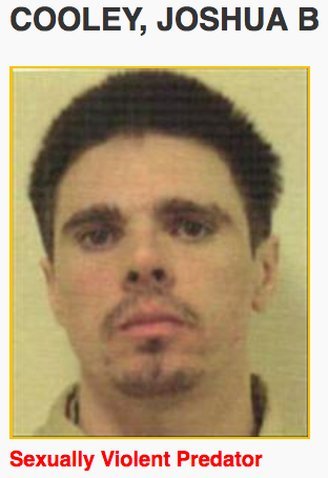
On August 13th, Judge John Feeney issued a ruling striking his December 2016 order for conditional release of Joshua Cooley from the State Hospital in Coalinga, a locked psychiatric facility for sexual offenders. Cooley has been housed at Coalinga since 2010, after a Humboldt County jury found him to be a “Sexually Violent Predator”.
Image from the California Megan’s Law website.
Feeney’s December 2016 order for Cooley’s release and the proposal of several specific placement sites that followed – including several in Humboldt County – received substantial opposition. District Attorney (DA) Maggie Fleming opposed the original order because the majority of psychological experts who had evaluated Cooley did not conclude that he could be safely returned to public life. As the State proposed specific placement sites, the Humboldt County District Attorney’s Office, along with other District Attorneys, individual citizens, community service providers, and law enforcement, presented reasons why Cooley’s release at those locations would not be reasonable. In the effort to place Cooley, the State made over 7 specific proposals for placement and considered more than 7000 potential sites.
Judge Feeney’s recent ruling relied not only on the inability to place Cooley, but also on his recent behavior at the State Hospital, which included refusal to participate in treatment programs. The ruling means that Cooley will remain confined at Coalinga unless a judge concludes that he could be safely returned to public life. Cooley’s potential for release will continue to receive annual evaluation.
DA Fleming stated:
“Achieving the right outcome in this case depended on citizens
making the effort to get involved, along with exceptional effort by
Assistant District Attorney Stacey Eads to clearly and
comprehensively present the People’s position in many written
communications. I appreciate the efforts of everyone who provided
Judge Feeney with the information he needed to fairly evaluate
Cooley’s current condition and potential for release, and to make
the appropriate decision.”



 -ALME ALLEN-