

OBITUARY: Lillian Clarke Hagele, 1922-2021
LoCO Staff / Monday, Nov. 8, 2021 @ 6:56 a.m. / Obits
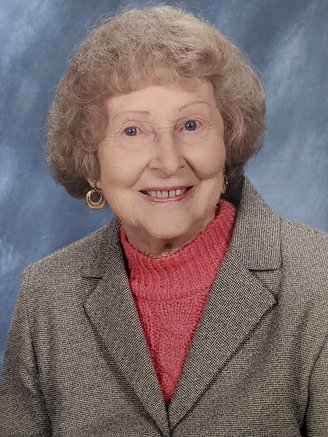
Lillian
Clarke Hagele
April
10, 1922 — October 22, 2021
Lillian Clarke Hagele passed away peacefully in her sleep October 22, 2021 at her home in Fortuna. She was born April 10, 1922 in Philadelphia, Penn. Lillian was preceded in death by her husband Raymond Hagele. At the time of Ray’s passing they were married 55 years.
Before she retired Lillian was an executive secretary for a manufacturing company in Pomona, Calif. After Lillian and Ray retired they first moved to Shelter Cove and then later made their home in Fortuna.
Lillian loved people, children, babies and animals. She was beautiful inside and out. She was loved by many people. She will truly be missed. She will forever be in our hearts.
Lillian is survived by her son, Scott Hagele and his wife, Sharon of Beaverton, Oregon; daughter, Sheri Christensen and her husband, Chris, of Fortuna; son Lance Hagele and his wife, Luana of Silverdale, Wash.; four grandchildren, Denae Lopez and her husband, Daniel, of McKinleyville; Jena Holmgren and her husband, Bret of Hydesville; Scott Christensen of Fortuna; and Raymond Hagele of Silverdale, Wash. Other family members include Carol Eshelman, three great-grandchildren, and numerous other nieces and nephews. Thank you to her many caregivers: Sue, Connie, Bonnie, Hope, Dona, Adalina, and Hope. Thanks also to Dr. Ruben Brinckhaus and Fannette Downey-Allman for their care and kindness.
Services will be held November 15, 2021 at Christ Lutheran Church in Fortuna at 2 p.m. Rev. Paul Demant will be officiating. Interment following at Sunrise Cemetery, Fortuna. In lieu of flowers, donations may be made to a charity of your choice. Arrangements were under the direction of Goble’s Chapel, Fortuna.
###
The obituary above was submitted on behalf of Lillian Hagele’s loved ones. The Lost Coast Outpost runs obituaries of Humboldt County residents at no charge. See guidelines here.
BOOKED
Yesterday: 12 felonies, 16 misdemeanors, 0 infractions
JUDGED
Humboldt County Superior Court Calendar: Today
CHP REPORTS
Us101 / Sr162 (HM office): Live or Dead Animal
ELSEWHERE
100% Humboldt, with Scott Hammond: #129. You Don’t Have to Be Wealthy to Give Back | Sara Dronkers
RHBB: Trinity County Marks 25th Anniversary of September 11 with First Responder Commemoration Ceremony
RHBB: CDPH Issues Immunization Recommendations for 2026-27 Respiratory Virus Season
RHBB: Redway Transfer Station to Close an Extra Day for Construction
Trinity County Forecast for ‘Significant’ Snow Dump That May Impact High-Elevation Areas of Highway 299; Strong Winds, Rain Expected Along the North Coast
John Ross Ferrara / Sunday, Nov. 7, 2021 @ 9:25 a.m. / How ‘Bout That Weather
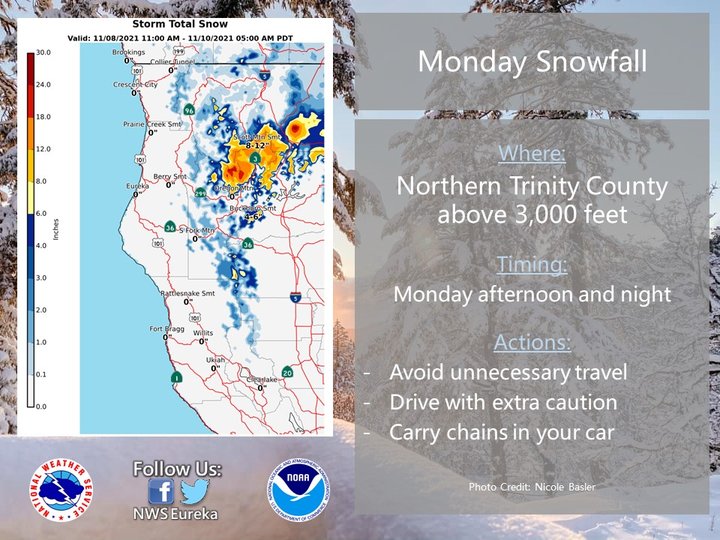
Graphics provided by the NWS.
###
LoCO ASMR:
trinity county forecast for significant snow dump
###
A major snowstorm is forecast to dump 8 to 12 inches of snow on the Trinity Alps Monday, which may also bring snow to higher elevation areas along Highway 299.
“Significant snow accumulation is expected late Monday for elevations above 3,000 feet in Northern Trinity County,” Eureka’s National Weather Service office stated. “A winter storm watch has been issued for some high-elevation passes. Use extra caution when traveling!”
About an inch of snow may also accumulate on roadways at elevations around 2,500 feet. Highway 299 is expected to most impacted by snow at Buckhorn Summit in Shasta County, where 4 to 6 inches of snow will be possible.
“If you must travel, keep an extra flashlight, food and water in your vehicle in case of an emergency,” the NWS stated. “Prepare for possible power outages.”
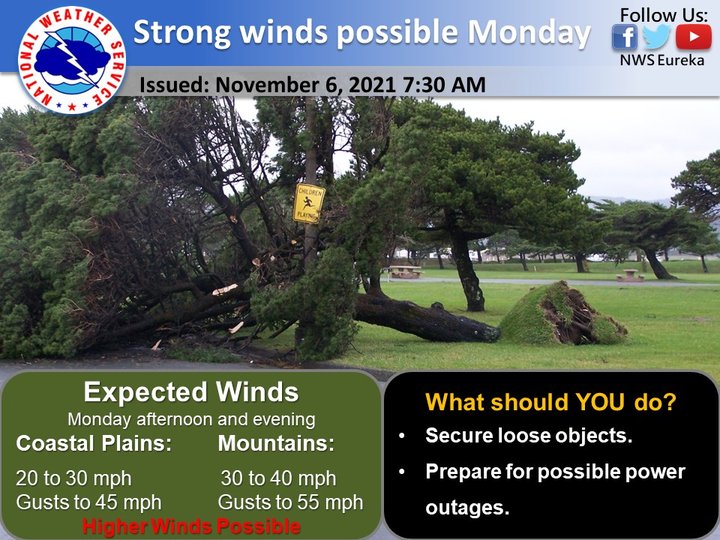
Strong winds and rain are forecast for the North Coast Monday. Coastal areas may see gusts up to 45 mph. Mountain areas will likely receive stronger gusts between 55 and 70 mph.
“A cold front will approach on Monday, with rain and snow expected to start Monday evening,” the NWS stated. “Preceding the rain, southerly winds will increase through the day Monday, peaking in the evening or overnight.”
The strong winds are expected to subside by Tuesday morning.
“Power outages are possible,” the NWS stated. “People are urged to secure loose object that may be blown away by the wind.”
(AUDIO) HUMBOLDT HOLDING UP: North Coast News’ Nazy Javid on Making Humboldt Home, Juggling Social Media and Her Daily Decision to ‘Choose Happy’
LoCO Staff / Sunday, Nov. 7, 2021 @ 8 a.m. / Humboldt Holding Up

Nazy Javid, North Coast News anchor and news director, got married in the midst of the COVID-19 pandemic
(AUDIO) Nazy Javid is Holding Up
Over the past few years, whenever there’s been a fire, a shooting, or a major car crash in the greater Eureka area, there’s a good chance you’d find Nazy Javid on the scene doing what she can to let her community know what’s up. Through a combination of hustle and charm, Javid has built herself a loyal audience since joining North Coast News in 2016, both on television and on Facebook.

On this week’s edition of Humboldt Holding Up — the Outpost‘s minimal-hustle, no-charm podcast — we Zoom it up with Nazy to find out what motivates her and her North Coast News team. “I think our mission is to be an advocate for our viewers, to hold public officials accountable, to hold the powerful accountable, to be a voice for folks who don’t have one,” says Javid.
Other topics on this week’s podcast include:
- How it came to be that she bucked the trend of TV news people using Humboldt as a stepping stone and made a home here
- The outpouring of support she received from Humboldt after her family fled here following 2018’s Camp Fire
- Lessons from her father, who himself fled revolution-era Iran and ended up opening a pizza restaurant in California
- Juggling her social media and news director duties while attempting to ignore non-constructive criticism online
- How faith, recovery and family inspired her to “Choose Happy” (which happens to be the name of her own fledgling podcast)
Click the audio player above (or subscribe on Apple Podcasts here) to listen to Nazy’s chat with the Outpost‘s Stephanie McGeary and Andrew Goff and/or scroll through past Humboldt Holding Up guests below.
PREVIOUS HUMBOLDT HOLDING UP GUESTS:
- #73 Pumpkin Carver Mike Craghead
- #72 Eureka Police Department Sergeant Leonard LaFrance
- #71 Eureka Artist Duane Flatmo
- #70 Arcata City Councilmember Sarah Schaefer
- #69 Humboldt Hot Air Director Neroli Devaney
- #68 St. Joes’ James Ladika and Austin Allison
- #67 Eureka Artist Richard Evans
- #66 NCRT’s Calder Johnson
- #65 TV Newsman Dave Silverbrand
- #63 Housing Policy Specialist Brian Heaton
- #62 Muralists Blake Reagan and Lucas Thornton
- #61 Arcata City Councilmember Emily Goldstein
- #60 Kayak Guide Eric Stockwell
- #59 Eureka City Councilmember Natalie Arroyo
- #58 Wiyot Cultural Center Manager Marnie Atkins
- #57 Humboldt County Growers’ Alliance’s Natalynne DeLapp
- #56 RREDC Executive Director Gregg Foster
- #55 Dell’Arte’s Michael Fields
- #54 Llama Wrangler Keagan Trischum
- #53 Crabs President David Sharp
- #52 Ferndale Organic Dairy Farmers Kristina Radelfinger and Dorice Miranda
- #51 Former Arcata Mayor Alex Stillman
- #50 Cooperation Humboldt’s David Cobb
- #49 Ink People Center for the Arts’ Libby Maynard
- #48 Humboldt Bay Social Co-Owner Amy Cirincione O’Connor
- #47 Musician Lyndsey Battle
- #46 Mad River Brewing CEO Linda Cooley
- #45 LoCO Editor Hank Sims
- #44 Humboldt Republic’s Jason Brandi
- #43 Table Bluff Farmer Hannah Eisloeffel
- #42 Logger Bar Owner Kate Martin
- #41 Teacher/Rapper Zach “Zigzilla” Lehner
- #40 Madaket Captain “Zippo” Libby Tonning
- #39 Event Planner Alegria Sita
- #38 Food For People’s Anne Holcomb
- #37 AHHA President Nezzie Wade
- #36 Performance Artist Noël August/Tucker Noir
- #35 Eureka Mayor Susan Seaman
- #34 Eagle House Owner Jennifer Metz
- #33 Absynth Quartet Drummer Mike “Tofu” Schwartz
- #32 HACHR Executive Director Lasara Firefox Allen
- #31 Alchemy Distiller Owner Amy Bohner
- #30 Eureka City Councilmember Kati Moulton
- #29 Eureka City Councilmember Scott Bauer
- #28 Ungraceful Ager Barry Evans
- #27 Arcata City Councilmember Sofia Pereira
- #26 HumBrews Music Booker Laurel Weston
- #25 Eureka City Councilmember Kim Bergel
- #24 Film Commission’s Cassandra Hesseltine and Nate Adams
- #23 Marble Maker Topher Reynolds
- #22 Arcata Playhouse Director Jacqueline Dandeneau
- #21 Humboldt Political Junkie Eric Kirk
- #20 Rio Dell Mayor Debra Garnes
- #19 Second District Supervisor Estelle Fennell
- #18 Arcata Food Aficionado Jada Calypso Brotman
- #17 Body Piercer Jackie Silva
- #16 Dick Taylor Chocolate’s Adam Dick
- #15 FUHS Teachers Mark Thom and Inma Thompson
- #14 Eureka City Manager Miles Slattery
- #13 Savage Henry Co-Founder Chris Durant
- #12 Eureka Street Art Festival Organizer Jenna Catsos
- #11 SCRAP Humboldt Founder Tibora Bea
- #10 Gym Owner Tyler Parr
- #9 Six Rivers Brewery Co-Owner Meredith Maier
- #8 Multicultural Skincare Therapist Levia Love
- #7 Annie’s Cambodian Server and Social Worker Joshua Coppock
- #6 Eureka City Councilmember Austin Allison
- #5 HSU Professor Deidre Pike
- #4 Pastor Bethany Cseh
- #3 Singer/Songwriter Chris Parreira
- #2 Eureka City Councilmember Leslie Castellano
- #1 Arcata City Councilmember Paul Pitino
GROWING OLD UNGRACEFULLY: Them Bones, Them Bones, Them Dry Bones
Barry Evans / Sunday, Nov. 7, 2021 @ 7 a.m. / Growing Old Ungracefully
Melior est die mortis die nativitatis (Better is the day of death than the day of birth)
– Ecclesiastes, inscribed on the roof of Évora’s Chapel of Bones.
###
What to do with the human body after it’s stopped functioning, i.e. dead? Our ancestors sure had plenty of imaginative options, from Viking internments with full fighting kit to Egyptian granite coffins entombed in huge pyramids to simply dropping cadavers off the side of a ship for a “burial” at sea. Mostly, of course, bodies were simply buried in the ground where they were left to rot until only the bones were left.
This happens surprisingly fast in moist climates — Hamlet’s poor Yorick (“I knew him well”) could only have been “six feet under” for a few years before being disinterred by the gravedigger. In the play, Hamlet holds a nice, clean skull in his hands while he muses on his late pal, “a fellow of infinite jest.”
In arid climates where flesh doesn’t readily disintegrate (mummified Egyptians are recognizable thousands of years after death) societies have taken a more pragmatic approach. In traditional Zoroastrianism, for instance, human cadavers were considered unclean (nasu), an early public health recognition that decaying corpses were a source of disease. The Zoroastrians’ ingenious solution was to place a newly-dead body at the top of a “tower of silence” (dakhma ) where, exposed to the sun, it provided protein to hungry vultures. The birds could do in a few weeks what would have taken hundreds of years in a desert grave.
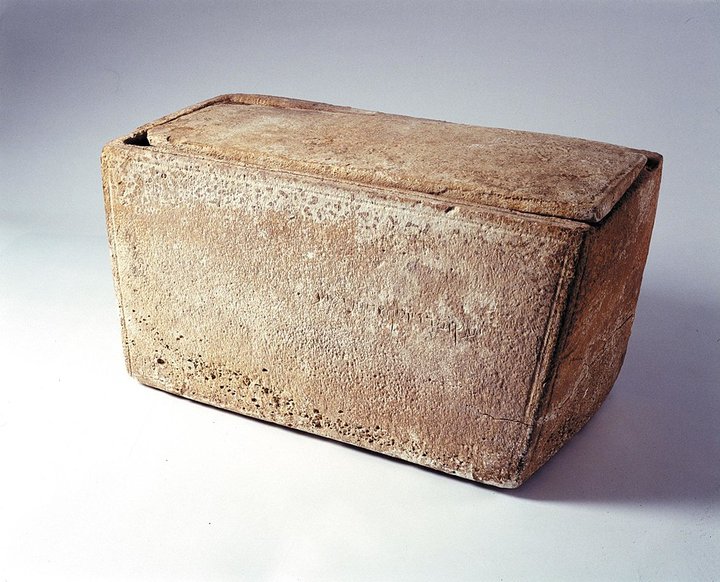
Purported 1st century ossuary inscribed (in Aramaic) “James, son of Joseph, brother of Jesus.” Originally accepted as authentic, it’s since been declared a modern forgery.
The James ossuary was on display at the Royal Ontario Museum from November 15, 2002 to January 5, 2003. Photo: Paradiso, via Wikimedia.
Ossuaries, or bone-chambers, are another creative approach. Their size varies enormously, from small stone “boxes” containing the bones of a single individual, to entire churches. You can find larger ossuaries in most Roman Catholic countries. This one, the Capela dos Ossos (Chapel of the Bones), is part of San Francisco church in Évora, Portugal.

Évora’s Capela dos Ossos, 60 feet long and 40 feet wide, is lined with the remains of thousands of individuals who died over half a millennium ago. Photo: Barry Evans.
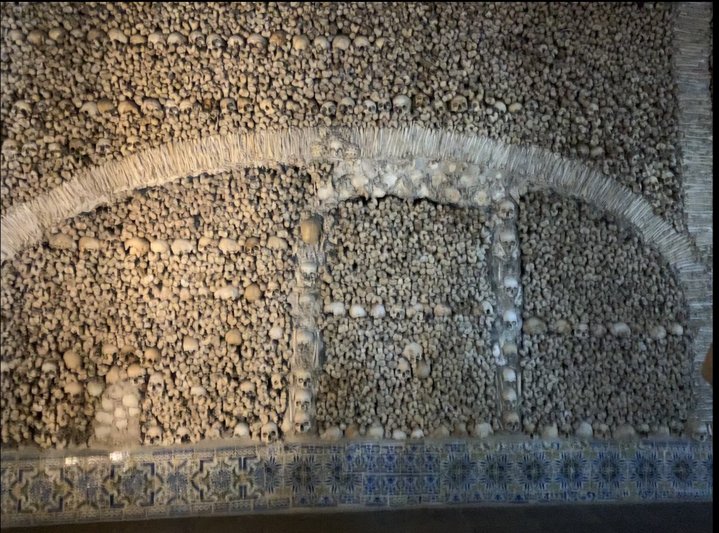
One of six “panels” of bones and skulls. Photo: Barry Evans.
Five hundred years ago, 42 monasteries in the city were each surrounded by the graves of monks and laypeople. At the time, Évora was an up-and-coming center of commerce and culture, and those cemeteries were taking up valuable real estate in that small, dense city whose boundaries were tightly circumscribed by mediæval walls. The Franciscans’ solution was to exhume the skeletons and line a purpose-built chapel with the remains of some 5,000 individuals, where they are now a somewhat ghoulish source of revenue: tourists pay about $6 apiece (half-price for 65+) to view, well, bones. Row upon row of them, floor to ceiling. Over the entrance to the chapel is a salutary inscription: Nos ossos que aqui estamos peos vossos esperamos, We bones that are here await yours.
Carpe diem!
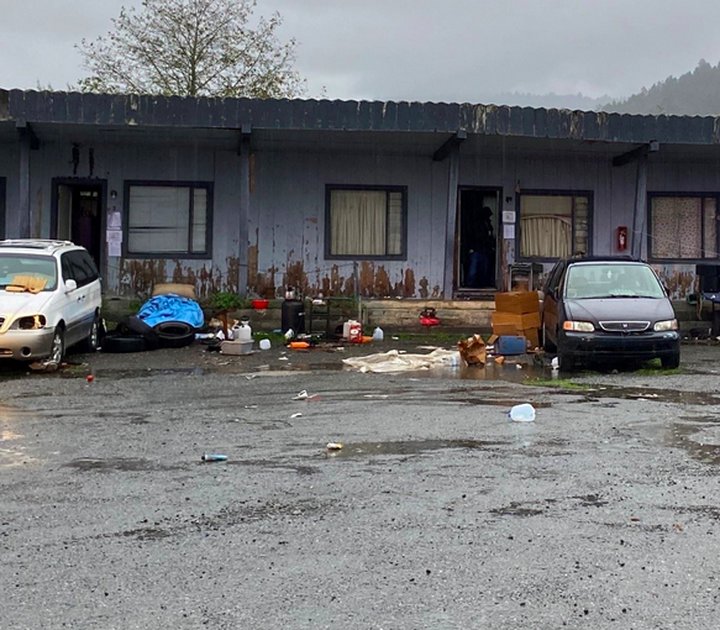
County Deems Orick Motel Uninhabitable; Evicts Tenants, Boards Up Windows to Prevent Entry
LoCO Staff / Saturday, Nov. 6, 2021 @ 1:05 p.m. / News
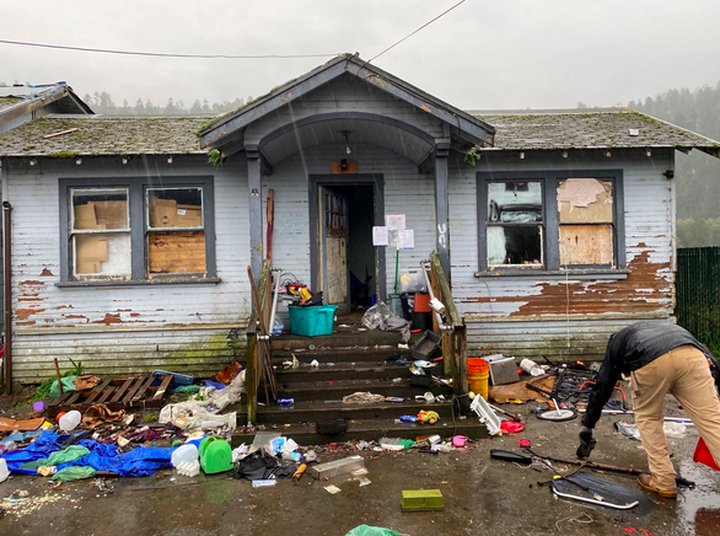
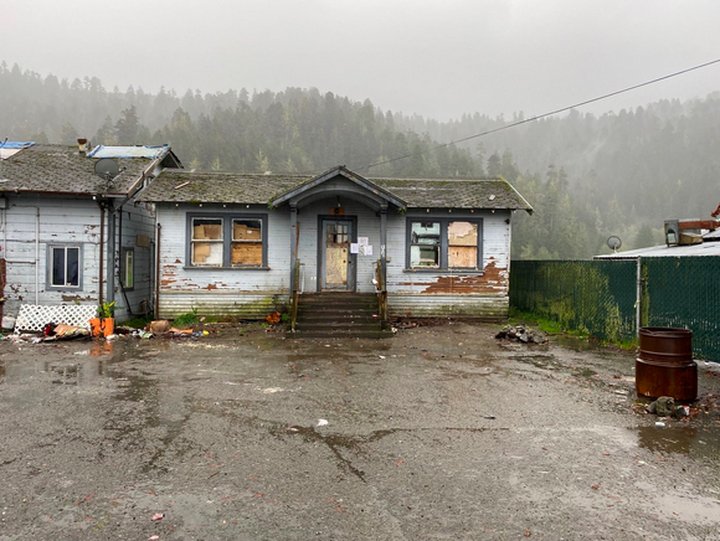
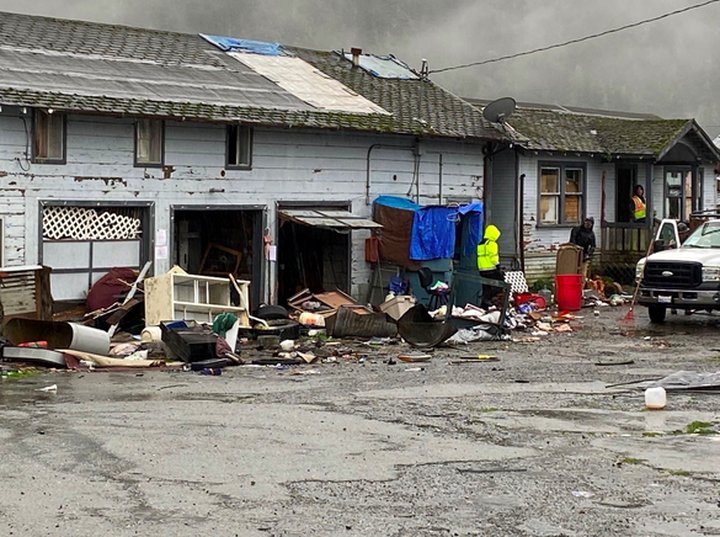
The now vacant and boarded up Green Valley Motel in Orick | Photos provided by the County of Humboldt
###
Press release from the County of Humboldt:
On Nov. 5, at about 8 a.m., an inspection and abatement warrant was served at the Green Valley Motel on State Highway 101 in Orick. The occupants were vacated and the motel was boarded up to prevent entry. The warrant was in response to a Notice and Order of Substandard Housing and Order to Vacate that was issued on Sept. 27, due to conditions at the motel that posed a significant hazard to the occupants and surrounding community.
An inspection on Sept. 15 by the County of Humboldt’s Code Enforcement Unit, Building Inspection and Department of Health and Human Services documented numerous violations of Humboldt County Code, California Building Code, Health and Safety Code and the International Property Maintenance Code. The violations included inadequate sanitation, structural and fire hazards, faulty weather protection, hazardous electrical work and mechanical equipment, inadequate heat supply, solid waste accumulation, infestations of rats, cockroaches and bedbugs.
The order to vacate gave the motel occupants 30 business days to leave the premises. During the 30-day period, the county worked with other organizations and local housing providers to relocate the most at-risk individuals and provided tenant relocation assistance to the occupants of the motel. The property owner will be responsible for all relocation expenses, staff time, contractors and materials. The costs will be recovered by all legal means available, including liens and tax assessments.
FALL BACK: Like it or Not, Daylight Saving Time Is About to End and Things Might Feel Weird Until We Adjust
Stephanie McGeary / Saturday, Nov. 6, 2021 @ 11:24 a.m. / PSA

If you still use of one of these old-school alarm clocks, you’ll need to set it back one hour on Saturday night | Image from pxhere. Creative commons license.
###
Sunday marks the end of daylight saving time — that seemingly never-ending practice of advancing our clocks one hour for roughly eight months out of the year, so that it gets dark at a later time — meaning that we shall return to standard time until the spring, when we do it all again.
Y’all know the routine at this point. Late Saturday night/ early Sunday morning (the change technically occurs at 2 a.m. because its supposed to be less disruptive, or something) we “fall back” by setting our clocks back one hour. In this modern age, many of our time telling devices — such as our cellphones and computers — will make the change automatically. But if you’re one of those old-school folks who has an analog clock or watch, you’ll bear the burden of winding back that bad boy yourself.
The practice of changing the clocks twice a year has long caused controversy. Arizona and Hawaii have famously opted to avoid the whole situation and stick to standard time throughout the year, while many states — including California — have been working to pass legislation to ditch the act of “falling back” and remain on daylight saving time year-round. Many people rejoice at the end of daylight saving time because it generally means that we get one extra hour of sleep, while others abhor the act of “falling back,” because it means that darkness falls at an even earlier clock time. Whichever camp your in, you can surely look forward to the time change prompting many opportunities for you to commiserate over or argue about the issue with your friends, family and coworkers.
At least we can probably all agree that, like it or not, the time change tends to throw our schedules off a bit until we all adjust. So lets just try not to be too cranky at each other, okay?
Sing it, Cher.
THE ECONEWS REPORT: Kelp Collapse?
The EcoNews Report / Saturday, Nov. 6, 2021 @ 10 a.m. / Environment

A bull kelp forest near Caspar in 2017. Photo: Chris Teague, via iNaturalist. Creative Commons license.
###
The destruction of the North Coast’s redwood forests is well known to EcoNews listeners, but did you know about the loss of our kelp forests?
Gang Green sits down with James Ray, a scientist with the California Department of Fish & Wildlife, who studies bull kelp populations along the North Coast. James talks about the marine heat wave in 2014 and the resulting 90% decline in bull kelp, in part due to an explosion in purple urchins, which have overgrazed some bull kelp beds into oblivion. The purple urchin used to be kept in check by sunflower sea stars, but bad news: in 2013, a wasting disease killed 90% of sunflower sea stars along the West Coast from Mexico to Alaska.
Is there any hope for our coastal kelp forests? James and his colleagues have seen some slight increases in some kelp beds, giving a glimmer of hope that this foundational species to the marine ecosystem could eventually recover even in the absence of sunflower sea stars.
AUDIO:
“The EcoNews Report,” Nov. 6, 2021
REQUIRED READING:
- New research to address kelp forest crisis in California - California Sea Grant
- Kelpwatch - an interactive kelp mapping tool that uses Landsat satellite data to display kelp canopy coverage throughout the state (2021 data coming soon)
- Kelp Forests Surge Back on Parts of the North Coast, with a Lesson About Environmental Stability - Bay Nature
- Iconic Sea Star Listed Critically Endangered After Study Finds Marine Epidemic Event Nearly Wiped Out Global Population - The Nature Conservancy
- Restoring Kelp in the Face of Climate Change - Humboldt Now


