

California Launches Ambitious Effort to Transform Medi-Cal to ‘Whole Person Care’
Kristen Hwang / Monday, Feb. 14, 2022 @ 7:29 a.m. / Sacramento
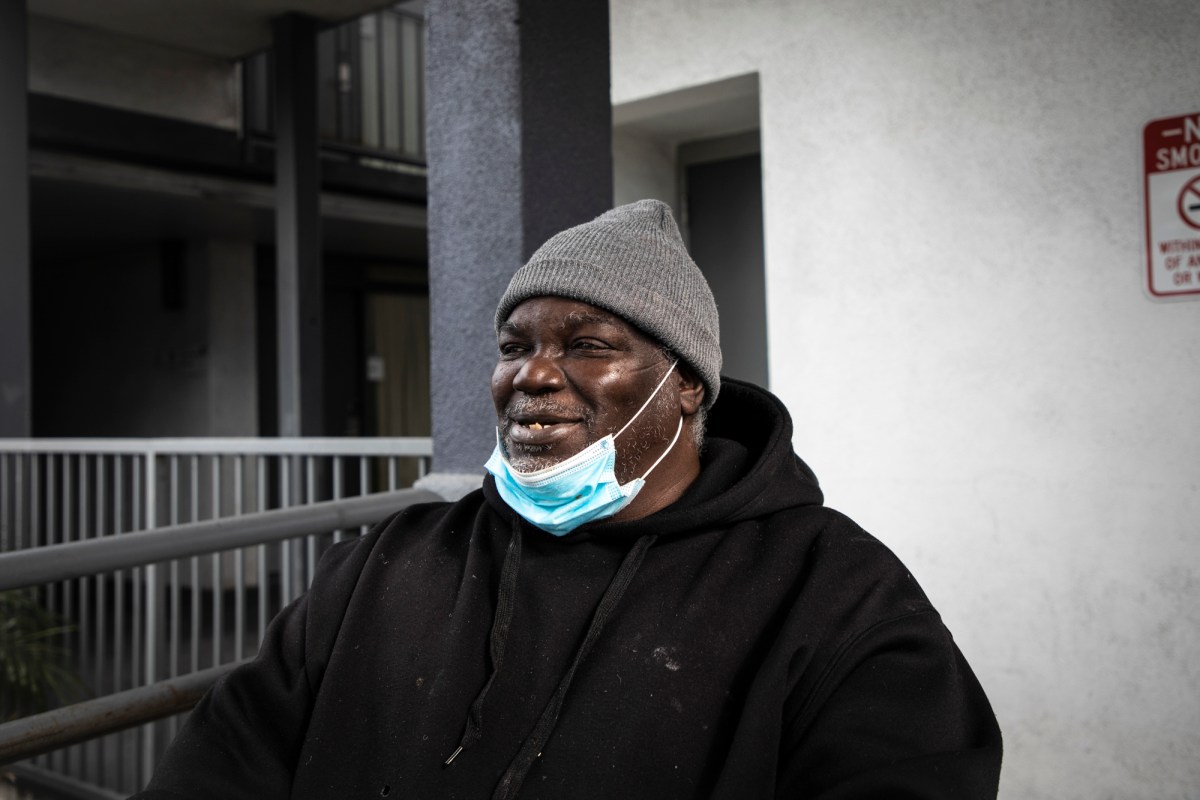
Edward El lives in a Project Roomkey shelter at the Radisson Hotel in Oakland but will soon be moving into his own apartment after spending much of the past 16 years homeless. He was assisted by a pilot project for the state’s new Medi-Cal reform program. Photo by Martin do Nascimento, CalMatters.
###
At 66, Edward El has a new lease on life — literally. In two weeks, he’ll move into his own apartment in Berkeley after spending the better part of the past 16 years homeless.
Years ago, a back injury and pinched nerves in his legs made standing and walking painful, and he was laid off from his construction job. He ended up in “shelter after shelter after shelter.”
But nine months ago, El moved into one of 12 Project Roomkey shelters in Alameda County designed to reduce COVID-19 among the homeless population. He was connected with a housing navigator, a counselor and medical staff. They helped El apply for affordable housing and rental assistance vouchers, and coordinated with landlords who would give homeless renters a chance. Now he’ll pay a fraction of the cost to live in an area where one-bedroom apartments often exceed $3,000 per month.
The team also made sure that El was enrolled in Medi-Cal and had transportation to his doctor’s appointments. He said he couldn’t have navigated the array of complex systems if it weren’t for his new case management team. “I’m happy. They knew about programs that I didn’t know about that allowed me to get a place,” he said.
Intensive case management like this is an example of the ambitious, sweeping changes California made to Medi-Cal beginning in January under an initiative it’s calling CalAIM, or California Advancing and Innovating Medi-Cal.
“This was designed to identify very high risk populations — oftentimes people who were coming to the emergency room five to 10 times a month.”
— Erica Murray, California Assn. of Public Hospitals and Health Systems
Medi-Cal offers medical insurance to low-income Californians, serving as a lifeline for nearly half of the state’s children, one in five adults and 2 million seniors and people with disabilities. But the program is inefficient: More than half of Medi-Cal’s roughly $133 billion annual budget is spent on just 5% of the program’s highest-needs individuals — people with multiple complex health problems compounded by homelessness, poverty, substance abuse, mental illness or incarceration, according the Department of Health Care Services.
Over the next five years, the goal of CalAIM is to address the upstream drivers of deteriorating health — things like food insecurity and housing instability — in an effort to reduce costly emergency department visits, hospitalizations and nursing home stays. The program redesign is based on “whole person care” principles, which help people avoid situations that worsen their physical and mental health.
“This was designed at the county level to identify very high risk populations — oftentimes people who were coming to the emergency room five to 10 times a month.” said Erica Murray, president and CEO of the California Association of Public Hospitals and Health Systems.
In his January budget, Gov. Gavin Newsom proposed $8 billion over five years to implement the program, about 6% of Medi-Cal’s total budget. Included are temporary payments to managed care plans to offer enhanced case management and other services.

Alameda County intake specialist Annie Wyley meets with a Medi-Cal patient in the repurposed dining room at the Radisson Hotel in Oakland. Photo by Martin do Nascimento, CalMatters
These so-called social determinants of health have not been historically covered by health insurance like Medi-Cal. Yet they have an outsized impact on people who often struggle with economic instability, poor nutrition, discrimination, violence and disproportionate exposure to polluted air and water.
“One of my patients calls it social deterrents to health,” said Alameda County Medical Director Dr. Kathleen Clanon.
No other state has mounted such a comprehensive program that wraps in so many elements. The scale is unprecedented, too: Medi-Cal provides health insurance for more than 13 million people.
“This is a big deal. Not only is California taking the lead but also setting a precedent for potentially other states to follow it,” said Anthony Wright, executive director of Health Access California, a consumer advocate group.
Pilot programs in 25 counties helped get CalAIM off the ground. Roughly 108,000 Medi-Cal patients were enrolled in county pilots and 15,000 in managed care pilots during a two-year period, according to an early analysis by UCLA researchers. As a result of the success, federal officials granted a waiver allowing CalAIM to move forward for the next five years.
A CalAIM case worker “was a hell of a godsend. If you don’t know the ins and outs, you just get spit out. You get absolutely no help at all.”
— David Norris, Medi-cal Patient
In Placer County, David Norris, 67, was one of the patients who benefited from the experimental programs.
Norris ended up in a homeless shelter after his mother, whom he was a long-term caregiver for, died. He earns $900 a month in Social Security and retirement, but it’s not enough for rent and living expenses. In April, an infected foot wound spread to the bone and cost Norris his left leg. Another infection resulted in more trips to the ER and subsequent surgeries. Several months later, a fight at the shelter ended in a shove, a fall and a broken right leg.
His caseworker, Todd Perbetsky, helped him enroll in Medi-Cal, find a nursing home to recuperate in and apply for a housing voucher. He’s now helping Norris find permanent housing after leaving the nursing home.
“These are definitely people that are falling through the cracks,” Perbetsky said. “They may not meet the criteria of some programs. They may need linkage to services. They can have tons of barriers to even getting their CalFresh turned on or other benefits they qualify for.”
Norris called Perbetsky a “hell of a godsend. If you don’t know the ins and outs, you just get spit out. You get absolutely no help at all. That’s where Todd…helps me and people like me navigate the waters and get all squared away.”
A Byzantine system
Wraparound services aren’t new, but they haven’t always been easy to access nor have they been directly connected to medical care. Walk through the wrong door and you might not get any help at all.
A homeless patient who suffers from addiction and mental health issues and has diabetes would have to approach three different county departments and a doctor in order to get all of their needs addressed, and even then they’re likely to get lost in the system.
“It’s a little bit like if you needed to get ingredients for a meal and instead of just going to the supermarket, you had to go to different stores to get your proteins and your fruits and your grains and your vegetables. And at those stores, you had to pay with different cards and navigate different rules about what you could buy,” said Melora Simon, a senior strategist at the California Health Care Foundation.
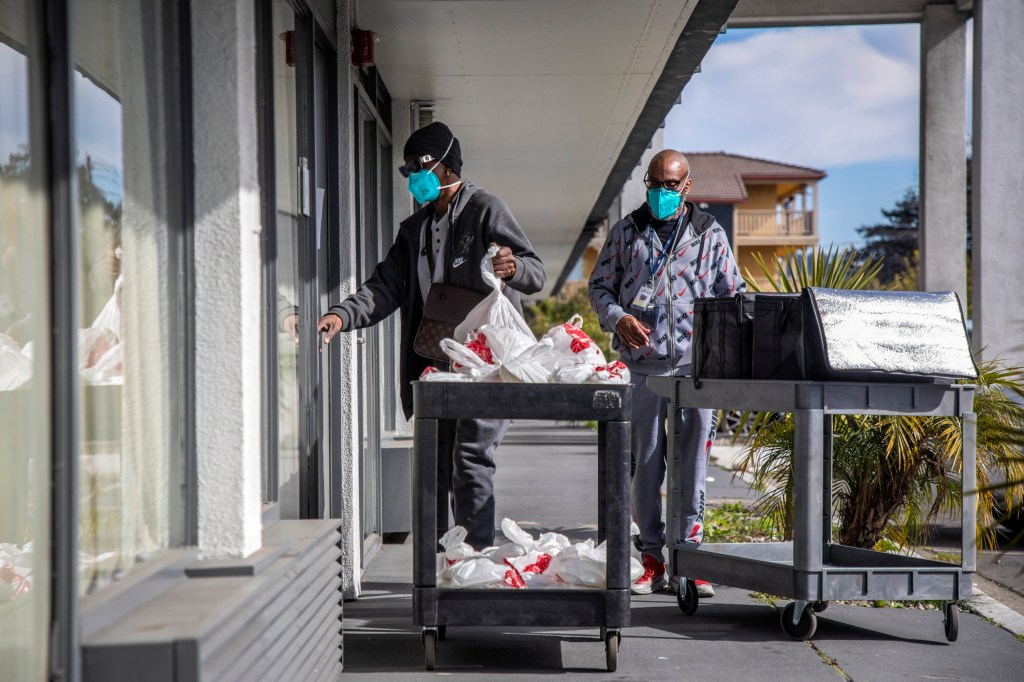
Terry Harper (left) and Frank Scott deliver meals to occupants at the Radisson Hotel. Photo by Martin do Nascimento, CalMatters
This fragmentation frequently causes barriers to health care and is one of the primary reasons the Department of Health Care Services is focused on reforming Medi-Cal under CalAIM.
One such barrier is making sure patients don’t get lost between systems that don’t traditionally talk to one another.
Clanon, who also works as a physician in Alameda County, said a few years ago a pregnant, HIV-positive patient needed to begin HIV treatment but had left the usual encampment she stayed in and couldn’t be found. A nurse spent more than an hour calling local emergency departments, homeless shelters and case managers to see if anyone had seen the patient, with no luck.
Had the system been integrated, Clanon’s patient would have been flagged as needing critical medical care any time she entered a homeless shelter, emergency department, substance abuse center or mental health facility.
“CalAIM is trying to fix the problem of disparate systems of care both among and between different counties and among and between different parts of the healthcare system,” said Diana Douglas, a health policy expert with Health Access California.
Accountability and missing pieces
Since 2016, California has dedicated more than $3 billion in state and federal funds to experiment with doing just that.
Four years after launch, the pilots demonstrated “substantial evidence” of improved follow-up after hospitalization for mental illness, increased participation in substance abuse treatment and decreased use of emergency services, among other metrics, according to the UCLA analysis.
In Contra Costa County, more than 12,000 patients were enrolled in the pilot annually, and the county health department hired more than 100 public health nurses, mental health specialists, community health workers, homeless service specialists, substance abuse specialists and social workers to provide coordinated case management.
“Most of them were types of positions that existed in the county before, but they were very siloed,” said Emily Parmenter, the pilot’s program manager at Contra Costa County Health Services. “So we brought them all together in these multidisciplinary teams where they had a wealth of experience…and were able to provide case consultations across divisions.”
Medi-Cal patients who enrolled in the Contra Costa pilot experienced medical emergencies less frequently than non-enrolled patients.
“We found that after being involved in the program for a year, our hospital admission rates decreased by 25%…and our (emergency department) rates were 14% lower compared to the control group,” Parmenter said.
UCLA researcher Nadereh Pourat, who conducted the pilot evaluation, said her team has just begun to analyze the impact on specific health conditions, such as blood pressure and congestive heart failure, as well as cost-effectiveness.
“We found that after being involved in the program for a year, our hospital admission rates decreased by 25%.”
— Emily Parmenter, Contra Costa County Health Services
Despite their promise — or perhaps because of it — advocates say the transition from pilot programs to CalAIM will need to be watched carefully.
Responsibility has now shifted from county health departments to health care plans, which don’t always meet quality benchmarks. And health plans in the 33 counties that did not have pilots are starting from scratch.
“There are serious concerns about Medi-Cal (health care) plans on the ground being able to implement some of the work necessary for CalAIM to really be effective and live up to its potential,” health policy expert Douglas said.
“In some cases, plans struggle to deliver quality care across what we think of as very basic measures: childhood immunizations, are people getting mammograms on time, just very basic preventive care and chronic disease management.”
Accountability is especially important for improving equity among minorities, advocates say.
“Communities of color are disproportionately impacted by these same factors: lack of housing, lack of income, lack of food security,” said Cary Sanders, senior policy director for the California Pan-Ethnic Health Network.
Health plans need to provide services that are “linguistically and culturally appropriate,” Sanders said.
One critical piece of the pilot programs that was left out of CalAIM is legal aid. In counties that funded legal aid during the pilot programs, lawyers and paralegals were stationed in medical clinics to assist patients who needed help with benefit denials, eviction notices, immigration issues, or domestic abuse cases.
Frequently patients and even their doctors don’t realize that their issue could use the help of a lawyer, said Daniel Nesbit, managing attorney for medical legal partnerships with California Rural Legal Assistance. Nesbit said during the pilot program in Monterey County his team helped 700 clients with more than 1,000 cases.
“A really good example is someone struggling with some sort of medical condition, and it’s making it hard for them to go to work every day and do their job to the full extent,” Nesbit said. “They might not know, for example, that they have a possible right to a reasonable accommodation under the Americans with Disabilities Act.”
“There are serious concerns about Medi-Cal (health care) plans being able to implement…the work necessary for CalAIM to really be effective.”
— Diana Douglas, Health Access California
Alameda and Contra Costa counties, which contracted with Bay Area Legal Aid to participate in the pilot, hired five additional attorneys dedicated to assisting Medi-Cal patients. The partnership helped reach people who ordinarily wouldn’t be able to access legal aid because their disability prevented them from attending an appointment or they didn’t have a phone number or address. Case managers were able to link people to the attorneys, accounting for 300 referrals a year.
But when the pilot ended in December and state funding dried up, attorneys were reassigned and are no longer able to focus on Medi-Cal patients.
“I’m still getting emails and phone calls from the case managers I worked with who I think are now kind of scrambling to figure out how to help,” said Abby Khodayari, an attorney who worked in Contra Costa County’s program. “Case managers are hoping to get help analyzing eviction notices and figuring out the validity of them. It’s hard not having dedicated time to be able to spend working on those issues.”
While legal services aren’t explicitly named as one of 14 pre-approved services under CalAIM, the Department of Health Care Services said health plans could integrate them as part of supportive housing services, which are covered.
But attorneys say it’s unlikely to happen unless plans get specific guarantees that CalAIM will cover the cost. They hope that subsequent phases of CalAIM will include legal aid.
“There hasn’t been a health plan here in LA who’s come forward and said we want to offer these legal services,” said Gerson Sorto, a managing attorney with Neighborhood Legal Services of Los Angeles.
Los Angeles County has continued funding their partnership through the summer, but there’s no permanent money in sight. “As of today, there is no funding secured or confirmed beyond June 30,” Sorto said.
Life under ‘whole person care’
Back at the Radisson Hotel in Oakland, the shelter where El is waiting patiently to move into his new apartment, he watches a home renovation show on the television. He likes to see how the hosts redesign the interior and gets ideas for his own future home.
Before losing his job, El lived in an apartment near Lake Merritt but hasn’t had a place to call his own in years. After he enrolled in Alameda County’s pilot program, things started turning around for him.
“These people really respect you and help if you ask for it,” El said.
“Most importantly, someone to listen. I might not have any answer at all but there’s power in listening.”
— Michael Webb, CalAIM peer
Part of the program is connecting Medi-Cal patients to peers with similar backgrounds.
“You can’t tell them ‘do this and do that.’ You walk alongside someone and support whatever they’ve got going on,” said Michael Webb, a CalAIM peer support navigator who struggled with addiction and homelessness. “Most importantly,” he said, “someone to listen. I might not have any answer at all but there’s power in listening.”
Down the hall from El’s room, shelter monitors are delivering lunch to residents that can’t make it to the dining room. Lunch is a chicken sandwich, banana, salad and a soda, but those with dietary restrictions or certain medical conditions like diabetes get tailored meals.
As part of the CalAIM program, caretakers perform wellness checks on shelter residents with disabilities, helping them clean, bathe and use the restroom.
In the lobby, an intake worker asks a new guest about his seizure disorder and works to link him to his CalAIM team of health care providers, case workers and housing navigators. As the program grows, millions more Californians may benefit. On this day alone, the Oakland team expects to sign up eight new people.
###
CALmatters.org is a nonprofit, nonpartisan media venture explaining California policies and politics.
BOOKED
Today: 12 felonies, 16 misdemeanors, 0 infractions
JUDGED
Humboldt County Superior Court Calendar: Friday, Sept. 4
CHP REPORTS
Us101 / Elk Valley Rd (HM office): Live or Dead Animal
1718 Mm36 E Hum 17.20 (HM office): Trfc Collision-Unkn Inj
ELSEWHERE
RHBB: CDPH Issues Immunization Recommendations for 2026-27 Respiratory Virus Season
RHBB: Redway Transfer Station to Close an Extra Day for Construction
RHBB: Dows Prairie Road to Close for Two Months for Culvert Repair
No Legal Battles for California’s New Election Maps. But What Lessons Can Be Learned?
Sameea Kamal / Monday, Feb. 14, 2022 @ 7:16 a.m. / Sacramento

Illustration by Miguel Gutierrez Jr., CalMatters
As the clock struck midnight on Feb. 10, 14 people scattered around California collectively exhaled in relief.
The 14 are members of the state’s independent citizens redistricting commission who drew 120 new districts for the Legislature, 52 for Congress and four for the state Board of Equalization that voters will use in this year’s election. The commissioners struggled at times to reach consensus, and their mapping was critiqued nearly every step of the way by some experts, advocates, elected officials and the public.
But after all the criticism, the commission approved the maps unanimously in late December, and Feb. 10 — the 45-day deadline for anyone to go to court to block the maps — came and went.
No one sued.
There’s still one more state hurdle to clear: critics have until March 27 to challenge the maps via a referendum — asking voters to reject them — before the new districts officially become effective. But there’s no sign any such costly effort is underway. (The maps could also be challenged in federal court as violating the U.S. constitution or the Voting Rights Act.)
“The absence of a state lawsuit challenging these maps is a testament to the effectiveness of California’s open, publicly accessible redistricting process and the design of its independent redistricting commission,” current commission Chairperson Russell Yee said in a statement.
“We worked hard to apply the constitutional redistricting criteria and consider testimony from throughout the state, especially from minority communities,” said Yee, a Republican professor and former pastor from Oakland. “While the maps do not please everyone, we believe they are fair and equitable. We would have confidently defended these maps in court, but are thankful we now won’t need to.”
The commission did face litigation earlier: An emergency petition filed on Nov. 30 on behalf of some Republican voters alleged that the commission held secret meetings with some interest groups, complained that an analysis of racially polarized voting wasn’t made public and challenged the selection of its legal counsel because the firm had previously worked for Democrats.
That emergency petition was denied by the California Supreme Court on Dec. 15.
Christian Grose, professor of political science and public policy at the University of Southern California, said that while the failure of prior lawsuits might explain the lack of litigation, so does how the commission did business. “A unanimous vote is a signal that something was done right,” he said.
Josue Franco, an assistant professor of political science at Cuyamaca College in San Diego, said the amount of public comment (more than 36,000 entries) as well as the failure of the petition, likely warded off more lawsuits.
“Any political process is a valve, with pressure being applied. Some have limited valves to open, so no pressure is released. So it builds up and builds up and builds up and explodes in some kind of failure of the process or judicial litigation,” he said. “ When you have processes that are public — allowing people to comment — they’re venting.”
“I think the lesson learned for any future commission is: If you continue to be as open and transparent and accessible as possible, you’ll continue to reduce the likelihood of any significant litigation,” Franco added.
That’s a bonus for taxpayers: Any of the $4.3 million set aside for litigation that isn’t used goes back into the state’s general fund.
The lack of lawsuits is somewhat surprising. After the first time California redistricting was done by an independent commission, in 2011, two lawsuits challenged the final maps, and another questioned the commission’s makeup.
And new election districts in other states are being taken to court. On Feb. 7, the U.S. Supreme Court reinstated a congressional map that a lower federal court ruled would disenfranchise Black voters. In December, the U.S. Department of Justice sued Texas, alleging that the maps drawn by a Republican-controlled Legislature and GOP Gov. Greg Abbott disenfranchise Latino voters. In North Carolina, the state Supreme Court threw out new congressional and legislative districts that the justices said were too partisan and ordered the Republican-majority Legislature to draw new ones by Feb. 18.
Even in other states where the maps were also drawn by independent commissions, there are lawsuits. In Michigan, state lawmakers say that the new congressional districts would dilute the voting power of minority communities. In Ohio, Black voters went to federal court seeking to block legislative maps.
“If you continue to be as open and transparent and accessible as possible, you’ll continue to reduce the likelihood of any significant litigation.”
— Josue Franco, assistant professor of political science at Cuyamaca College
Just before approving California’s maps and delivering them to the secretary of state on Dec. 27, commissioners noted the exceptional challenges they faced during their 18 months of work, including the pandemic and the delay of Census data that compressed their timeline to have new districts in time for the June primary.
Meeting deadlines and avoiding lawsuits aren’t the only measures of success. Other assessments could shape what statewide and local California redistricting looks like after the 2030 Census and beyond.
Grading the new lines
Ballot measures passed in 2008 and 2010 set the minimum criteria for fair maps: equal population, compliance with the federal Voting Rights Act and compactness of districts, among others. But beyond that, some look at how well the new districts reflect California’s diverse population — with no race or ethnic group making up a majority.
According to the Public Policy Institute of California, the number of majority Latino districts increased “significantly,” with six more for U.S. House, three more for state Senate and an additional five for state Assembly – nearly matching the share of the Latino voting-eligible population at 30%.
There was less change for other ethnic groups. There are two Asian-majority state Assembly districts, up from one, but no state Senate or congressional districts. There are no majority Black districts.
Another measure of fair representation: “influence” districts, where a group makes up at least 30% of voters. While the number of Latino “influence” districts declined, there are two Black influence congressional districts and two legislative districts and six Asian influence congressional districts and 10 legislative ones.
While community groups were vocal during the process, some said the final maps attempted to address most, if not all, their concerns.
The true test of representation will be the results of elections this year and in subsequent cycles. A report by the USC Schwarzenegger Institute showed that the 2011 maps largely succeeded in helping to add elected officials of color in California between 2012 and 2020.
And while the commission is not permitted to consider the new districts’ impact on incumbents or political parties, another assessment is how politically competitive they become.
Party control, based on voter registration, flipped in three congressional, four Senate districts and four Assembly districts.
Still, Democrats will likely remain dominant based on the new maps, favored to win 41 congressional seats, 31 state Senate seats and 62 Assembly seats, according to the PPIC analysis. There were also 21 members of Congress, 13 state senators and 20 Assembly members put into the same districts as other incumbents.
Adding to the turnover and possibly changing the partisan balance, so far 21 Assembly members and state senators have resigned or have announced they’re not seeking reelection this year. Another seven senators are barred from running again by term limits.
“In the 2001 cycle, there was essentially a gentleman’s agreement that enabled everyone to run for reelection and stay in power,” said Jonathan Mehta Stein, executive director of California Common Cause, which pushed for the independent redistricting commission. “This was a process that was exactly the opposite. The commission was literally moving lines and making massively important decisions on a livestream. They’re going to stumble, and thousands of people are going to watch it. But I don’t think I would trade that for a cleaner alternative.”
Lessons from 2010, and for 2030
While this California redistricting was heavily scrutinized, the 2010 commission dealt with its own challenges, including tight timelines and budget restraints. But they also had the advantage of being the first independent commissioners.
So another measure of the current commission’s success might be how well it learned lessons from the previous group. Some prior commissioners who followed the 2021 process say the current commission was able to do more public outreach and took advantage of more advanced technology.
But some of the same problems remained: time management, a lack of clear guidance on how to assess competing communities of interest and a struggle to be consistent in making decisions.
There were also continued attempts by partisans to sway the commission — something researchers had warned after the 2011 California redistricting would only grow stronger. “Political forces that were baffled, angered, quietly involved, or generally thrown on the defensive will be much better prepared to exercise influence,” said a 2013 report commissioned by the League of Women Voters of California.
Former commissioner Jodie Filkins Webber said she was flabbergasted seeing the number of organizations that mobilized for this redistricting. Webber, a Republican, and Democratic commissioner Cynthia Dai wrote a commentary last year warning that too many closed sessions, while allowed, would erode the public’s trust in the process. The current commission routinely held private sessions during its marathon meetings.
“All of us who were commissioners are very protective of the institution and of an open process, which is why a lot of us were critical of the commission,” said Angelo Ancheta, the final chairperson of the 2010 commission.
Current commissioner J. Ray Kennedy, a Democrat from San Bernardino County who works as an international elections consultant, said that while the commission did more outreach, there is still room for more public education — for instance, explaining why the commission started from scratch, not from existing districts.
“I understood a lot of people were going to resist any redistricting, but I was still a little surprised at how many people said, ‘Don’t do anything to my district,’” Kennedy said in an interview. “I think that message did not get out as much, or it didn’t stick — that districts have to change. And so in the future, that would be a point of focus: How to help all Californians understand that districts have to change.”
Whether or not to start from a blank slate — as well as other administrative decisions — is up to each California redistricting commission. Said former commissioner Jeanne Raya: “I think it’s important that each commission not be tethered to the one that came before.”
And while, thanks to a push from the 2010 commission, the 2020 commission was given more time, its decision to count state prison inmates in drawing districts, combined with the Census delay, resulted in a time crunch.
“We need to look at the timeline in the future to make sure that there is enough time for all of these things to happen,” Kennedy said.
That and other lessons will be compiled into a report to the next commission, along with legislative recommendations. The commission is scheduled to meet Feb. 18 and 23 to discuss lessons learned and other topics.
“We built and exercised respect for each other and came up with something that all 14 of us believe isn’t perfect, but will provide good representation for California going forward.”
— J. Ray Kennedy, member of California Citizens Redistricting Commission
The current commissioners, like their predecessors, may also travel throughout California and to other states to share the impact an independent commission can have.
Members of both citizen commissions agree that other institutions should learn from having a bipartisan group work together and reach consensus, especially in these politically polarized times, when 63% of California’s likely voters are pessimistic that Americans with different political views can still work out their differences.
“We built and exercised respect for each other and came up with something that all 14 of us believe isn’t perfect, but will provide good representation for California going forward,” Kennedy said. “I think that’s the story that really needs more focus in this time of hyperpartisanship…that we can put together kind of a random group of citizens to do civic work on behalf of the entire community and get it done.”
###
CALmatters.org is a nonprofit, nonpartisan media venture explaining California policies and politics.
OBITUARY: Carol Lee, 1953-2022
LoCO Staff / Monday, Feb. 14, 2022 @ 6:52 a.m. / Obits
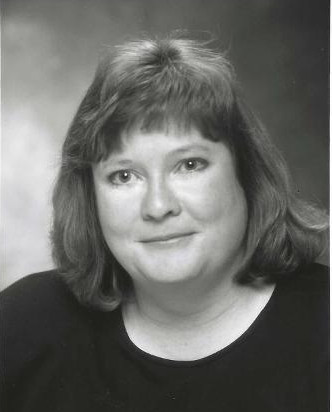
On
a sunny Saturday afternoon as she visited with a friend in the
sunroom at Eureka’s Hospice, Carol said, “I’ve had a good
life!” She died Tuesday morning, Feb. 8, 2022, of ovarian cancer
peacefully with Jody and Vickie Victorine by her side.
Carol was born on June 2, 1953, in Eureka to Glen and Evelyn Lee of Ferndale. She grew up in the hills above Ferndale, exploring the forests and creeks with her siblings and many cousins. She loved to sit under the willow tree beside the house to read about far-off places she hoped to see someday. Carol’s father built a special room for her out in the family’s garage so she could read and no one would bother her. When airplanes flew overhead, she dreamed of traveling to faraway places. As a small child, she showed an early penchant for reading. When her father finished reading his newspaper, Carol would pick it up carefully, fold it just so, and then proceed to read it. Her Aunt Margie often commented “That Carol is one smart cookie!”
Carol’s formal education began at Ferndale Elementary School and continued at Ferndale High School. At Ferndale High, one of Carol’s tasks was to help the high school counselor. One day, she noticed that a pamphlet from Pepperdine University had been tossed in the wastebasket. She retrieved it, read it and decided she was the type of student they were looking for. She applied for entrance.
After graduation from Ferndale High in 1971, Carol found herself in Southern California as a Pepperdine co-ed. A highlight of life there was her appearance on the game show Card Sharks. She won $10,000, which certainly helped with tuition. Carol also appeared on Jeopardy during her college days. She graduated in 1975 with a Bachelor of Arts Magna Cum Laude degree. She then began the study of law at University of Southern California Law School. She received her Juris Doctorate in 1980 and passed the bar exam on her first try. In 1982 she earned a Master’s Degree from Humboldt State University.
It was then that her childhood dreams of traveling came true. She accepted a job with the small Pacific Nation of Saipan as the legal counsel to its House of Representatives. She was instrumental in developing the island nation’s constitution. While there, she and a group hired a guide to travel to China. Unfortunately, a few days after they arrived, the guide was unable to continue. As all arrangements for the trip had been made and paid, the group, with the guide’s input, decided Carol, the youngest member of the group, should become their leader. She agreed. The trip was a success. Another memorable journey was to the Pacific Island of Guam. Several years later she had her European experience living in Heidelberg, Germany. Carol loved to travel the world revisiting her favorite countries with her mother.
With the travel bug at least partially satisfied, Carol returned to California to accept a position working as a lobbyist in the state capital. She was very proud that her lobbying efforts led to California’s passage of the mandatory helmet law for motorcyclists and their passengers. She also met with national leaders, including several presidents in Washington, D.C., to advise them on issues important to Californians.
Her final position was as CEO of the California Medical Foundation headquartered in Sacramento. She spent 20 years in that position.
Her heart was never far from her real home up Williams Creek in Ferndale. When she was working, she would come home to her cabin every chance she got. On these visits home, she would host family reunions. The aunts, uncles, cousins, nieces, and nephews plus many others would gather to roast hot dogs and to roast S’mores at Carol’s cabin. She enjoyed taking all the young kids to “root beer” pond to cool off on hot summer days. She loved her family very much. She was quick to lend a hand when someone needed it.
Upon her retirement, Carol returned to Ferndale. She designed a beautiful two-story log house and had it built on the site where her family had lived for many years. Her favorite flowers, daffodils and rhododendrons, dotted the nearby hillsides. Her goal to plant 300 daffodils bulbs every year was accomplished. The old fruit trees blossomed among them as did wildflowers.
For entertainment, Carol drove her mother and Aunt Margie to the nearby Bear River Casino. They’d enjoy dinner as well as test to see if their usual luck would hold. Carol’s luck did hold as she won a car and a 4 x 4 Gator as well as generous slot machine pay-outs.
To keep her mind active, Carol served two terms on the Humboldt County Civil Grand Jury. Her commitment to the betterment of the Ferndale community was shown by her board membership on the Salt River Watershed Council. With her legal background, she was a very valuable member of both groups.
Carol planned to live a long and happy life up Williams Creek Road, but it was not to be. She left these messages to her family and friends:
I hate to leave you all behind, but we’ll meet again one day.
Carol’s final message
Life’s
race well run,
Life’s
work well done.
Life’s
victory won,
Now
cometh rest.
— Edward Parker
Never doubt that a small group of thoughtful, committed citizens can change the world. Indeed, it’s the only thing that ever has.
— Margaret Mead
Carol was preceded in death by her father Glen Lee, her brother Ronnie Lee and many aunts, uncles, and cousins.
Among those surviving her are her loving mother, Evelyn Lee; her sister Cindi Ambrosini and her husband Richard; nieces and nephews Toby Ambrosini, Mandy Dowden and husband Greg, Tyler Ambrosini, Lorilee Ambrosini and Michael Sandford; her great nieces and nephews Abigal Ambrosini, Macy Gomes, Nicholas Gomes and Mylah Ambrosini. Her faithful canine companion “A Dog Named Sue” brought her much love, companionship, and happiness.
Pall bearers will be Tyler Ambrosini, Rocky Crowl, Nicholas Gomes, Jose Ibarra, Robert Wilson and Steve Wilson. Honorary pallbearers are Toby Ambrosini, Hazen Crowl and Jody Victorine.
Carol was especially thankful to her amazing cancer support group who helped her through difficult times.
The family would like to thank the following for their friendship and help during Carol’s illness: Gary Crowl, Rocky Crowl, Steve Wilson, Annie Martin, Shirley Foster, Tracy and Jose Ibarra, John Vernon, Vickie, Jody and Brittney Victorine, Elva Daily and her many doctors and nurses at Redwood Memorial Hospital, Providence St. Joseph Hospital, Stanford University Hospital, and Hospice of Humboldt. A special thanks goes to her little friend Alison Dayton for playing Barbie Dolls, silly games and baking cupcakes with Carol when she needed it the most!
There will be a viewing on Thursday, February 17, 2022, from 3 p.m. to 6 p.m. at Goble’s Mortuary in Fortuna.
The graveside services will be on Friday, February 18, 2022, at 2 p.m. at the Ferndale Cemetery.
###
The obituary above was submitted on behalf of Carol Lee’s loved ones. The Lost Coast Outpost runs obituaries of Humboldt County residents at no charge. See guidelines here.
MONDAYS WITH MICHAELE: Drinking Outdoors! What a Concept!
LoCO Staff / Monday, Feb. 14, 2022 @ 6:30 a.m. / Mondays With Michaele
Photos: Matt Filar
Is it too early in the week for wine? Too bad! Michaele is ready to indulge.
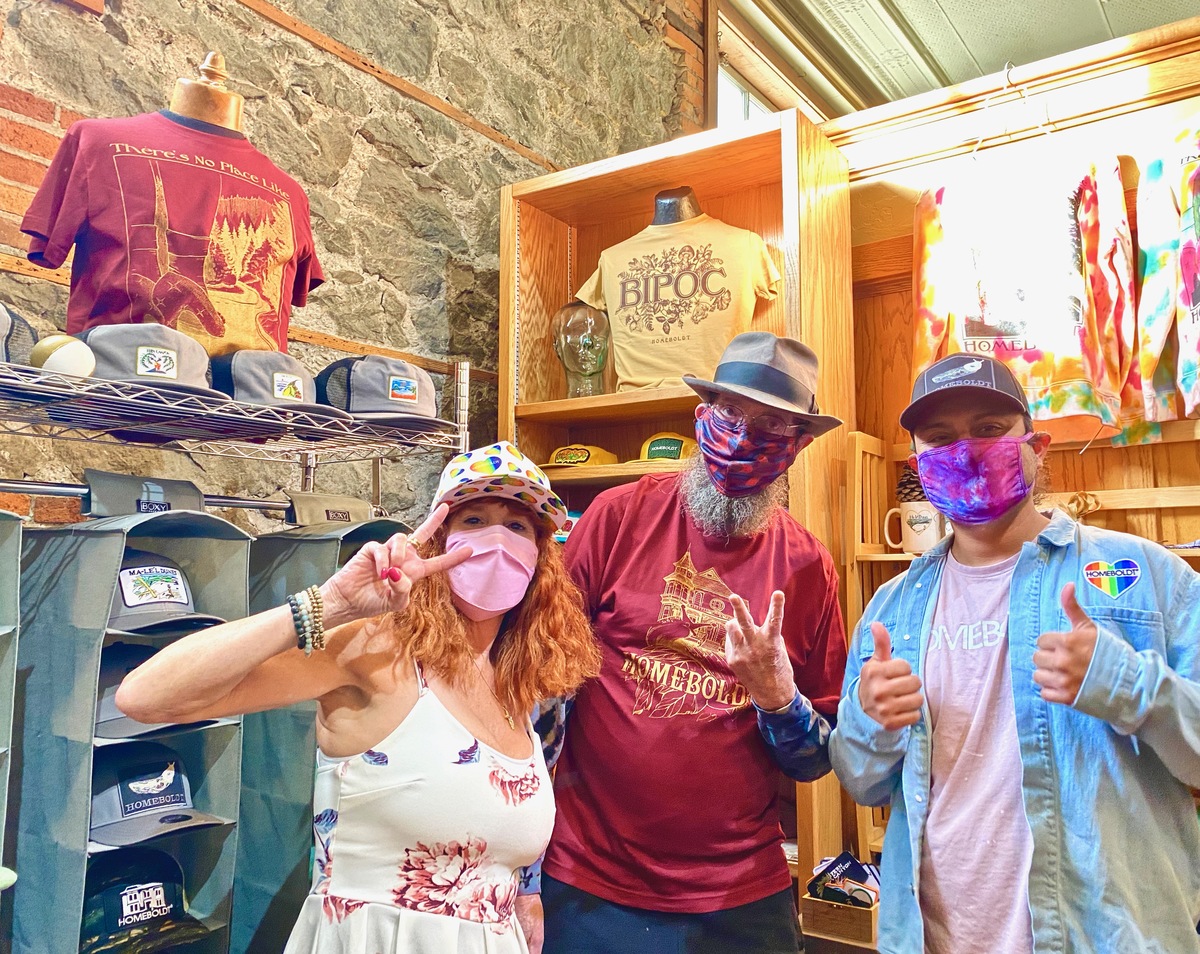
This time out, your President of Positivity is making the rounds through Arcata with her good bud Bob Doran. First, the pair swing through the Jacoby’s Storehouse to visit Tommy Hernandez at Homeboldt to pick up a local hat and a t-shirt. Then it’s off to Septentrio Winery for sunshine and drinks with winery owner Tynel Humphreys and Arcata City Councilmembers Meredith Matthews and Sarah Schaefer!
It’s good to be Michaele! Let’s make this week so awesome that last week gets jealous! Ciao Bella!


Hit-and-Run Driver Smashes Into Eureka Storefront, Local Business Owner Says
John Ross Ferrara / Sunday, Feb. 13, 2022 @ 2:15 p.m. / Traffic

Photos of the damage provided by Shumard.
An unknown Super Bowl Sunday driver allegedly plowed into Roy’s Auto Center at approximately 8:30 a.m. near the intersection of 5th and Broadway before fleeing the scene. Roy’s Auto Center owner Trent Shumard told the Outpost that the involved car is believed to be a red Mitsubishi Lancer or a Subaru WRX.

“[The car] spun out and crashed into our offices, causing structural damage to our building,” Shumard said. “Eyewitnesses say that the car proceeded down 5th and turned on E Street.”
Photos of the scene show the building’s glass facade smashed in multiple places. Drivers have reportedly damaged cars on the lot in the past, but Shumard said that this is the first time a car has driven into his building.
“Fortunately we have a tight community of business owners eager to help when incidents like this occur,” he said.
The broken glass has since been cleaned from the sidewalk and the building’s holes are now boarded up.


(AUDIO) HUMBOLDT HOLDING UP: Jesse Wiedel Paints a Fantasy Version of Humboldt That Maybe Hits Too Close To Home
LoCO Staff / Sunday, Feb. 13, 2022 @ 8 a.m. / Humboldt Holding Up

“Ash Can,” a 2022 painting by local artist Jesse Wiedel depicting an act of unlikely heroism in the face of a very-Eureka phenomenon
(AUDIO) Jesse Wiedel is Holding Up
Jesse Wiedel sees the world a little differently. Many of the Eureka-based artist’s paintings depict fantastical scenes featuring free-but-feral humanity that somehow manage to be both bleak and hilarious. Often set in gritty locations that would be familiar to Humboldt eyeballs, his works are like a cracked mirror held up to our corner of the world, offering a cathartic experience to those with the capacity to be amused by a colorful and outlandish version of the breakdown of society. They’re fantasy, but not by much.

On this episode of Humboldt Holding Up — LoCO’s weekly breakdown of podcasting — we speak with Wiedel about his art and why he’s drawn to the characters he conjures. Click the audio player above (or head on over to Apple Podcasts) to hear Wiedel’s chat with the Outpost’s Stephanie McGeary and Andrew Goff.
If you’re unfamiliar with Wiedel’s art click on over to his website for a nicely catalogued collection of his works. We’ll also include a small sampling of some of his more locally inspired works below.

“The Glory Clouds” (2021)

“Hand of Doom” (2020)
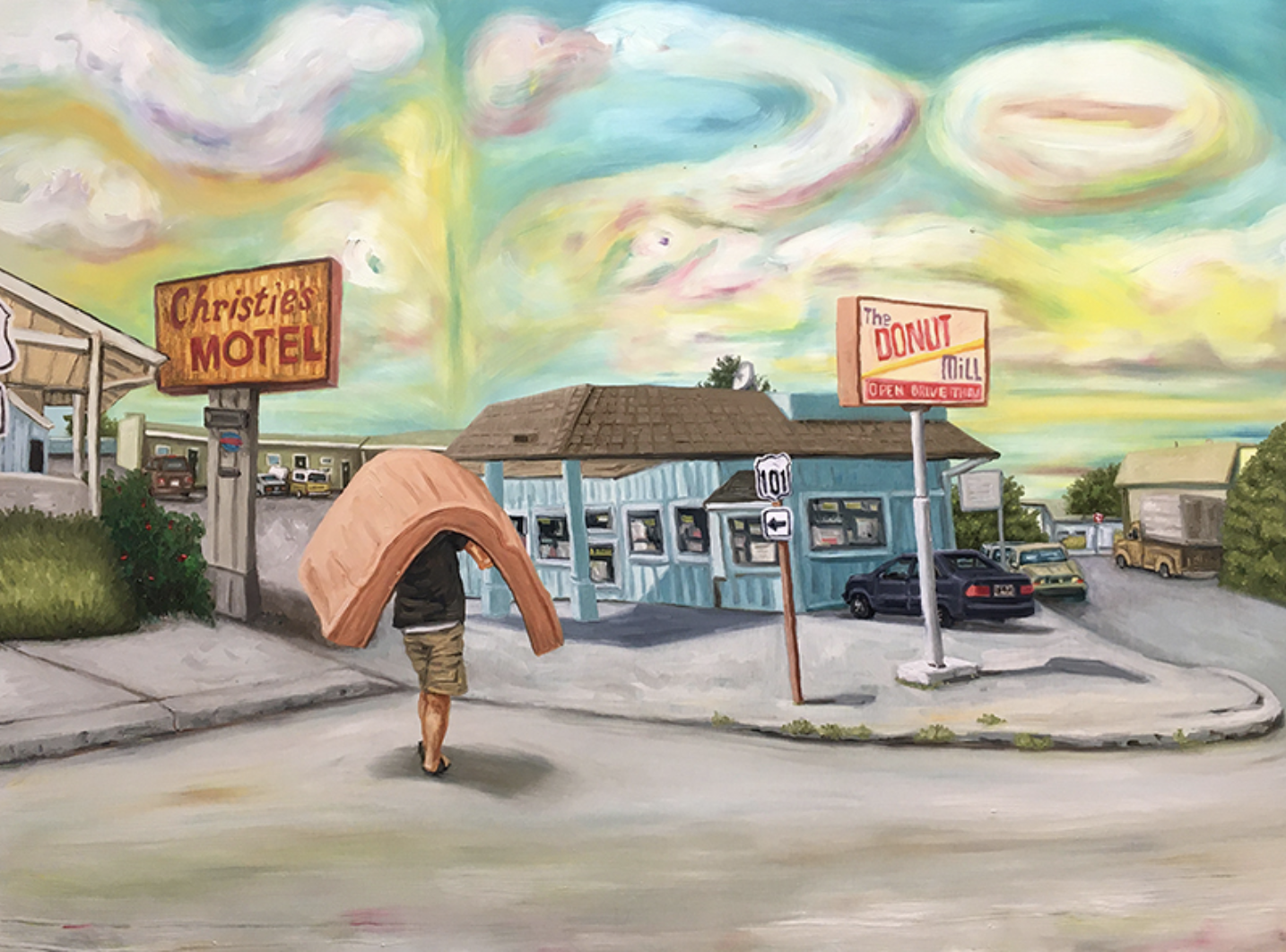
“Area 101” (2020)

“Christ’s Entry Into Humboldt County” (2019)
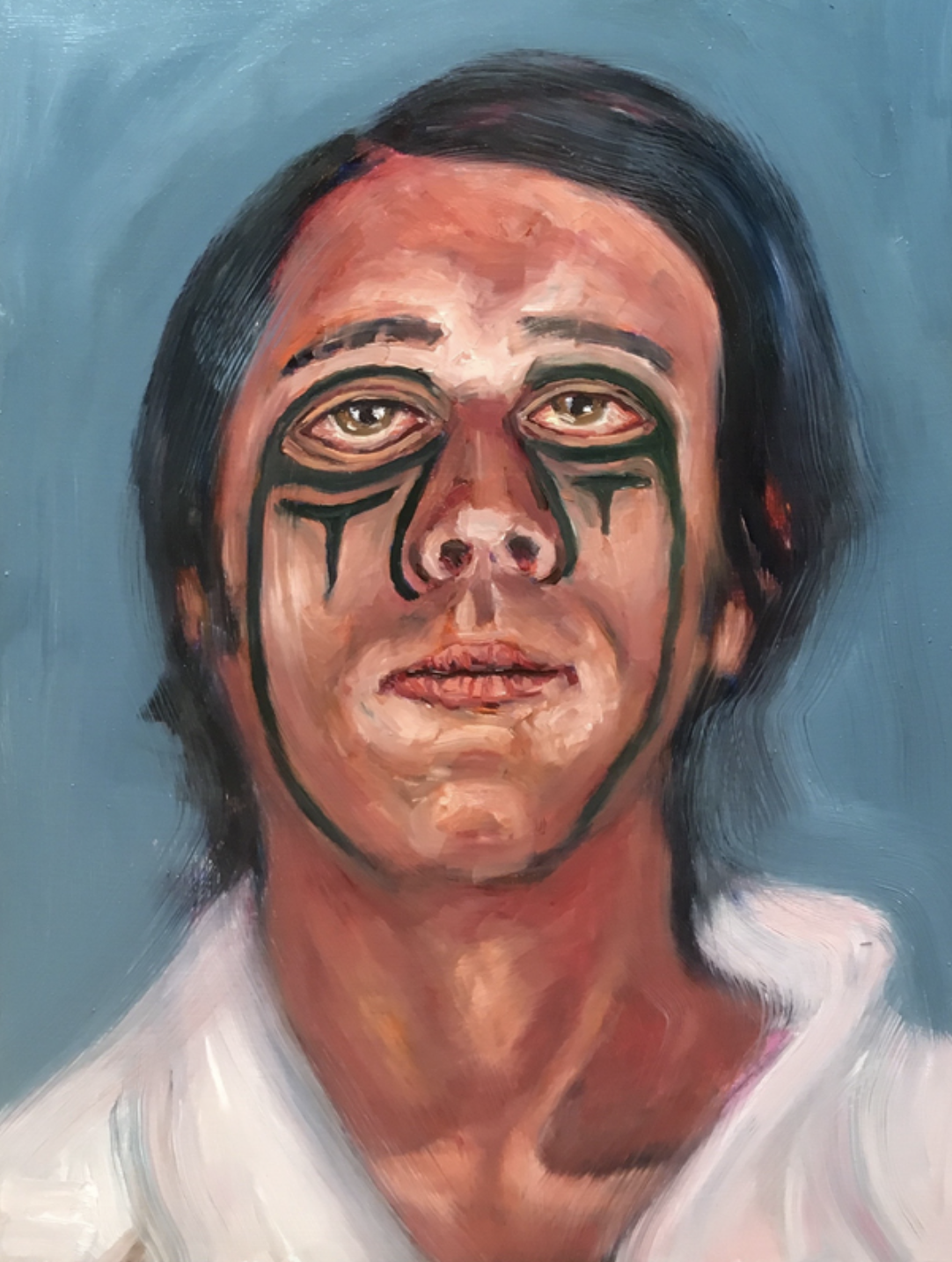
“The Corsair” (2018)

“Afternoon of the Comet” (2017)
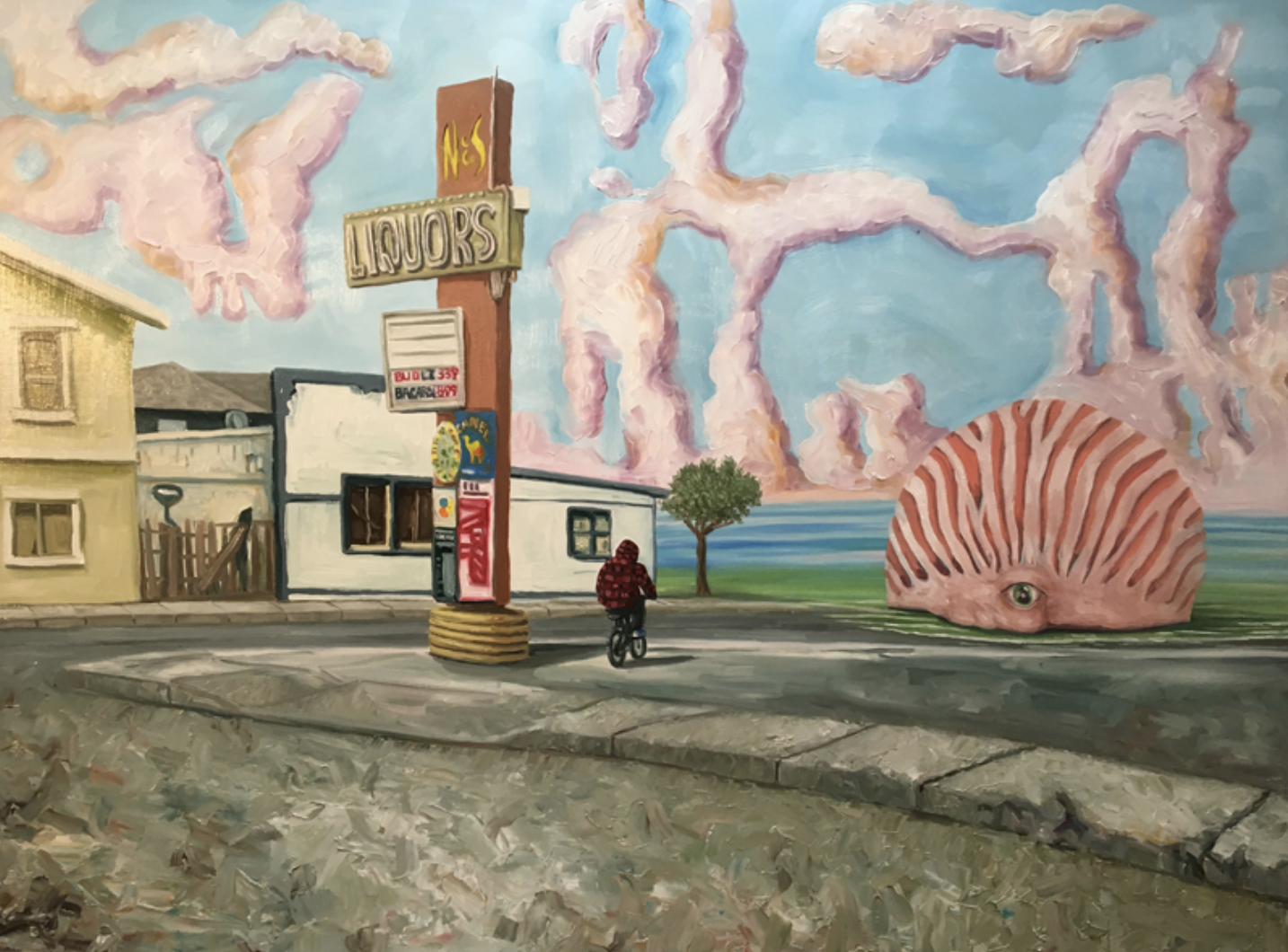
“Liquor and Drugs” (2016)

“The Pale Horse” (2015)

“Whaler’s Inn” (2014)

“Fragile” (2014)
And as always, be sure to scroll the list of past Humboldt Holding Up guests if you’re feeling bored and/or lonely.
PREVIOUS HUMBOLDT HOLDING UP GUESTS:
- #82 Keyboard Veteran Brian Swislow
- #81 Lost Lewis Treasure Hunter Corey Lewis
- #80 “The Cannabis Conversation” Writer Jesse Duncan
- #79 Humboldt COAD’s Alison Sterling Nichols
- #78 Miranda’s Rescue Founder Shannon Miranda
- #77 Eureka Police Department Chief Steve Watson
- #76 ‘The Bartow Project’ Michelle Hernandez and Zuzka Sabata
- #75 Foggy Bottoms Boys Thomas and Cody Nicholson Stratton
- #74 North Coast News’ Nazy Javid
- #73 Pumpkin Carver Mike Craghead
- #72 Eureka Police Department Sergeant Leonard LaFrance
- #71 Eureka Artist Duane Flatmo
- #70 Arcata City Councilmember Sarah Schaefer
- #69 Humboldt Hot Air Director Neroli Devaney
- #68 St. Joe’s James Ladika and Austin Allison
- #67 Eureka Artist Richard Evans
- #66 NCRT’s Calder Johnson
- #65 TV Newsman Dave Silverbrand
- #63 Housing Policy Specialist Brian Heaton
- #62 Muralists Blake Reagan and Lucas Thornton
- #61 Arcata City Councilmember Emily Goldstein
- #60 Kayak Guide Eric Stockwell
- #59 Eureka City Councilmember Natalie Arroyo
- #58 Wiyot Cultural Center Manager Marnie Atkins
- #57 Humboldt County Growers’ Alliance’s Natalynne DeLapp
- #56 RREDC Executive Director Gregg Foster
- #55 Dell’Arte’s Michael Fields
- #54 Llama Wrangler Keagan Trischum
- #53 Crabs President David Sharp
- #52 Organic Dairy Farmers Kristina Radelfinger and Dorice Miranda
- #51 Former Arcata Mayor Alex Stillman
- #50 Cooperation Humboldt’s David Cobb
- #49 Ink People Center for the Arts’ Libby Maynard
- #48 Humboldt Bay Social Co-Owner Amy Cirincione O’Connor
- #47 Musician Lyndsey Battle
- #46 Mad River Brewing CEO Linda Cooley
- #45 LoCO Editor Hank Sims
- #44 Humboldt Republic’s Jason Brandi
- #43 Table Bluff Farmer Hannah Eisloeffel
- #42 Logger Bar Owner Kate Martin
- #41 Teacher/Rapper Zach “Zigzilla” Lehner
- #40 Madaket Captain “Zippo” Libby Tonning
- #39 Event Planner Alegria Sita
- #38 Food For People’s Anne Holcomb
- #37 AHHA President Nezzie Wade
- #36 Performance Artist Noël August/Tucker Noir
- #35 Eureka Mayor Susan Seaman
- #34 Eagle House Owner Jennifer Metz
- #33 Absynth Quartet Drummer Mike “Tofu” Schwartz
- #32 HACHR Executive Director Lasara Firefox Allen
- #31 Alchemy Distillery Owner Amy Bohner
- #30 Eureka City Councilmember Kati Moulton
- #29 Eureka City Councilmember Scott Bauer
- #28 Ungraceful Ager Barry Evans
- #27 Arcata City Councilmember Sofia Pereira
- #26 HumBrews Music Booker Laurel Weston
- #25 Eureka City Councilmember Kim Bergel
- #24 Film Commission’s Cassandra Hesseltine and Nate Adams
- #23 Marble Maker Topher Reynolds
- #22 Arcata Playhouse Director Jacqueline Dandeneau
- #21 Humboldt Political Junkie Eric Kirk
- #20 Rio Dell Mayor Debra Garnes
- #19 Second District Supervisor Estelle Fennell
- #18 Arcata Food Aficionado Jada Calypso Brotman
- #17 Body Piercer Jackie Silva
- #16 Dick Taylor Chocolate’s Adam Dick
- #15 FUHS Teachers Mark Thom and Inma Thompson
- #14 Eureka City Manager Miles Slattery
- #13 Savage Henry Co-Founder Chris Durant
- #12 Eureka Street Art Festival Organizer Jenna Catsos
- #11 SCRAP Humboldt Founder Tibora Bea
- #10 Gym Owner Tyler Parr
- #9 Six Rivers Brewery Co-Owner Meredith Maier
- #8 Multicultural Skincare Therapist Levia Love
- #7 Annie’s Cambodian Server and Social Worker Joshua Coppock
- #6 Eureka City Councilmember Austin Allison
- #5 HSU Professor Deidre Pike
- #4 Pastor Bethany Cseh
- #3 Singer/Songwriter Chris Parreira
- #2 Eureka City Councilmember Leslie Castellano
- #1 Arcata City Councilmember Paul Pitino
GROWING OLD UNGRACEFULLY: Wordle Riddle
Barry Evans / Sunday, Feb. 13, 2022 @ 7 a.m. / Growing Old Ungracefully
“Llanddewi Rhydderch last received publicity for a curious reason when it emerged that the Pacific nation of Kiribati had an honorary consulate there.”
— From The Guardian, extolling the highlights of the Welsh village where Josh Wardle, inventor of Wordle, is from.
Along with the eternal questions that keep many of us awake at night — Will I die before Social Security goes broke? What’s the difference between a UFO and a UAP? Is J-Lo’s new movie autobiographical?—comes a new one out of left field, ready to become the debate of the age: Is my first guess four vowels (ADIEU, AUDIO…) or four consonants (CLAMP, GRIPS…)?
Me, I’m a consonant guy. Even if I knew all the vowels, I wouldn’t know what to do with them, they’re too mushy. Consonants, on the other hand, have bite and depth. I’ve been doing the New York Times daily crossword for so long that my heart rate goes up if I’m blessed with a K or (be still my heart) a Q. Or G as the last letter—usually a giveaway for an …ING ending. If all I see is something like A?E?OI?A?, I give up that area and look elsewhere for low-hanging fruit. OTOH, if I get, say, ?D?N??D?L I’m home free, the word practically speaks itself, albeit hoarsely.
In case you’ve been stuck in a cave or on Last Chance Grade for the last few months, Wordle is a nice new daily word game. (I’ve seen “nice attached to it so many times, it goes with the territory now.) Since being unleashed on the world last October, it’s taken off like a…virus? Its inventor, Josh Wardle, is Brooklyn-based Welsh software engineer who wanted to do something, well, nice, for his word-game-playing partner. Wordle is simple to play. You have six chances to guess a mystery five-letter word. With each guess, you get feedback: a gray letter means that letter isn’t in the target word; yellow means it’s in there (perhaps more than once), but not in the position you had; green says, this letter is correct and it’s correctly placed.

Here’s one reason Wordle is so addictive. After four unsuccessful guesses and with barely any information, I was able to deduce the correct word (hence the green tiles in the fifth row) from the remaining letters.
When I said, “unleashed on the world,” I wasn’t kidding. In the few months it’s been around, Wordle has been cloned into over 100 languages, along with such self-explanatory versions as Sweardle, Lewdle and Harry Potter-themed Wizarding Wordle. But what do you do when your language is, say Chinese Mandarin? No problem, apparently. Instead of five “English” letters, Li Zhong, a programmer from Hangzhou, adapted Wordle into chengyu characters. These are “a type of traditional Chinese idiomatic expression, most of which consist of four characters. Chengyu were widely used in Classical Chinese and are still common…today.” (Thanks Wikipedia.) Chengyu Wordle now has nearly 100,000 players.

Traditional chengyu meaning “Break the pots and sink the boats,” referencing the Battle of Julu, 207 BC, when Xiang Yu, after leading his army across the Yellow River, burned his boats to be sure every soldier was ready to die. He won.
The riddle is this: In an age when huge dot.coms are spending years and millions designing new games for online players, how come one guy with a budget of $100/month (for his server) can create a game that three million people worldwide play daily, all in the space of a few months? Some answers:
- It’s simple (it takes a minute to learn how to play)
- It’s free (even the New York Times, which recently bought the rights to publish Wordle for “a seven-figure sum,” offers it at no cost)
- Games are limited, since the “official” Wordle is once a day (although you can play more for practice here if you want)
- It’s just the right mix of easy vs. challenging. If it’s too easy for you, switch to “hard mode,” wherein all correct letters in a guess (yellow and green) must be used in your subsequent guesses
- It’s communal, in the sense that you can share your result, without spoilers, with your online pals thus:

Got it in four!
Here’s how to get started, at Josh Wardle’s orginal site.
It’s addictive…don’t say I didn’t warn you.


