Duplex Housing Law Met With Fierce Resistance by California Cities
Manuela Tobias / Monday, April 11, 2022 @ 7:14 a.m. / Sacramento
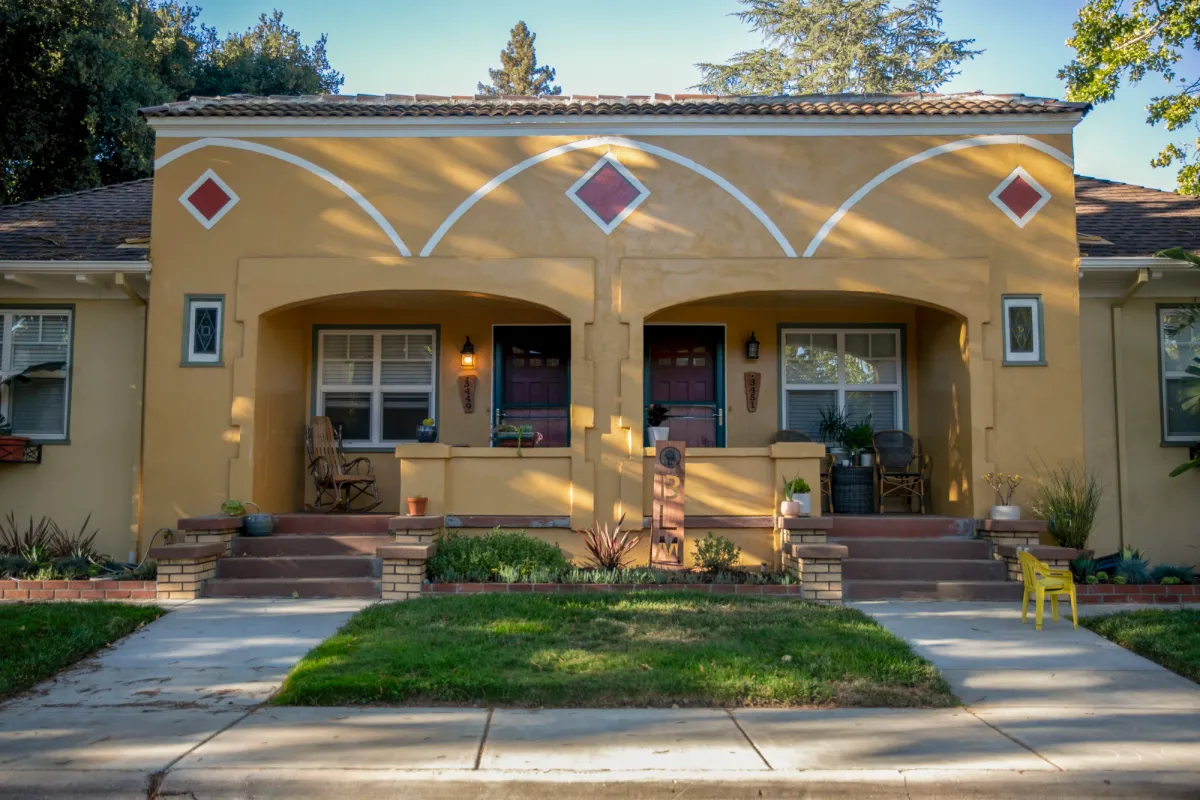
A duplex in East Sacramento. Photo by Anne Wernikoff, CalMatters
###
The state housing department is gearing up to send stern warnings to cities trying to skirt a new housing law advocates hope will bring more affordable housing.
Senate Bill 9, a state law that went into effect Jan. 1, allows property owners to build duplexes and in some cases, fourplexes, on most single-family parcels across the state. Cities, more than 240 of which opposed the bill, have pushed back against the state with ordinances that would severely curb what property owners can build.
The Housing and Community Development Department confirmed it has received complaints about 29 such cities it told CalMatters it plans to investigate. If it determines cities are indeed defying state housing laws, the department will send letters that offer technical assistance, and request a plan to fix those issues within 30 days.
The first of those letters will be sent out “relatively soon,” according to David Zisser, who leads the housing department’s newly created Housing Accountability Unit. Zisser said he hopes the department won’t have to issue letters to all the cities they investigate.
“By the time we send out a few letters, my hope is that jurisdictions will start to see themselves in those letters and start to make corrections to their own ordinances,” he said.
If a second warning letter fails, the state attorney general’s office, with whom they have been coordinating closely, would step in.
In fact, Attorney General Rob Bonta has intervened twice already. Pasadena carved out exemptions for landmark districts within the new law, which could apply to vast swaths of the city. Bonta told the city last month they could face a lawsuit if they didn’t reverse course. In a response letter, the city’s mayor said they are in full compliance with the law.
In February, Bonta also called out Woodside, a wealthy Silicon Valley town that claimed its entirety was protected mountain lion habitat and therefore couldn’t accommodate duplexes. It quickly reversed course following the state’s warning.
Both cities were on the housing department’s list of 29 cities.
The state housing department doesn’t have authority to enforce the duplex law, according to Zisser, which is why the cities on their list will be investigated for defying the 16 housing statutes under their purview, one of which limits a city’s ability to restrict the development of new housing.
Who’s on the naughty list?
Temple City, a Los Angeles suburb of 36,000 with a median home value of nearly $1 million, crafted an ordinance in December — ahead of the law going into effect — with a list of more than 30 development and design standards property owners must meet in order to develop new homes under the state’s new duplex-friendly law. The purpose of the ordinance was not a secret.
“What we’re trying to do here is to mitigate the impact of what we believe is a ridiculous state law,” said councilmember Tom Chavez during a Dec. 21 city council meeting, in which they unanimously adopted an urgency ordinance limiting the effect of the duplex law in the city. He acknowledged the state may push back.
Traditional single-family zoning — with room for one house for a single family with a front yard and a backyard — is what has always attracted people to Temple City, said William Man, another councilmember.
“SB 9, at least in principle, is dismantling that before our eyes,” he said.
Temple’s ordinance says property owners must get rid of their garage or driveway before getting a building permit, and residents of the new unit will be banned from obtaining street parking passes. New tenants can’t own a vehicle and must intend to walk, bike or take ubers around the suburb, according to a planning memo.
The city is also demanding that all new units meet the highest level of LEED certification, a designation typically held by premium office buildings like Facebook’s Headquarters in Menlo Park.
Finally, the new ordinance says new homes can be no larger than 800 square feet — also the minimum set by state law — and must be rented at below-market value to be affordable to low-income families for 30 years, a standard that is echoed across multiple cities’ anti-duplex law ordinances. A family of four would need to make $94,600 or less to qualify, and could only be charged 30% of their total income in rent, or $2,365 a month.
The affordability requirement threatens the viability of these projects, according to Muhammad Alameldin, a policy associate at UC Berkeley’s Terner Center for Housing Innovation who has been reviewing multiple ordinances for an upcoming analysis.
While developers who build affordable housing usually rely on subsidies from the federal and state governments to operate, “These are just homeowners who have no assistance from their localities or from anyone, and lack technical expertise,” he said.
Another city on the housing department’s list: Sonoma, a historic city north of San Francisco known for its ritzy wineries. Besides requiring similar affordability covenants for new housing, Sonoma now requires that any prospective duplex property have at least three mature trees and 10 shrubs. The new duplex unit or singular house would have a maximum area of 800 square feet, and at least 600 square feet of shared yard space.
“What we’re trying to do here is to mitigate the impact of what we believe is a ridiculous state law.”
— Tom Chavez, Temple City councilmember
The count of cities with restrictive ordinances is higher among some pro-housing advocacy organizations, like the California Renters Legal Advocacy and Education Fund. They identified more than 55 cities by following city council and planning department meetings in which “it’s pretty clear the intent is to limit the use of SB 9 as much as possible,” said the group’s executive director Dylan Casey.
The typical median income across the 55 cities was $129,000, while the average home cost $1.9 million.
“With few exceptions, these are mostly the very expensive, very high- income suburbs that are rushing to prevent implementation of SB 9,” Casey said.
A few other cities have engineered creative strategies to work around the law without catching heat from the state yet.
Absent from the state’s watch list is Laguna Beach, a surf town in Orange County, which is playing with geometry to ensure property owners don’t split their lots, according to Isaac Schneider, co-founder of Homestead, a startup that helps homeowners develop Accessory Dwelling Units and more recently, split their lots under the new duplex law.
Schneider said the law’s power lies in lot splits, whereby property owners can cut their land in half to create smaller, more affordable parcels and thus spur homeownership. Laguna Beach’s ordinance says the owner can’t do that, unless the new lot is a perfect rectangle.
That presents an issue, Schneider explained, because the line for most lots would need to be drawn behind an existing house — in the backyard. But in order to have street access, as required by law, planners normally create a flag shape, with a driveway or other access point to reach the new house without demolishing the existing structure. (Sonoma’s ordinance also bans flag lots.)
The ordinance also requires the new lot to border the road for at least 30 consecutive feet. However, the typical lot is 50 feet wide in Laguna Beach, Schneider’s group found. That means if a house is situated in the center of the lot, a lot split would require demolishing the existing home.
“They’ve made a math problem you cannot solve,” Schneider said.
When CalMatters asked if these restrictions would render most projects infeasible, Laguna Beach Community Development Director Marc Wiener wrote in an email: “The intent is that subdivided lots have standard property boundaries and that there is adequate vehicle access to both parcels. Most lots are rectangular and meet the 30-foot frontage requirement, therefore it is not viewed as a limiting factor.”
“With few exceptions, these are mostly the very expensive, very high- income suburbs that are rushing to prevent implementation of SB 9.”
— Dylan Casey, executive director of the California Renters Legal Advocacy and Education Fund
While the duplex law was a nail-biter in the Legislature, and continues to incite resistance among cities, it has barely made a dent in housing production. Planners in Bay Area cities haven’t heard a peep from property owners looking to split their parcels or build a duplex.
Sen. Scott Wiener, a Democrat from San Francisco, says the law has only been in effect for 90 days, and resistance from cities is just a feature of housing legislation in the state.
“It’s not surprising at all that there will be resistance and cities will try to find loopholes,” he said. “We just need to enforce the law, and we now have the attorney general and (the housing department) willing to do that plus private litigants who will sue if need be. And if it turns out that there are loopholes that need to be closed, we can do that.”
But cities are also reverting to legal challenges. A group of four LA County cities, led by wealthy Redondo Beach, filed a lawsuit March 29 in Los Angeles County Superior Court against the attorney general’s office, claiming the state “eviscerated” cities’ land use control.
Bonta’s office issued a statement in response: “We look forward to defending this important law in court and we will not be deterred from our ongoing efforts to enforce SB 9 and other state housing laws.”
###
CalMatters.org is a nonprofit, nonpartisan media venture explaining California policies and politics.
BOOKED
Today: 7 felonies, 6 misdemeanors, 0 infractions
JUDGED
Humboldt County Superior Court Calendar: Today
CHP REPORTS
Briceland Thorn Rd / Ferron Rd (HM office): Traffic Hazard
Us101 (HM office): Defective Traffic Signals
ELSEWHERE
Governor’s Office: Governor Gavin Newsom on California securing massive victory for democracy
Coalition for Responsible Transportation Priorities: A Mixed Bag for Transit
RHBB: Family Searching for 25-Year-Old Man Released from Involuntary Hold at Eureka Hospital
KINS’s Talk Shop: Talkshop September 4th, 2026 – Pam Powell
Whirlybird Alert! PG&E to Conduct Practice Inspections in Low-Flying Helicopters Across Humboldt This Week
LoCO Staff / Sunday, April 10, 2022 @ 1:15 p.m. / Helicopters

Outpost file photo of a PG&E chopper. | Luke Patterson
PG&E press release:
Starting Tuesday, April 12, Pacific Gas and Electric Company (PG&E) will begin conducting practice patrol flights in the North Coast, as part of its efforts to reduce the impact of Public Safety Power Shutoff (PSPS) events on customers.
High winds can cause tree branches and debris to contact energized electric lines, damage equipment and cause a wildfire. As a result, we may need to turn off power during severe weather to help prevent wildfires. PG&E does NOT anticipate initiating a PSPS this week.
During an actual PSPS, power cannot be restored until the severe weather passes and the lines are free of tree branches and other debris. Crews will inspect de-energized lines utilizing aircraft, vehicles, and foot patrols to identify and repair damage before restoring power.
“These practice patrols are designed to gather information that helps PG&E understand the amount of time it takes to safely complete the patrol,” said Ron Richardson, Vice President of PG&E’s North Coast Region. “The pre-patrols improve safety, help us execute the patrol more efficiently and provide key information to determine service restoration timing – all to reduce the impact on our customers during an actual PSPS.”
PG&E will be flying different helicopters at different times Monday through Friday, but not necessarily every day, between the hours of 7:00 a.m. and 5:00 p.m. through the month of April.
Helicopters will fly low, roughly 100 feet, along electric distribution lines within Lake, Mendocino, and Humboldt counties. Patrol areas include:
Annapolis, Bridgeville, Carlotta, Clearlake, Clearlake Oaks, Eel River, Elk, Fort Bragg, Fort Seward, Fruitland, Garberville, Gualala, Harris, Hoopa, Low Gap, Maple Creek, Middletown, Mount Konocti, Point Arena, Rio Dell, Willow Creek.
If hazards or damage is identified during the patrols, they will be reported immediately.
Power will NOT be interrupted during patrols
We are continuing to evolve and improve to keep our customers safe and reduce the impacts of PSPS outages. There is no single solution to reducing the risk of wildfires.
That is why we are:
- Beginning to underground 10,000 miles of distribution powerlines in and near high fire-threat areas as part of an unprecedented, multiyear effort.
- Continuing to upgrade the electric grid by hardening powerlines to reduce wildfire risks.
- Installing sectionalizing devices to narrow the scope of PSPS outages so fewer customers are without power.
- Piloting new technologies that detect threats to the electric grid and rapidly reduce or shut off power.
Every wildfire season is different, and the ongoing drought and the conditions will determine the number of times we will need to shut off power, without compromising safety.
- Installing microgrids that use generators to keep the electricity on during PSPS outages.
PG&E’s Safety Action Center offers information for customers on how to prepare for PSPS events and what they can do to keep their family, home and business safe when outages occur.
(AUDIO) HUMBOLDT HOLDING UP: ‘How About a Bout of Bounskee?’ Local Game Inventor Justin Schwartzman Invites You to Play His Creation
LoCO Staff / Sunday, April 10, 2022 @ 9 a.m. / Humboldt Holding Up
(AUDIO) Justin Schwartzman is Holding Up
Citizens of Humboldt! Should you ever find yourself bored, rest easy knowing the creative folk of our region have done it again and have innovated yet another activity that graciously allows you to keep one hand free to hold a beer and/or joint. Yay, us! Introducing: Bounskee!

What is Bounskee, you are justified in wondering? Bounskee is a new locally made game that borrows elements from both skee-ball and beer pong and can be played by fun-seekers of virtually any age or physical ability. Click that video above and you’ll be hard-pressed to not grasp what’s happening, here. You throw the ping pong ball into the hole, you score points, you feel good. Simple.
On today’s edition of Humboldt Holding Up, we speak with local inventor Justin Schwartzman about how and why he developed Bounskee and what ambitions he has for pushing the game out into the world at large. His creation is already spreading local joy. You may have seen Bounskee units set up in Septentrio Winery, Six Rivers Brewery or Fieldbrook Market. And there’s already a Bounskee league that meets weekly at Humboldt Brews!
Click the audio player above or head over to Apple Podcasts to hear Justin’s chat with LoCO’s Andrew Goff and Stephanie McGeary. And also be sure to scroll our aural rolodex of past HHU guests below.
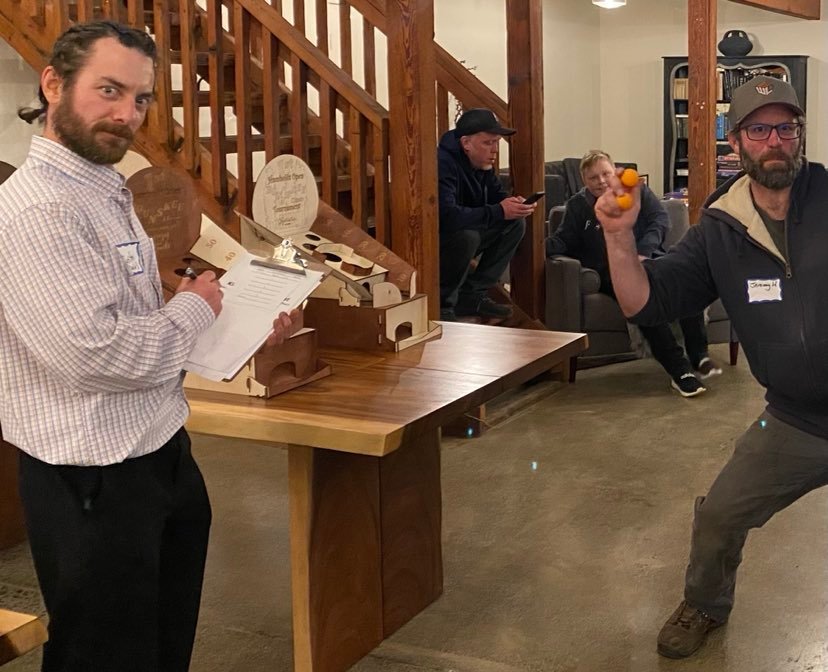
Justin Schwartzman, left, keeps score at a recent Bounskee event. You can learn more on the Bounskee website
PREVIOUS HUMBOLDT HOLDING UP GUESTS:
- #88 Arcata Senior Planner Delo Freitas
- #87 Humboldt County Supervisor Virginia Bass
- #86 Annie’s Cambodian’s Laura Chau-Yang
- #85 Comedian Josh Barnes
- #84 Cal Poly Humboldt’s Jenn Capps, Connie Stewart & Mike Fisher
- #83 Eureka Artist Jesse Wiedel
- #82 Keyboard Veteran Brian Swislow
- #81 Lost Lewis Treasure Hunter Corey Lewis
- #80 “The Cannabis Conversation” Writer Jesse Duncan
- #79 Humboldt COAD’s Alison Sterling Nichols
- #78 Miranda’s Rescue Founder Shannon Miranda
- #77 Eureka Police Department Chief Steve Watson
- #76 ‘The Bartow Project’ Michelle Hernandez and Zuzka Sabata
- #75 Foggy Bottoms Boys Thomas and Cody Nicholson Stratton
- #74 North Coast News’ Nazy Javid
- #73 Pumpkin Carver Mike Craghead
- #72 Eureka Police Department Sergeant Leonard LaFrance
- #71 Eureka Artist Duane Flatmo
- #70 Arcata City Councilmember Sarah Schaefer
- #69 Humboldt Hot Air Director Neroli Devaney
- #68 St. Joe’s James Ladika and Austin Allison
- #67 Eureka Artist Richard Evans
- #66 NCRT’s Calder Johnson
- #65 TV Newsman Dave Silverbrand
- #63 Housing Policy Specialist Brian Heaton
- #62 Muralists Blake Reagan and Lucas Thornton
- #61 Arcata City Councilmember Emily Goldstein
- #60 Kayak Guide Eric Stockwell
- #59 Eureka City Councilmember Natalie Arroyo
- #58 Wiyot Cultural Center Manager Marnie Atkins
- #57 Humboldt County Growers’ Alliance’s Natalynne DeLapp
- #56 RREDC Executive Director Gregg Foster
- #55 Dell’Arte’s Michael Fields
- #54 Llama Wrangler Keagan Trischum
- #53 Crabs President David Sharp
- #52 Organic Dairy Farmers Kristina Radelfinger and Dorice Miranda
- #51 Former Arcata Mayor Alex Stillman
- #50 Cooperation Humboldt’s David Cobb
- #49 Ink People Center for the Arts’ Libby Maynard
- #48 Humboldt Bay Social Co-Owner Amy Cirincione O’Connor
- #47 Musician Lyndsey Battle
- #46 Mad River Brewing CEO Linda Cooley
- #45 LoCO Editor Hank Sims
- #44 Humboldt Republic’s Jason Brandi
- #43 Table Bluff Farmer Hannah Eisloeffel
- #42 Logger Bar Owner Kate Martin
- #41 Teacher/Rapper Zach “Zigzilla” Lehner
- #40 Madaket Captain “Zippo” Libby Tonning
- #39 Event Planner Alegria Sita
- #38 Food For People’s Anne Holcomb
- #37 AHHA President Nezzie Wade
- #36 Performance Artist Noël August/Tucker Noir
- #35 Eureka Mayor Susan Seaman
- #34 Eagle House Owner Jennifer Metz
- #33 Absynth Quartet Drummer Mike “Tofu” Schwartz
- #32 HACHR Executive Director Lasara Firefox Allen
- #31 Alchemy Distillery Owner Amy Bohner
- #30 Eureka City Councilmember Kati Moulton
- #29 Eureka City Councilmember Scott Bauer
- #28 Ungraceful Ager Barry Evans
- #27 Arcata City Councilmember Sofia Pereira
- #26 HumBrews Music Booker Laurel Weston
- #25 Eureka City Councilmember Kim Bergel
- #24 Film Commission’s Cassandra Hesseltine and Nate Adams
- #23 Marble Maker Topher Reynolds
- #22 Arcata Playhouse Director Jacqueline Dandeneau
- #21 Humboldt Political Junkie Eric Kirk
- #20 Rio Dell Mayor Debra Garnes
- #19 Second District Supervisor Estelle Fennell
- #18 Arcata Food Aficionado Jada Calypso Brotman
- #17 Body Piercer Jackie Silva
- #16 Dick Taylor Chocolate’s Adam Dick
- #15 FUHS Teachers Mark Thom and Inma Thompson
- #14 Eureka City Manager Miles Slattery
- #13 Savage Henry Co-Founder Chris Durant
- #12 Eureka Street Art Festival Organizer Jenna Catsos
- #11 SCRAP Humboldt Founder Tibora Bea
- #10 Gym Owner Tyler Parr
- #9 Six Rivers Brewery Co-Owner Meredith Maier
- #8 Multicultural Skincare Therapist Levia Love
- #7 Annie’s Cambodian Server and Social Worker Joshua Coppock
- #6 Eureka City Councilmember Austin Allison
- #5 HSU Professor Deidre Pike
- #4 Pastor Bethany Cseh
- #3 Singer/Songwriter Chris Parreira
- #2 Eureka City Councilmember Leslie Castellano
- #1 Arcata City Councilmember Paul Pitino
GROWING OLD UNGRACEFULLY: Conspiracy Theories and Chaos?
Barry Evans / Sunday, April 10, 2022 @ 7 a.m. / Growing Old Ungracefully
I had an “aha” moment last week reading this month’s Scientific American. The venerable magazine (it began life in 1845) and I go back a long way — I’ve been a subscriber since 1964–and I mostly trust its articles. Lately, it’s gone woke, with several overly political, ultra-liberal, articles that, IMHO, have no place between its covers. With that caveat, it still does a pretty good job covering “science writ large.”
The article in question is short and to the point, under the heading “Fake-News Sharers,” written by two researchers at Duke. They performed eight studies with nearly five thousand participants to figure out who was passing on all the fake stories that crop up in your and my social media feeds daily (hourly?).
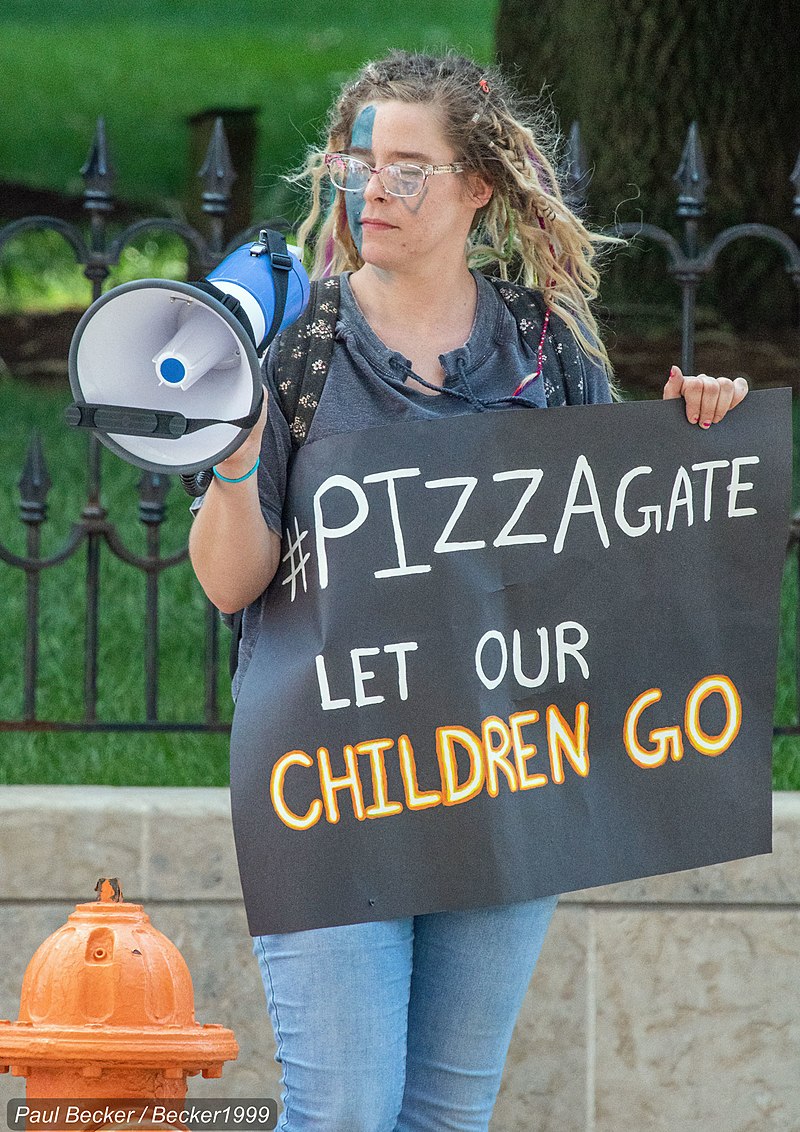
Pizzagate protester (Becker1999 via flickr, Creative Commons license)
Now, we all tend to selectively believe information that jibes with our prior beliefs, and to reject what we don’t already believe. People have long known about “confirmation bias,” sometimes called “the yes-man in our brain.” For instance, around 400 BC, Thucydides wrote, “…it is a habit of mankind to entrust to careless hope what they long for, and to use sovereign reason to thrust aside what they do not fancy.” Confirmation bias is probably built right into our genes: rather than seeking the truth, our ancestors (from whom we inherited instinctive behaviors) presumably tried to avoid the most costly errors. So they tended to believe what someone in their tribe told them, not so much because it was true, but because the cost of disbelieving it — loss of friendship, death — was worse than accepting a dubious assertion.
The Duke researchers found that their test subjects, liberals and conservatives alike, selectively believed what they wanted to be true and what they’d be willing to pass on. One group, however, expressed a desire to share false news more than others: the “LCCs” or low-conscientiousness conservatives. Conscientiousness, a term used in personality tests, “captures differences in people’s orderliness, impulse control, conventionality and reliability.”
The research consisted of: first assessing participants’ political leanings and conscientiousness with tests that looked at their values and behaviors; then presenting their subjects with real and fake COVID-themed news stories, asking if they believed them and whether they’d share them. So far, so good — the participants said they believed and would pass on stories according to their prior beliefs. But — here’s the kicker — even when participants were told that an article which they’d indicated they’d be willing to share was false, LCCs still said they’d share it! But why, if they knew it wasn’t true?
My aha was this: according to the researchers, LCCs “expressed a general desire for chaos…the desire to disrupt and destroy the existing political and social institutions.” That is, they pass on stories they know to be fake because it furthers their desire for chaos.
Never mind whether someone actually believes that Jewish Space Lasers are responsible for wildfires, or that a Washington DC pizzeria kept children chained in its basement, or that the election was stolen (despite rulings to the contrary from 60 courts, including the right-leaning Supreme Court). The point isn’t truth or falsity; rather, it’s whatever furthers the goal of doing away with democracy and law and order. The point is to bring chaos to the nation. Or anarchy. Or fascism. Or revolution. From where I sit, it looks like it’s working.
Have a nice day.
Mad River Brewery CEO to Throw First Pitch at Today’s Giants Game
Isabella Vanderheiden / Saturday, April 9, 2022 @ 11:37 a.m. / :) , Tribes

Mad River Brewery CEO Linda Cooley | Submitted
###
Mad River Brewery CEO and Yurok Tribal member Linda Cooley will hop on the pitcher’s mound this afternoon to throw the first pitch at today’s Giants game at Oracle Park in San Francisco!
The exciting news comes about a month after Mad River Brewery became the first tribal-owned craft brewery to offer its products at a Major League Baseball stadium. Oracle Park now offers a slew of Mad River’s brews including Historic State Park IPA, Steelhead Extra Pale Ale, and Undammed Huckleberry Hopped Hard Seltzer.
“It’s a proud day as a Yurok tribal member to have this opportunity,” Cooley stated in a Facebook post. “I am deeply thankful to the San Francisco Giants for being inclusive, striving for diversity, and being the change. It’s incredible to have my daughter here watching what hard work and values can bring. Nothing is impossible!”
The San Francisco Giants will play the Miami Marlins at 1:05 p.m.
Previously: Mad River Brewing Inks Deal With San Francisco Giants to Provide Beer to Oracle Park
THE ECONEWS REPORT: Microplastic in My Blood?
The EcoNews Report / Saturday, April 9, 2022 @ 10 a.m. / Environment

Photo: 5Gyres:Oregon State University, via WIkimedia. Creative Commons license.
Plastic pollution in our oceans is a high-profile problem.
Jen Savage, Senior Manager of the Plastic Pollution Initiative of the Surfrider Foundation, joins the show to talk about just how bad the problem has gotten — if the headline didn’t give it away, it’s so bad that a recent study found microplastics in human blood — and what can be done to stop the problem.
[Note from Jennifer Savage: Since recording, the tobacco and cannabis industries convinced the state assembly’s Health Committee to gut the state bill that Tom and I discussed. It will no longer ban cigarette or cigar filters, only single-use vaping products.]
AUDIO:
“The EcoNews Report,” April 9, 2022.
LINKS:
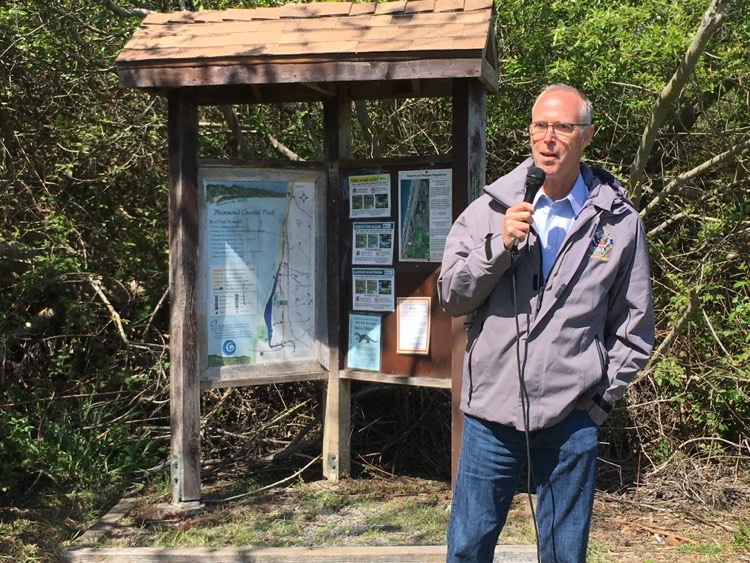
New Bridge Incoming! On a Beautiful Friday Afternoon, Rep. Jared Huffman and Gang Toured the Old Hammond Trail Bridge and Envisioned the New Bridge That Will Replace It
Stephanie McGeary / Saturday, April 9, 2022 @ 8:40 a.m. / Government , Trails
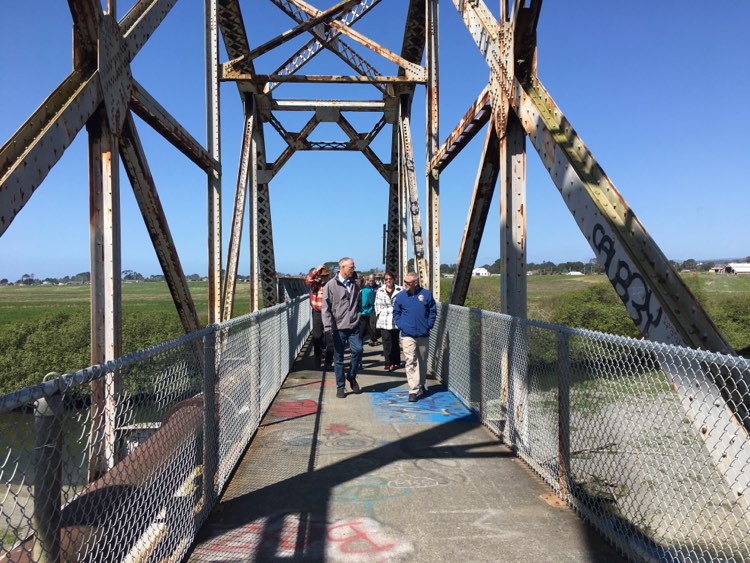
Congressman Huffman and gang walk the rusty and graffiti-covered Hammond Trial Bridge | Photos: Stephanie McGeary
###
For 25 years, Humboldt County staff have been pushing for replacement of the old and deteriorating Hammond Trail Bridge — a segment of the Hammond Trail that crosses the Mad River and provides a non-motorized connection between Arcata and McKinleyville. Now, thanks to $5 million in funding from the Consolidated Appropriations Act, a replacement bridge will soon be a reality.
Congressman Jared Huffman joined Humboldt County staff and elected officials — including Fourth District Supervisor Virginia Bass, Fifth District Supervisor Steve Madrone, Director of Public Works Tom Mattson, Michael Proulx of the Humboldt Trails Council and County Administrative Officer Elishia Hayes — on Friday afternoon to walk the bridge and learn more about the project plans.
“I know that this is a beloved trail in this community,” Huffman said during a press event near the south entrance of the bridge. “And we want to keep it in service and at an even higher standard for generations to come…I’m so pleased that we could bring this five plus million dollars home from Washington to do this critical work.”
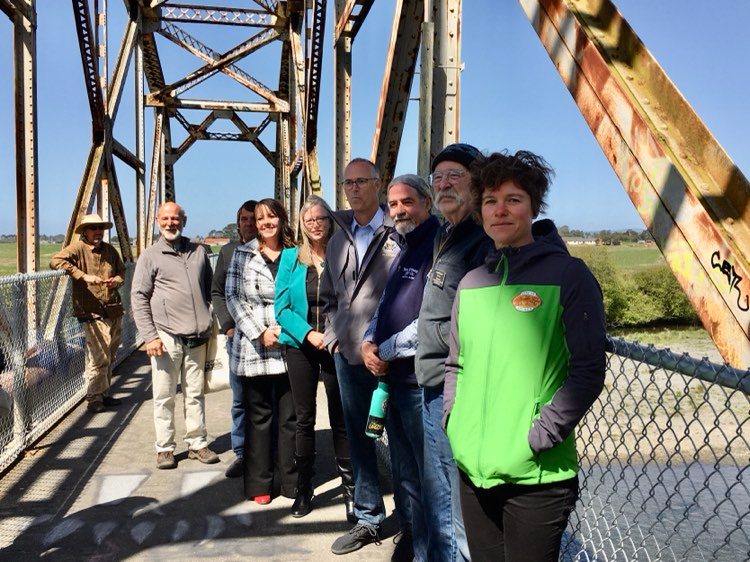
The bridge replacement funding is part of a little more than $6.2 million Huffman secured for projects in Humboldt County — $1 million will be used to expand the Burre Dental Center in Eureka and $218,000 will go toward updating Humboldt County’s Comprehensive Economic Development Strategy (CEDS).
Of course, the heftiest chunk of change — $5 million — will be used for the bridge replacement, a badly needed project that the county has had a very difficult time funding. “I want to express my extreme gratitude to our congressman for bringing this [funding] home,” Mattson said to the crowd gathered near the bridge on Friday. “The replacement of this bridge falls into a no-person’s-land of funding.” Mattson said that the county has applied for state funding for the project multiple times, but has not been approved because state funding tends to go toward new projects, not the replacement of existing projects.
The bridge was built as a railroad crossing in 1941 and converted into a pedestrian and bicycle bridge as part of the Hammond Trail in 1983. Though periodic maintenance has kept it from completely falling apart, the bridge’s steel trusses have badly deteriorated beyond what can be fixed with temporary repairs. County staff has been saying that the bridge needs to be replaced since 1997. Suffice to say, the project is long overdue.
However, the $5 million is not quite enough to cover the entire cost of the replacement, which Mattson said will cost closer to $7 million. So the county will need to seek some additional state funding to finish the project. With the initial funding already in place, staff will begin the design and technical studies this year. If all goes to plan, Mattson told the Outpost, the engineering and environmental review should be complete by 2025 and construction is expected to begin in 2027.
Once complete, the bridge will continue to serve as a part of the Hammond Trail, a connection to the Humboldt Bay Trail and, eventually, the Great Redwood Trail. The timing of the funding has been very exciting for local trails advocates, with the final leg of the Humboldt Bay Trail receiving approval from the California Coastal Commission this week.
“It’s been a very good trail week,” Proulx said during Friday’s event. “And this certainly is a capstone. And, as some people have said, I’m hoping it will lead to more and better things for trails in Humboldt County.”