Election season is just about back! Yeah, we just got done with one of the damn things, but here in California we tend to have them twice a year on the even-numbered years.
On the local level, last election was all about county offices (supervisor, district attorney, auditor-controller, etc.)
This November, it’s gonna be all about your city offices — your mayors and councilpeople and the like. Take the city of Eureka, for example: You’re going to have three seats on the City Council up for a vote — a council majority — as well as the mayorship. Pretty big deal!
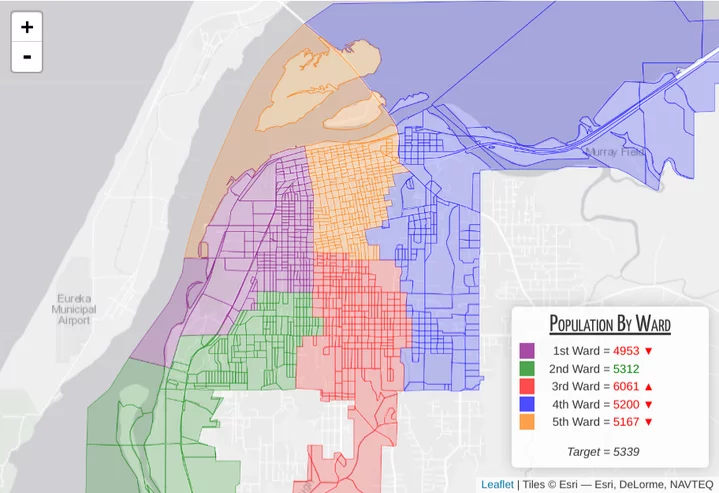
Which seats on the council, you ask? It’s a good question, because Eureka elects its councilmembers by district. Here you go:
The seats up for grabs include the First Ward (purple), the Third Ward (red) and the Fifth Ward (yellow). The First is currently represented by Councilmember Leslie Castellano, who hasn’t yet announced whether or not she is running for reelection (as far as we know). The Third, currently represented by Natalie Arroyo, will be up for grabs: Arroyo was just elected to be a Humboldt County supervisor, and was termed-limited out of office this time around anyway. The Fifth, represented by Kim Bergel, will also be wide open, as Bergel is likewise termed out.
Mayors can live anywhere in the city limits.
Here’s a zoom-inable map. Would you like to run for office? Do you live in any of these districts, or are you willing to pretend to do so plausibly enough to deceive our historically lax anti-carpetbagging enforcement apparatus?
The details are in the following press release from the City of Eureka:
Filing dates for nomination papers to serve as Mayor or Councilmember begin Monday, July 18, 2022 through
Friday, August 12, 2018, at 4:00 P.M. Nomination papers will be available by appointment at the City Clerk’s
Office, City Hall, 531 ‘K” Street, Eureka, beginning July 18th at 9:00 A.M., and must be filed with the City Clerk no
later than the August 12th, 4 PM deadline. Nominations will be accepted for the following offices:
Mayor Full term of four years
Council Member, First Ward Full term of four years
Council Member, Third Ward Full term of four years
Council Member, Fifth Ward Full term of four years
The Eureka Charter requires that anyone filing for the office of Mayor, must be 25 years old and a registered
voter residing in the City limits of Eureka. Those individuals interested in a Council position must be 18 and a
registered voter and resident of the Ward they wish to represent.
Information on the nomination packet is also available on-line at: Candidate Nomination Packet.
Please call Pam Powell, City Clerk for more information or to set up an appointment to review and receive
nominations papers.
Hoopa Valley Tribal member Danielle Rey Frank. All photos contributed by Save California Salmon; Photographed by Carlos Jaramillo; Styled by Marcus Correa. Reprinted from Vogue with permission.
###
Hoopa Valley Tribal member Danielle Rey Frank made a splashy debut in the latest issue of Vogue Magazine for her remarkable work as a youth climate activist. The story is a part of the magazine’s new photographic series, “Tokala,” which spotlights the efforts of BIPOC (Black, Indigenous, and People of Color) youth climate activists across the country.
The article highlights Frank’s work as a young activist with Save California Salmon and focuses on the Hoopa Valley Tribe’s connection to the Trinity River and ever-increasing threats to water quality and critical salmon habitat.
“The Trinity River runs through the heart of the Hoopa Indian Reservation, and our home is beautiful – it’s built around the river,” Frank told Vogue. “We perform our boat dances on top of the river in canoes dressed in regalia. It’s a world-renewing ceremony. It’s meant to balance the good and the bad in the world.”
Frank also describes the decades-long fight to undam the Klamath River. Removal of the four dams along the Lower Klamath River will restore 420 miles of historical salmon runs and reduce temperature conditions that cause disease in threatened fish species and toxic algal blooms.
“It’s going to be the biggest dam removal project in American history,” she continued. “The permits are in the tribe’s hands now; we’ve got indigenous engineers designing the destruction of the dams.”
Frank’s story is a part of the Future Coalition’s Youth Direct Action Fund Tokala project, an effort spearheaded by creative director/stylist Marcus Correa, photographer Carlos Jaramillo and filmmaker Jazmin Garcia. The name “Tokala” comes from the historical Tokala (Kit Fox) Society of the Lakota Tribe, according to the article’s author Christian Allaire — a group of warriors who exhibited bravery and leadership from a young age.
…In the new photography project, which is published exclusively on Vogue, the team set out to find present-day youth who are proving to be leaders in their respective communities.
The team traveled across the U.S. to capture activists—all under the age of 25—and the evolving environments that have motivated their work. “Our goal is to empower all these subjects and give them a platform to hopefully inspire younger generations or other people in their community,” says Jaramillo. The first segment of the series focuses on the West Coast, looking at issues happening in Hoopa Valley—focusing on Frank—and in L.A., where they zeroed in on the activist Atlakatl Ce Tochtli Orozco. “We wanted to shine light on places that have not been given light—getting a good mixture of different regions and issues,” says Correa.
On Tuesday, July 12, the Northern California Condor Restoration Program (NCCRP) will attempt to release a fourth California condor (prey-go-neesh) into Yurok ancestral territory and Redwood National Park, where the critically endangered birds have been absent for more than a century.
The timing of the release is contingent upon a few factors. The NCCRP will wait for free-flying prey-go-neesh to be present at the management facility before they initiate the release procedure. The presence of additional prey-go-neesh will ensure A1 is as calm as possible during the transition into the wild. Prior to the release, A1 must voluntarily enter and exit a staging pen with access to the outside world. The release can be viewed live via the Yurok Condor Cam, which can be found here: https://www.yuroktribe.org/yurok-condor-live-feed The NCCRP is a partnership between the Yurok Tribe and Redwood National and State Parks (NPS).
A1 will join Ney-gem’ ‘Ne-chween-kah (A0), Poy’-we-son (A3) and Nes-kwe-chokw’ (A2), which represent the first prey-go-neesh to soar over Yurok skies since 1892. A1 is the final member of the first prey-go-neesh cohort to be released into the redwood region. The second group of birds is expected to arrive next month for a late summer/early fall release. The NCCRP plans to reintroduce one cohort of prey-go-neesh every year for at least the next two decades.
The NCCRP released the first three prey-go-neesh on two separate days in May. The staggered reintroduction is one component of a comprehensive management plan for the new population. Monitored seven days a week, the previously released prey-go-neesh are adjusting exceptionally well to their new environment. NCCRP biologists and technicians regularly observe the birds exhibiting healthy behaviors, such as feeding, soaring, and finding appropriate and safe roosts. The cultural and environmental restoration project is off to an amazing start.
The Yurok Tribe and Prey-go-neesh
For the Yurok Tribe, prey-go-neesh reintroduction is more than a rewilding project. In a very real way, restoring condor habitat and returning prey-go-neesh to the Yurok landscape signifies progress toward restoration of Yurok culture and traditions. Prey-go-neesh is prominently featured in the Yurok creation story. The condor is also an essential component of the Tribe’s White Deerskin Dance and Jump Dance, both of which aim to bring balance to the world.
The Yurok Tribe started working in earnest on condor reintroduction in 2008. For the Yurok Tribe, the restoration of this sacred species is part of a larger effort to restore the temperate rainforest ecosystem. Initial funding from the US Fish and Wildlife Service allowed the Yurok Wildlife Department to implement a study to determine if Yurok ancestral territory is still capable of sustaining condors. With additional funding support from Redwood National Park, the U.S. Fish and Wildlife Service, the Bureau of Indian Affairs, as well as the Administration for Native Americans, Pacific Gas and Electric Company, Global Conservation Fund, the Redwood National Park Foundation, and many more corporate, agency and private supporters and citizens, the Yurok Wildlife Department completed a vast volume of work to prepare for the reintroduction of this imperiled species.
Working in collaboration with the Ventana Wildlife Society, Redwood National Park, and Pacific Gas and Electric Company, the Tribe designed and built the NCCRP release and management facility. The flight pen includes a simulated, shock-wired power pole (to teach the birds to avoid this threat after release), two four-foot diameter pools and a perch overlooking old-growth redwood forest. NCRRP staff are present 24 hours a day seven days a week to observe the birds from custom-modified shipping containers which form a fire-resistant observation structure, complete with isolation pens, where birds receive regular health evaluations and treatment if required.
Press release from the Humboldt County Sheriff’s Office:
On July 9, 2022, at about 7:38 a.m., Humboldt County Sheriff’s deputies on patrol in the Myrtletown area observed a stolen vehicle parked outside a residence on the 1300 block of Santa Clara Street.
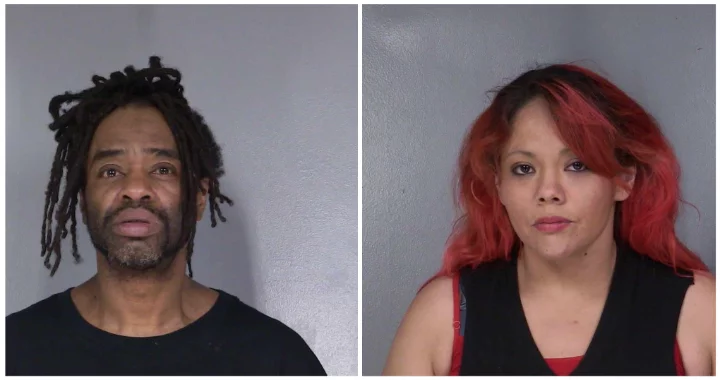
Deputies contacted multiple individuals at the residence, including 53-year-old Anthony Maurice Watkins, who had outstanding warrants for his arrest, and 29-year-old Ashley Weta Sheveland, who was found to be associated with the stolen vehicle.
During a search of Watkins incident to arrest, deputies located approximately four grams of methamphetamine.
Due to the totality of circumstances, including numerous community complaints regarding possible drug activity at this residence and the presence of methamphetamine located during the search of Watkins, deputies requested a search warrant for the residence. The warrant was approved by the Humboldt County Superior Court and a search of the residence was conducted.
During the search, deputies located numerous prescription pills, .5 grams of fentanyl, .75 grams of heroin, over 2 grams of methamphetamine, nearly 12 grams of an unidentified, suspected controlled substance, drug paraphernalia and items consistent with the sale of controlled substances.
All items of evidentiary value were seized, and the case is being forwarded to the Humboldt County District Attorney’s Office for review and prosecution.
Watkins was arrested and booked into the Humboldt County Correctional Facility on charges of possession of a controlled substance (HS 11377(a)), in addition to warrant charges of transportation/sale of a controlled substance (HS 11379(a)).
Sheveland was arrested and booked into the Humboldt County Correctional Facility on charges of possession of a stolen vehicle (PC 496d(a)).
This case is still under investigation. Anyone with information about this case or related criminal activity is encouraged to call the Humboldt County Sheriff’s Office at (707) 445-7251 or the Sheriff’s Office Crime Tip line at (707) 268-2539.
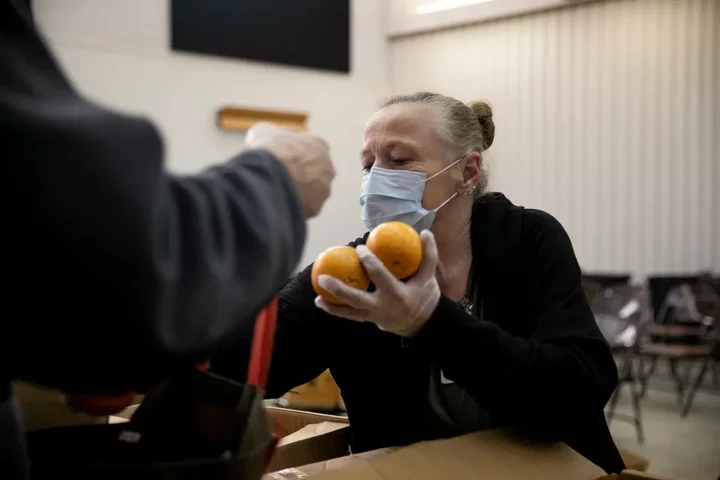
Food bank volunteer Betty Kimmel wears a protective mask as she hands out oranges to seniors in Martinez on March 19, 2020. Photo by Anne Wernikoff for CalMatters.
But the payments, aimed at mitigating higher prices for gas and other goods, will leave out lots of low-income Californians. Among those passed over are some seniors, many living on disability benefits, and some of the lowest-income adults.
That’s because the direct deposits and debit cards — expected to begin arriving in late October and conclude in January 2023 — will be sent out based on tax returns.
About 3 million Californians are in families that earn little enough that they aren’t required to file taxes, according to research by Public Policy Institute of California for its 2019 California Poverty Measure. The poverty rate among people who live in families that don’t need to file taxes is 60%, the institute estimates. Neither the state Department of Finance nor the Franchise Tax Board, which is responsible for collecting state personal income tax in California, knew exactly how many Californinas will be left out of the rebate.
Tying the payments to taxes feels like a Catch–22 to Kerry Weber, a retiree in San Diego. He and his wife live on Social Security retirement benefits, a “tiny” pension and some veterans disability benefits. That adds up to “lots less” for the two of them, he says, than a joint income of roughly $51,000 above which they’d have to pay taxes — so they don’t file.
But Weber has felt inflation squeeze his fixed income. Higher gas prices have made road trips to San Francisco and Tahoe to visit his children pricier, and the lumber he bought to build a table for his granddaughter is now much more expensive.
“They’re saying: ‘Look pal, you don’t make enough money that you and your wife have to file an income tax,’” said Weber. “‘That’s great, I agree with you 100%,’ ‘Oh, by the way, you don’t get any stimulus,’” said Weber. “‘What?’”
Why is this happening?
The Legislature wanted to create a program to send payments to people who don’t file taxes and aren’t enrolled in safety net programs that received a boost in the budget. But after negotiations with the Newsom administration, that proposal didn’t make it into the final budget.
H.D. Palmer, spokesperson for the Department of Finance, said that he couldn’t offer specifics on why the proposal didn’t make it into the final budget, but that proposals from both sides didn’t make it into the compromise.
Representatives for Senate President Pro Tem Toni Atkins and Assembly Speaker Anthony Rendon said nobody could figure out how to administer such payments.
“Ultimately, the configuration of the rebate was subject to three-party negotiations as part of the final budget, and there were concerns that there wasn’t an efficient and secure way of accomplishing a grant program to non-tax filers,” said a statement from the office of Atkins, a San Diego Democrat.
The Legislature “really wanted to get help to these people, but … we were not able to do it logistically,” said a spokesperson for Rendon, a South Gate Democrat.
Sen. Toni Atkins has taken at least
$1.8 million
from the Labor
sector since she was elected to the legislature. That represents
20%
of her total campaign contributions.
Who’s in and who’s out?
The payments will go out to Californians who filed 2020 tax returns by October 2021, according to the Franchise Tax Board, which has a tool for calculating how much you are eligible to receive based on how much you earn and other factors.
But in California, people earning less than $19,310 who don’t have a child or someone else depending on them — one of many different gross income thresholds — aren’t required to file income taxes. The state also doesn’t count Social Security retirement or disability benefits as taxable income, meaning people who receive those benefits aren’t required to pay taxes, so long as they have minimal other income.
Lawmakers tried to aid some low-earners who may not file taxes by increasing payments for people receiving CalWorks benefits, a program for needy families. They also increased benefits for people who receive Supplemental Security Income — a state-supplemented version of social security benefits for senior or disabled people who would otherwise not qualify for, or have extremely small social security payments.
The boosts for people in those two programs are good, said Trinh Phan, a senior staff attorney focused on economic security at Justice in Aging, which advocates for low-income older adults. But, she said, the budget package still leaves out some people who are very low-income.
For example, someone getting by just on Social Security Disability Insurance could miss out on this rebate and the boosts to CalWorks and Supplemental Security Income: They might earn little enough that they don’t have to file taxes, but if they don’t have kids they likely won’t qualify for CalWorks. And, if their disability benefits pay more than $1060.21 per month, they wouldn’t qualify for Supplemental Security Income either, said Phan.
Some low-income Californians won’t receive the rebate, Department of Finance spokesperson H.D. Palmer said. But he pointed out that many people who aren’t required to file taxes still choose to do so, sometimes to receive other benefits distributed through the system. In 2020, an additional 500,000 low-income tax returns were filed in California, Palmer said in a statement, “presumably to qualify for a Golden State Stimulus payment or perhaps even a federal relief payment.” Palmer also pointed to other forms of financial assistance in the budget, such as $1.4 billion in aid for people with unpaid utility bills.
Still, some aren’t impressed.
“This sucks,” said Brooke Hamlin, an 81 year-old who lives off of Social Security retirement benefits in San Rafael. She said she gets by on less than $20,000 per year, padded out with food stamps and Meals on Wheels. “It’s arranged so that the poorest, neediest people don’t get it,” Hamlin said.
Hard to reach
People who don’t pay taxes and aren’t in a benefits program run by California are hard for the state to reach quickly with aid. Social security benefits are administered by the federal government, and the state doesn’t have data on recipients, said Jesse Rothenstein, a professor of public policy and economics at University of California, Berkeley, and faculty director of the California Policy Lab.
“It’s obviously not great that we’re missing people, and many of them are some of the most vulnerable people in the economy,” said Rothenstein. But, he said, “It’s not as if there’s a mechanism available that reaches everybody.” Given a set of imperfect options, using the tax system was the best choice, Rothenstein said.
“To see that they have done it again this year is just further proof that nobody’s paying attention to people who need the most help,” said Charis Hill, a disability advocate who lives in Sacramento.
“It’s obviously not great that we’re missing people, and many of them are some of the most vulnerable people in the economy.” — Jesse Rothenstein, professor of public policy and economics at UC Berkeley
California’s government doesn’t know much about the people who don’t file taxes. The Franchise Tax Board doesn’t track the number of residents who aren’t required to file taxes, or what share of those people live in poverty, according to statements in response to CalMatters’ questions. A spokesperson for the board said that no state agencies appear to track that information.
The difficulty of reaching people with this payment exposes a weakness in the state’s system “that needs to be addressed on a longer-term basis,” said Chris Hoene, executive director of the California Budget and Policy Center, which advocates for targeting aid to lower-income people. Part of the solution would be better data sharing between the federal government and the states, he said.
But, given the options policymakers were considering — including giving money to car owners, as Gov. Newsom proposed, and cutting the gas tax — he thinks the payments based on income are a good outcome.
Weber, the San Diego retiree who missed out on both Golden State Stimulus payments and also won’t receive the rebate this year, is frustrated.
“I feel like I’m shoveling doo-doo against the tide here,” he said.
###
CalMatters.org is a nonprofit, nonpartisan media venture explaining California policies and politics.
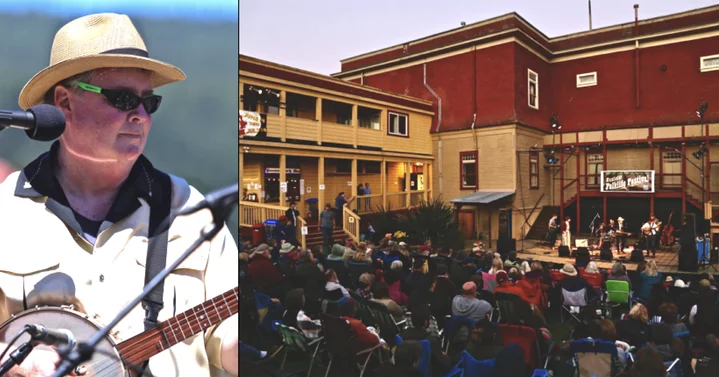
Humboldt’s summer of returning joys continues this coming week with the first edition of the Humboldt Folklife Festival to take place out in Blue Lake since the fun-killing pandemic made gathering with community virtually impossible. Starting Thursday, Dell’Arte’s Rooney Amphitheater will again host a collection of the county’s finest musicians. And if you think recent hip replacement surgery is going to stop longtime festival organizer Patrick Cleary from tappin’ his toe (or jumpin’ up on stage), well, you don’t know Patrick.
On this week’s episode of Humboldt Holding Up — the Lost Coast Outpost’s feisty lo-fi podcast experiment — Cleary shares what it means to him to be able to again offer a forum for local performers to show their stuff and chats about the various acts scheduled to appear this year. We also discuss his time as head of the Humboldt Area Foundation and (full disclosure) LoCO‘s parent company Lost Coast Communications.
Click the audio player above or head over to Apple Podcasts to hear Patrick gab it up with LoCO’s Stephanie McGeary and Andrew Goff and/or make sure to take a gander at the below list of other locals we’ve convinced to Zoom with us.
Despite the fact that 61% of adults in this country say abortion should be legal all or most of the time, on June 24, the Supreme Court overturned the 1972 Roe vs. Wade ruling. Considering that 1 in 4 women in the U.S. will have had an abortion by the time they are 45, this was an act of breathtaking misogyny.
When I first heard about the impending decision by the SCOTUS (leaked by Politico on May 2), my initial reaction was one of anger and despair, followed by, “I wonder just how much difference this will make in the real world?” Like the War on Drugs and criminalization of miscegenation and gay sex, people are smart and will find a way around ridiculous/racist/homophobic laws. Except that many women—especially young girls who have just missed their period—aren’t just “people.” They’re often vulnerable, frightened and poor, perhaps without access to the internet. Which is why it’s vital to get the word out about “medical abortion.”
Medical abortions, which currently account for about 55 percent of abortions in this country (and 90% in several European countries), are brought about by two oral drugs, mifepristone and misoprostol. Taken one at a time over two days, they induce what are essentially miscarriages. It’s a well-tested protocol, initially approved by the FDA in 2000 and revised (smaller doses, fewer side effects) in 2016, recommended for up to 10 or 11 weeks after a woman’s last period. The overwhelming evidence is that the procedure is effective (98%) and safe: less than 1 in 200 medical abortions using this method result in hospitalization, usually for infection. Last December, the FDA removed a previous restriction on mailing the pills to patients.
So will the availability of the two-pill regime nullify the effects of undoing Roe vs. Wade? It will certainly temper them, as borne out last year by the experience in Texas following its ban on abortions after six weeks of pregnancy (typically before a woman knows for sure she’s pregnant!). There, the abortion rate only fell by about ten percent. Women were either getting abortions by traveling to other states, or they obtained abortion pills for self-medication online from Plan C or similar organizations. (The M+A hotline has excellent information about self-managing an abortion.)
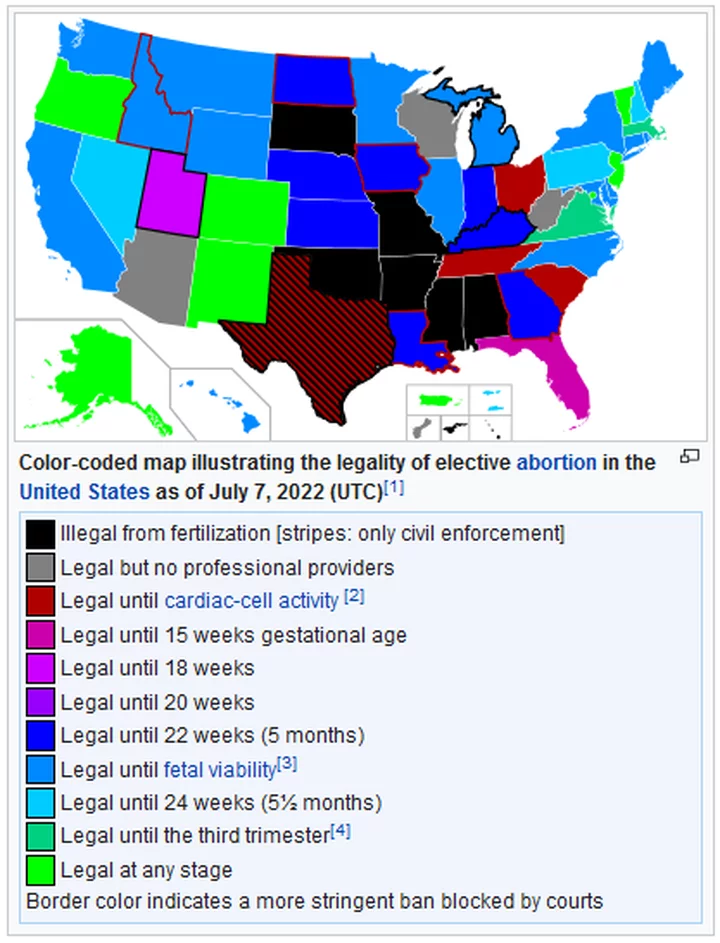
Note, “fetal viability” = 23 or 24 weeks after conception. (Wikipedia)
However, medical abortion is far from a universal solution for getting around the laws in about half the country where states now ban, or are about to ban, legal abortions. Even before the SCOTUS decision, abortion was being criminalized. Last April in Texas, for instance, the over-zealous Starr County Sheriff’s Department charged 26-year-old Lizelle Herrera with murder for an alleged self-induced abortion, holding her on a $500,000 bail. (She was later released, with an apology from the DA.)
So the problem for a pregnant woman wanting an abortion is fear of criminal prosecution for breaking the law if she lives in an anti-abortion state. We can expect anti-abortion groups to capitalize on this fear. Already, about 1 in 10 Google searches for abortion advice result in links to “crisis pregnancy centers” whose mission is to actually prevent someone getting an abortion. Look out for fake websites pretending to sell abortion pills or, worse, actually selling fake pills, thus deceiving a woman into thinking she’s successfully aborted.
Here in California, women live in comparative freedom regarding abortions. The state’s Penal Code (section 187) “demonstrate[s] that a woman cannot be prosecuted for murder as a result of her own omissions or actions that might result in pregnancy loss” per California Attorney General Rob Bonta. Bonta recently wrote to his fellow AGs in other states urging them not to prosecute women (or their doctors) for abortions.
If you believe, as I do, that it’s nobody’s business other than a woman’s if she chooses to abort her fetus, we can all help make sure the procedure is safe and readily available. Planned Parenthood is leading the charge to ensure than any woman wanting an abortion can obtain reliable information about her options and has access to self-medication via the two-pill regime. That organization can use all our support and donations.