

Ulisses Rodriguez Sentenced to Life in Prison for the Murders of Jeremy Kuemmel and Tiffany Ellebrecht
Rhonda Parker / Monday, April 4, 2022 @ 9:21 a.m. / Courts

After the grieving family members of victims Jeremy Kuemmel and Tiffany Ellebrecht spoke about how their lives had been destroyed by their gruesome murders, Judge Gregory Elvine-Kreis turned and faced their killer.
“I hope those words resonated with you, Mr. Rodriguez,” the judge said to Ulisses Rodriguez. “Because you’re going to have a long time to think about them. Mr. Rodriguez, it is the judgment and sentence of this court that you serve life in prison without the possibility of parole.”
Rodriguez, now 26, shot Kuemmel and Ellebrecht to death on Aug. 14, 2018, because he believed Kuemmel stole some marijuana plants from the grow site Rodriguez was managing in Southern Humboldt. Kuemmel, 32, and Ellebrecht, 31, had been working and living at the site.
“He killed two people for reasons that are ridiculous,” said Daniel Kearney, Kuemmel’s uncle and the first speaker at the sentencing. He said his nephew “may have been a lot of things, but he was not a thief.”
Kearney said that while Rodriguez was running around acting like “a big shot,” his nephew was at the grow site “starving” and with no fuel.
Kuemmel took a few young plants worth $20 to $30 each to get money for necessities, Kearney said. And for that he lost his life.
Kearney, along with other speakers on Friday, called Rodriguez a monster.
“I’d love to be able to threaten him,” Kearney said. “I’d love to be able to call him every name in the book.”
Instead, Kierney said, he can just hope Rodriguez has a “long, long long time to think about this and then dies in prison.”
Suzanne Palmieri, who called herself “Jeremy’s second mom,” said “none of us should be here today. We’re here only because of the actions of a monster.”
Another speaker, Ellebrecht’s sister-in-law Tess Ellebrecht, told Rodriguez Kummel was a wonderful person who would have made a great friend.
“You would have benefited from his friendship,” she told Rodriguez. He sat stiffly, staring forward, as people spoke about their grief and pain.
“He killed himself the day he killed Tiffany and Jeremy,” said Ellebrecht, who was not only Tiffany’s sister-in-law but a close, lifelong friend of hers.
“I hope you see Jeremy and Tiffany around every corner,” she told Rodriguez.
What was actually on Rodriguez’s mind was getting his sentencing postponed. Before the sentence was imposed, Rodriguez said he hadn’t had the required time to review his Probation Department report with his attorney, Andrea Sullivan.
Although the Probation Department submitted the report on March 24, Sullivan hadn’t received it as of Friday morning. She appeared via Zoom from her Lake County office to announce this. Elvine-Kreis ordered her to drive to Humboldt County to go over the report with Rodriguez. She said she could be here by 1:30 or 2 p.m., but ended up arriving after 3 p.m., keeping many people waiting for hours. The judge told her off for that.
When the sentencing finally began, Sullivan said she was ready but Rodriguez wasn’t. He wanted to address the judge.
“Your Honor I was hoping to have more time,” Rodriguez said. “I was supposed to have it (the probation report) four or five days and go over it with her (Sullivan.) Me and her were going to sit down and talk about motions, including a motion for new trial.”
Elvine-Kreis interrupted him, saying his attorney was prepared to go forward with sentencing and he had received no motions indicating otherwise. Rodriguez tried talking over the judge.
“Stop talking,” Elvine-Kreis warned him. “I’m not talking to you.”
“I haven’t been able to talk to her, Your Honor.”
Elvine-Kreis closed the courtroom for 10 minutes so Rodriguez and Sullivan could confer. By the time the public was allowed back in, Rodriguez had filed a motion to replace Sullivan as his lawyer. The judge denied the motion.
Several speakers expressed their sympathy for Rodriguez’s family. Martin and Georgina Rodriguez drove from Chico to attend the sentencing, accompanied by Ulisses Rodriguez’s 8-year-old son Sebastian. The boy was not in court to see his father sentenced, remaining in the courthouse hallway with his grandmother.
Kuemmel and Ellebrecht were shot dead, then chained together and put in the back of Kuemmel’s SUV, which was set on fire. Their bodies were burned beyond recognition.
Deputy District Attorney Luke Bernthal, the trial prosecutor, was in court for his office. At least one of the jurors from Rodriguez’s trial attended the sentencing.
PREVIOUSLY:
- Chico Man Arrested in Connection to Two Bodies Found Inside Burning Vehicle Near Ettersburg Junction
- Chico Man Pleads Not Guilty to SoHum Double Homicide
- Preliminary Hearing Set for Chico Man Charged With SoHum Double Murder
- Chico Man Held to Answer for Murder of SoHum Couple in Dispute Over Stolen Weed
- COURT ROUNDUP: Trial for Suspect in Gruesome SoHum Double Murder Set for Christmas Eve; Godoy-Standley Judged Mentally Competent; Fortuna Murderer Gets Two Years’ Credit
- HUMBOLDT COURT ROUNDUP: Updates on Two Murder Cases, Two Attempted Murder Cases
- COURT ROUNDUP: Mck Woman to Plead Guilty to Manslaughter; Hoopa Man’s Murder Trial Set to Begin; More Updates
- TODAY in COURT: Bear River Triple-Murderer’s Sentencing Delayed; Double-Murder Trial Over SoHum Couple’s 2018 Deaths Scheduled to Start Next Week
- TODAY in COURT: Two Local Murder Cases Moving Forward
- RODRIGUEZ TRIAL: First Testimony in SoHum Double Murder Trial Describes How the Burning Vehicle and Bodies Inside Were Found
- RODRIGUEZ TRIAL: Terrified Witness Describes Being Forced to Handle Bodies at Gunpoint
- RODRIGUEZ TRIAL: Detective Describe How They Tracked Down Double Murder Suspect and a Witness
- RODRIGUEZ TRIAL: Accused Murderer Spent the Days After Killing Searching for New Cars and Reading About the Crime, Investigator Testifies
- RODRIGUEZ TRIAL: Text Messages Suggest SoHum Murder Suspect Was Planning to Rob His Own Grow Operation, Prosecution Argues
- RODRIGUEZ TRIAL: Medical Examiner, Other Evidence Specialists Testify to Manner of Victims’ Deaths
- RODRIGUEZ TRIAL: Defense Lays Out Alternative Theory of the Double Murder as the Case Goes to the Jury
- RODRIGUEZ TRIAL: Guilty On All Charges, Says Juror; Convicted Double Murderer Could Face Life in Prison
BOOKED
Today: 7 felonies, 6 misdemeanors, 0 infractions
JUDGED
Humboldt County Superior Court Calendar: Today
CHP REPORTS
No current incidents
ELSEWHERE
Governor’s Office: Governor Gavin Newsom on California securing massive victory for democracy
Coalition for Responsible Transportation Priorities: A Mixed Bag for Transit
RHBB: Family Searching for 25-Year-Old Man Released from Involuntary Hold at Eureka Hospital
KINS’s Talk Shop: Talkshop September 4th, 2026 – Pam Powell
(AUDIO) HUMBOLDT HOLDING UP: Catching Up on the Arcata Gateway Plan With Senior Planner Delo Freitas
LoCO Staff / Sunday, April 3, 2022 @ 9 a.m. / Humboldt Holding Up

Arcata Senior Planner Delo Freitas spends many of her waking hours thinking about Arcata’s Gateway Plan
(AUDIO) Delo Freitas is Holding Up!
With Cal Poly Humboldt’s ambitious expansion goals and the potential for growth in other new and existing industries around Humboldt, City of Arcata officials have been diligently working to figure out how to accommodate an expected influx of people who might want a foggy college town as the setting for their story. As part of those efforts, it’s been nearly a year since the City of Arcata announced its Gateway Plan, which designates a 138 acre section of the city west of downtown as an area of focus for future high-density housing projects.
On today’s episode of Humboldt Holding Up — LoCO’s good-enough Zoom-aided podcast thingy — we attempt to get an idea on how the Gateway Plan is progressing with Delo Freitas, a senior planner with the City of Arcata.
Click the audio player above or head over to Apple Podcasts to hear Delo’s chat with LoCO’s Andrew Goff and Stephanie McGeary. And also be sure to scroll our aural rolodex of past HHU guests below.
PREVIOUS HUMBOLDT HOLDING UP GUESTS:
- #87 Humboldt County Supervisor Virginia Bass
- #86 Annie’s Cambodian’s Laura Chau-Yang
- #85 Comedian Josh Barnes
- #84 Cal Poly Humboldt’s Jenn Capps, Connie Stewart & Mike Fisher
- #83 Eureka Artist Jesse Wiedel
- #82 Keyboard Veteran Brian Swislow
- #81 Lost Lewis Treasure Hunter Corey Lewis
- #80 “The Cannabis Conversation” Writer Jesse Duncan
- #79 Humboldt COAD’s Alison Sterling Nichols
- #78 Miranda’s Rescue Founder Shannon Miranda
- #77 Eureka Police Department Chief Steve Watson
- #76 ‘The Bartow Project’ Michelle Hernandez and Zuzka Sabata
- #75 Foggy Bottoms Boys Thomas and Cody Nicholson Stratton
- #74 North Coast News’ Nazy Javid
- #73 Pumpkin Carver Mike Craghead
- #72 Eureka Police Department Sergeant Leonard LaFrance
- #71 Eureka Artist Duane Flatmo
- #70 Arcata City Councilmember Sarah Schaefer
- #69 Humboldt Hot Air Director Neroli Devaney
- #68 St. Joe’s James Ladika and Austin Allison
- #67 Eureka Artist Richard Evans
- #66 NCRT’s Calder Johnson
- #65 TV Newsman Dave Silverbrand
- #63 Housing Policy Specialist Brian Heaton
- #62 Muralists Blake Reagan and Lucas Thornton
- #61 Arcata City Councilmember Emily Goldstein
- #60 Kayak Guide Eric Stockwell
- #59 Eureka City Councilmember Natalie Arroyo
- #58 Wiyot Cultural Center Manager Marnie Atkins
- #57 Humboldt County Growers’ Alliance’s Natalynne DeLapp
- #56 RREDC Executive Director Gregg Foster
- #55 Dell’Arte’s Michael Fields
- #54 Llama Wrangler Keagan Trischum
- #53 Crabs President David Sharp
- #52 Organic Dairy Farmers Kristina Radelfinger and Dorice Miranda
- #51 Former Arcata Mayor Alex Stillman
- #50 Cooperation Humboldt’s David Cobb
- #49 Ink People Center for the Arts’ Libby Maynard
- #48 Humboldt Bay Social Co-Owner Amy Cirincione O’Connor
- #47 Musician Lyndsey Battle
- #46 Mad River Brewing CEO Linda Cooley
- #45 LoCO Editor Hank Sims
- #44 Humboldt Republic’s Jason Brandi
- #43 Table Bluff Farmer Hannah Eisloeffel
- #42 Logger Bar Owner Kate Martin
- #41 Teacher/Rapper Zach “Zigzilla” Lehner
- #40 Madaket Captain “Zippo” Libby Tonning
- #39 Event Planner Alegria Sita
- #38 Food For People’s Anne Holcomb
- #37 AHHA President Nezzie Wade
- #36 Performance Artist Noël August/Tucker Noir
- #35 Eureka Mayor Susan Seaman
- #34 Eagle House Owner Jennifer Metz
- #33 Absynth Quartet Drummer Mike “Tofu” Schwartz
- #32 HACHR Executive Director Lasara Firefox Allen
- #31 Alchemy Distillery Owner Amy Bohner
- #30 Eureka City Councilmember Kati Moulton
- #29 Eureka City Councilmember Scott Bauer
- #28 Ungraceful Ager Barry Evans
- #27 Arcata City Councilmember Sofia Pereira
- #26 HumBrews Music Booker Laurel Weston
- #25 Eureka City Councilmember Kim Bergel
- #24 Film Commission’s Cassandra Hesseltine and Nate Adams
- #23 Marble Maker Topher Reynolds
- #22 Arcata Playhouse Director Jacqueline Dandeneau
- #21 Humboldt Political Junkie Eric Kirk
- #20 Rio Dell Mayor Debra Garnes
- #19 Second District Supervisor Estelle Fennell
- #18 Arcata Food Aficionado Jada Calypso Brotman
- #17 Body Piercer Jackie Silva
- #16 Dick Taylor Chocolate’s Adam Dick
- #15 FUHS Teachers Mark Thom and Inma Thompson
- #14 Eureka City Manager Miles Slattery
- #13 Savage Henry Co-Founder Chris Durant
- #12 Eureka Street Art Festival Organizer Jenna Catsos
- #11 SCRAP Humboldt Founder Tibora Bea
- #10 Gym Owner Tyler Parr
- #9 Six Rivers Brewery Co-Owner Meredith Maier
- #8 Multicultural Skincare Therapist Levia Love
- #7 Annie’s Cambodian Server and Social Worker Joshua Coppock
- #6 Eureka City Councilmember Austin Allison
- #5 HSU Professor Deidre Pike
- #4 Pastor Bethany Cseh
- #3 Singer/Songwriter Chris Parreira
- #2 Eureka City Councilmember Leslie Castellano
- #1 Arcata City Councilmember Paul Pitino
GROWING OLD UNGRACEFULLY: Fear of Flying and Other Probabilities
Barry Evans / Sunday, April 3, 2022 @ 7 a.m. / Growing Old Ungracefully
When dealing with probabilities, our intuition, or gut feeling, is easily fooled. F’rinstance, you may be familiar with the “birthday paradox” — not really a paradox, it just seems so. Imagine you’re at a party with 22 other people. You announce what day and month your birthday falls on. Then a second person does the same. And so on until everyone has stated their birthday. Turns out, in a room of 23 people, the odds of two of you sharing the same birthday are better than 50/50. It seems paradoxical because you’re putting 23 people up against 365 days in a year.
Here’s how it works. (Skip what follows if you hate math.) In a group of 23 people, there are 253 one-on-one comparisons to make (22 + 21 + … + 1), that is, 253 chances for matching birthdays. The chance of two people not having matching birthdays is 364/365, so with 23 people having 253 chances of matching birthdays, the chance of no matches is (364/365)^253, or slightly less than 50%. QED.
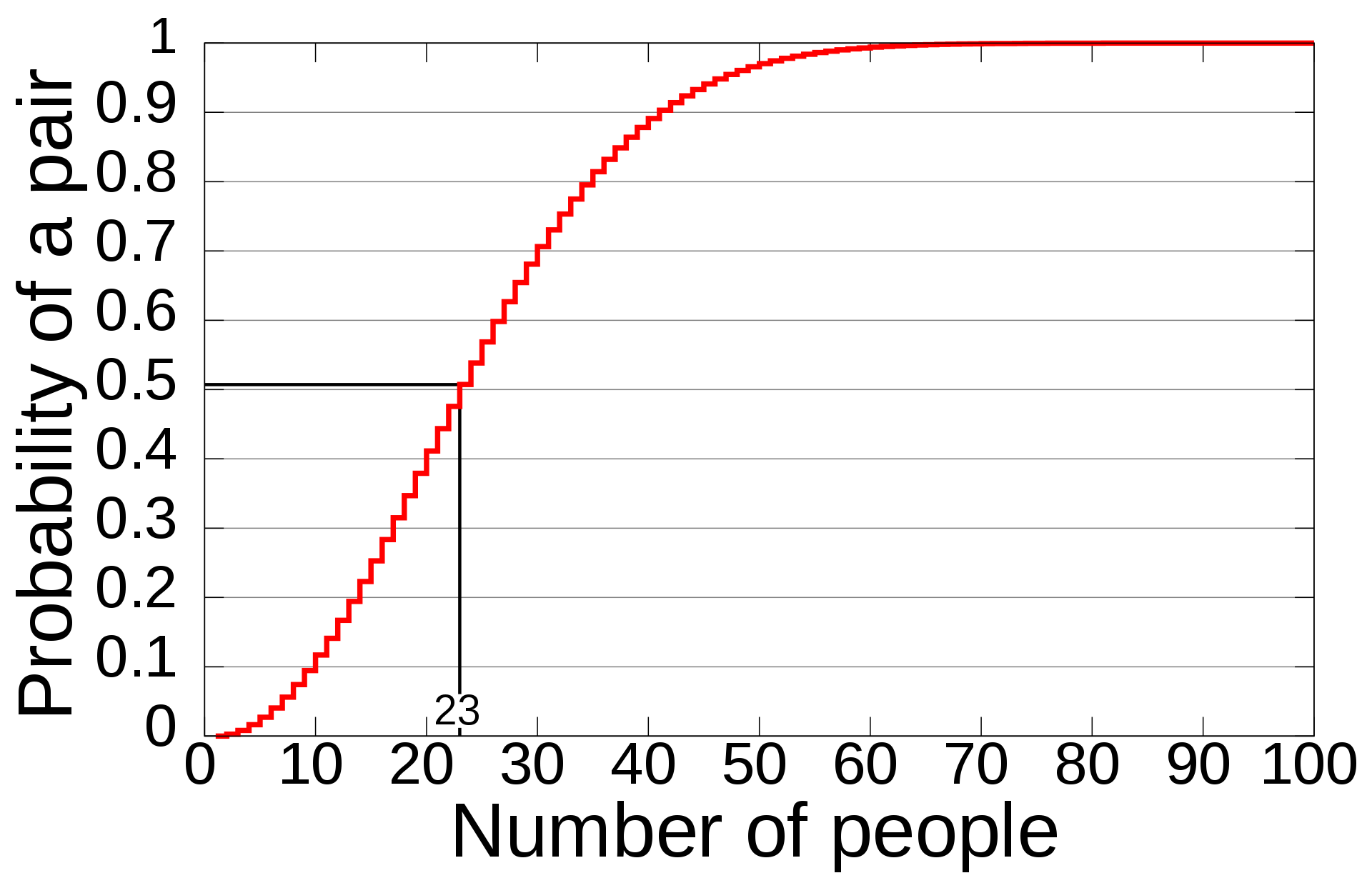
Graphic: Rajkiran g, via Wikimedia. Creative Commons license.
Another non-intuitive probability is taken seriously by a couple of my “fear of flying” friends, otherwise perfectly sensible and rational people. I point out that the average American has about a 1 in 11 million chance of dying in a plane crash in any one year (—they’d have to fly every day for 10,000 years before having a 50/50 chance of being in a crash). They’re unmoved. “Maybe,” they say, “but my odds are 1 in infinity, so long as I don’t fly.” “But you drive, and your annual odds are about 1 in 5,000 of dying in a car accident,” I’ll say.
It’s more nuanced than that, of course. In a plane, we’re essentially passive cargo. But when we drive, we’re in charge, and even passengers can see where they’re going. Flying, we have to have faith that the folks up front know what they’re doing. (They do.) Following 9/11, some of that faith was lost: fewer people flew and more drove, which probably accounts for the additional 700-1,000 people who died in vehicle crashes from October through December, 2001, as compared to the same months in 2000.
Then there’s the awareness aspect. Plane crash = headlines; car crash = meh. The media teaches us to be far more scared of plane crashes than car crashes, and while our brains may be skeptical, our guts don’t work that way. (Similarly, our media hypes mass shootings, yet over 99% of U.S. gun deaths — 45,222 in 2020 — are unrelated to mass shootings, according to the CDC. Most are suicides.)
How each of us deals with odds depends, not only on understanding the math, but also on our individual personalities. Are you, for instance, a risk-averse Volvo driver or a risk-loving freestyle rock climber? Here’s an easy test: I offer you a choice: $20 or — depending on a coin toss — either $40 (heads) or $0 (tails). Which do you take? Me, I’d go with the second choice (and have, in the past, to my net benefit).
Now you’re up on probability, here’s a tricky one. You’re shown two urns, one of which contains one black and one white ball; the other contains two black balls. You pick one urn at random and put your hand in, pulling out one ball: it’s black. What’s the probability that the second ball in that urn is also black? (I’ll post the answer in the “comments” section of LoCO tomorrow, Monday.)
LETTER FROM ISTANBUL: At The Ukraine-Russia Peace Talks
James Tressler / Sunday, April 3, 2022 @ 7 a.m. / Letter From Istanbul
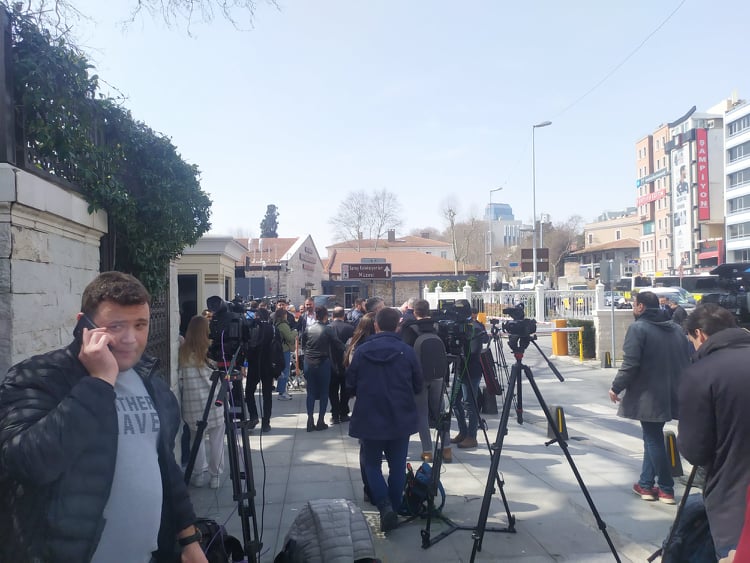
Photo: Tressler.
PREVIOUSLY:
- LETTER FROM ISTANBUL: The War To The North, And The Quiet Here
- LETTER FROM ISTANBUL: Eye on the Bosphorus
- VIDEO POSTCARD FROM ISTANBUL: Outside the Russia-Ukraine Peace Talks
###
When I wrote last week that the Bosphorus may yet have a role to play in the Ukraine-Russia war, I wasn’t far wrong.
First, several mines were found floating in the Bosphorus, having drifted south from the Black Sea. Fortunately, they were diffused and disposed of without incident. And then it was announced that Ukrainian and Russian delegates were meeting in Istanbul to discuss a possible peace settlement. Never mind playing a role; for the moment at least, Istanbul was at the center of the world’s stage.
On the ferry last Tuesday morning, I found myself scanning the smooth waters of the Bosphorus for any stray mines (not that I would know what to do if one was spotted – was I going to cry out “Ahoy! Mine, starboard?”) and looked out at the guilded façade of Dolmabahçe Palace on the distant shore, where the two-day meetings were to take place. President Erdoğan was even in town, and would greet the delegations at 10:30, according to the news reports.
I was excited, nervous. It was shaping up to be a big day, possibly even historic – although not much was expected to come of the talks, even as the war drags into its second month, with thousands of refugees having arrived here in Turkey and elsewhere. The question, heading into the meeting, was whether the two sides could agree to a ceasefire, which reports indicated was probably unlikely.
The meetings were to be held in the presidential working office, a part of the palace that is closed to the public. When I arrived mid-morning, traffic along the main avenue was busy as usual – it was not blocked off. The sidewalk near the working office was barricaded. Police and men in camo, carrying machine guns, were posted in and around the entrance, while other security personnel patted down the journalists and checked their IDs.
Reporters, their TV cameras and other gear, were already in good numbers along the sidewalk. They all looked busy and focused, while I drifted about rather nervously, feeling self-consciously out of place. I passed an Asian TV presenter giving her stand up report, and browsed the other crews, including CNNTurk. Other reporters and their crew were speaking in Russian.
On a slim, stray hope, I walked up to the entrance, where police were checking press credentials. One of them gave me a quick glance and asked to see my press pass, which of course I didn’t have. He shook his head and waved me away from the entrance.
A bulky, rough-shaven man was talking to the security, holding up an empty coffee cup. “Where is trash?” he asked, in a thick accent, pointing at the cup. Naturally, there were no bins or Dumpsters around, no doubt a security precaution against possible explosives.
Approaching the man, who was still clutching the coffee cup, I asked where he was from.
“Russia,” he said, eyeing me with edged curiosity. I quickly introduced myself, and explained that I was a teacher doing a project with my students. (This was half true; at the school we have discussed doing current events projects, which would give students more opportunities to speak about topics outside of the books).
The man stopped me and said he would be right back, before disappearing back through the entrance. He probably just wanted to get rid of me, I thought. But then a moment or two later, a tall, blonde woman in a black power dress came up. She was Russian and spoke in polite, abrupt English. She listened for a second before handing me over to a trim American in a grey suit and dark tie.
The American was Donald Courter, a correspondent and anchor for Russia Today, or RT, the Russia state-controlled international television network. A native of New Jersey and Rutgers University graduate, Courter is in his late twenties and has been living and working in Moscow for the past five years. Listening to him speak briefly with his colleague, I complimented him on his Russian.
“His Russian is perfect!” his colleague agreed.
Courter listened with interest as I outlined the school project. “Actually it’s more of a pilot project,” I said.
“Oh, pilot projects can be the most fun!” he said, with enthusiasm. “Cause at this point you don’t really know where it’s all going.”
That last part was certainly true. I asked Courter if he shared the generally reported consensus that a cease fire was unlikely. He nodded, reminding me that these were actually the fourth round of talks since the war began in late February, and those meetings mostly focused on humanitarian corridors in and around the cities where the fighting is heaviest. Here, Courter was able to give me more insight as to the Russian defense ministry’s perspective, which has framed the invasion of Ukraine not as a territorial grab but rather as a fight against neo-Nazis and other “terror” groups operating within parts of the Ukraine. Of course, many would dispute that claim, but I guessed Courter was just putting things in context.
Switching back to Istanbul, I asked what role he thought Turkey could play in resolving the conflict. Bear in mind, at this point, Erdoğan had already met with the delegates of both sides, and reminded them of Turkey’s neutral role, and said that he expected the talks to “yield significant results.” Erdoğan also had welcomed Russian president Putin and his Ukrainian counterpart Zelensky (both of whom the Turkish president described as “dear friends”) to come to Turkey at some point in the near future.
Courter again nodded in agreement.
“Well, I think what’s going on here is a great example of how Turkey can play the role of mediator,” he said. “Maintain good relations with both sides. I think that’s the role Erdoğan and Turkey are trying to play here.”
Given that the war could drag on much longer than anyone expected – should nothing come of the talks – I asked if we here in Istanbul had any reason to be concerned, and I brought up the issue of the mines having been found floating in the Bosphorus, which he knew about.
Courter said he doubted Turks would be much affected by a prolonged war, given the country’s neutral status. Western countries, however, could feel the impact of Putin’s recent announcement that so-called “unfriendly countries” will have to pay for gas and oil in rubles (“Because they are putting all these sanctions on Russia and yet getting so much gas and oil from Russia”).
As far as a ceasefire, much remains up for debate on both sides, as has been reported elsewhere. Basically, Zelensky and the Ukrainians have been open to staying neutral (out of NATO or the EU) in exchange for the Russians getting out of their country. I was curious to know if Russians would be agreeable to ending the war on this basis alone, or did they want more than just “neutrality?”
“Well, Russia’s two major demands are neutrality and de-Nazification and de-militarization of Ukraine,” he said. “Because the biggest threat to Russia and to the people of Donbass the past few years has been, specifically, these neo-Fascist military batallions that have been indiscriminately bombing not just the soldiers but the people of Donbass. I’ve been there many times. I saw for myself that they are bombing innocent people and that’s why Russia started this special operation.”
Of course, this last statement would be open to a lot of debate, as Courter himself seemed aware. Critics of the Russian occupation have argued that this whole operation is a land grab, a power maneuver, framed by Putin and his administration as a “war on terror” or “liberation.” (Sound familiar, anyone?).
I thanked Courter for his time, and let him get about doing his job, and also thanked his Russian colleague for videotaping us. She responded with a bright, engaging smile that was probably well known by audiences back home. “You are welcome!” she said, in her Russian way. “Rad pazna komitsa!” (“Pleased to make your acquaintance.”)
At any rate, neither one of us, Courter nor I, had the answers or resolutions. Standing there on the sidewalk outside the palace, alongside all the other journalists, you realize that we’re all just bystanders, no different really from the Istanbullus who were passing nearby, casually going about their day while these momentous events (or non-events, depending on your point of view) were happening behind those closed doors. The meeting was not open to the public or even the press, for that matter.
Still, I was reminded of the old days back in California, sitting through endless public hearings, board and council meetings, waiting for a vote that would be tabled yet another week. Hours and hours of waiting – for nothing. Rushing back to the newsroom to file a report – on nothing. (Aside: later that day, news reports indicated cautious optimism regarding progress, on both sides, regarding some of the humanitarian corridor issues). And yet it was still exciting, being a witness to these important events, feeling part of a greater community. I felt that then and, standing on the sidewalk outside the palace here, I felt it again. And all those other reporters and their crews, from different parts of the world – hopefully they did as well.
I crossed the street, leaving the world and history to its business, and headed to a familiar pub in the nearby Besiktaş neighborhood. It was lunchtime, and the barman was serving tea and pints of beer at the table. Recognizing me, he smiled and brought over a pint of Tuborg.
We chatted for a moment about the big meeting over at the palace. A broad smile crossed his face, that feeling of pride locals have whenever their city is in the news. He praised president Erdoğan and seemed sure that Turkey would find a way to resolve the conflict.
“We love Russian people, we love Ukrainian people!” he said, smiling again, and it reminded me of how much Turks, especially in the south coast, depend on tourists from their neighbors to the north. After the pandemic, coupled with hyperinflation, Turks are anxious to see the tourists pack the beaches of Antalya and Alanya again this summer. So perhaps we can see why this meeting is being held here, at least from the Turks’ point of view. They do have a role to play in bringing about an end to this destructive conflict – and why? Because they have a lot at stake as well. As do I. Heading back home later that day on the ferry, once again I peered out at the bright waters of the afternoon Bosphorus, the thought of drifting stray mines once again crossing my mind. We and all the other boats passing north and south went about our journeys safely.
And that evening, walking with my wife and son in our neighborhood, we stopped and looked out at a gold sun melting into a falling rose-colored sky beyond the calm waters of the Bosphorus at the bottom of the hill. Maybe the Russian and Ukrainian delegates were at this very moment looking up at that same sun setting over the peaceful city. I thought about that, and hoped that as they slept that night their dreams would be of be of peace as well.
###
CODA: The following day, most news outlets were reporting that Russian forces were pounding the hell out of Ukraine cities, stepping up their offensive. I stopped by the palace. The scene was deserted – no reporters, no security, just pedestrians passing by, going about their usual day. Judging from the news, and from the silence outside the palace, the peace talks were evidently over, for now anyway.
###
James Tressler, a former Lost Coast resident, is a writer and teacher living in Istanbul.
THE ECONEWS REPORT: Understanding ‘Urbanism’
The EcoNews Report / Saturday, April 2, 2022 @ 10 a.m. / Environment

On this week’s EcoNews Report, planning expert Dan Zack joins Gang Green to talk about “urbanism” — a term that might sound scary for rural Humboldt County. But despite its name, principles of urban design can be applied across the whole of the county, from Bridgeville to Eureka. Because at its core, urbanism is just about making planning work for humans. Dan also breaks down “form based codes,” a relatively new idea in urban planning that is at the heart of the Gateway Area Plan, Arcata’s new planning effort to allow for mixed-use infill development near the city’s core.
“The EcoNews Report,” April 2, 2022.
Like what you hear? Dan is giving a slightly longer presentation on “The Principles of Good Infill Development” on April 7 at 6 p.m. via Zoom. There will also be the opportunity to ask him some questions. Register online here. (Kudos to the Coalition for Responsible Transportation Priorities for sponsoring Dan’s talk!)
OBITUARY: Willis M. Webb Jr., 1929-2022
LoCO Staff / Saturday, April 2, 2022 @ 6:56 a.m. / Obits
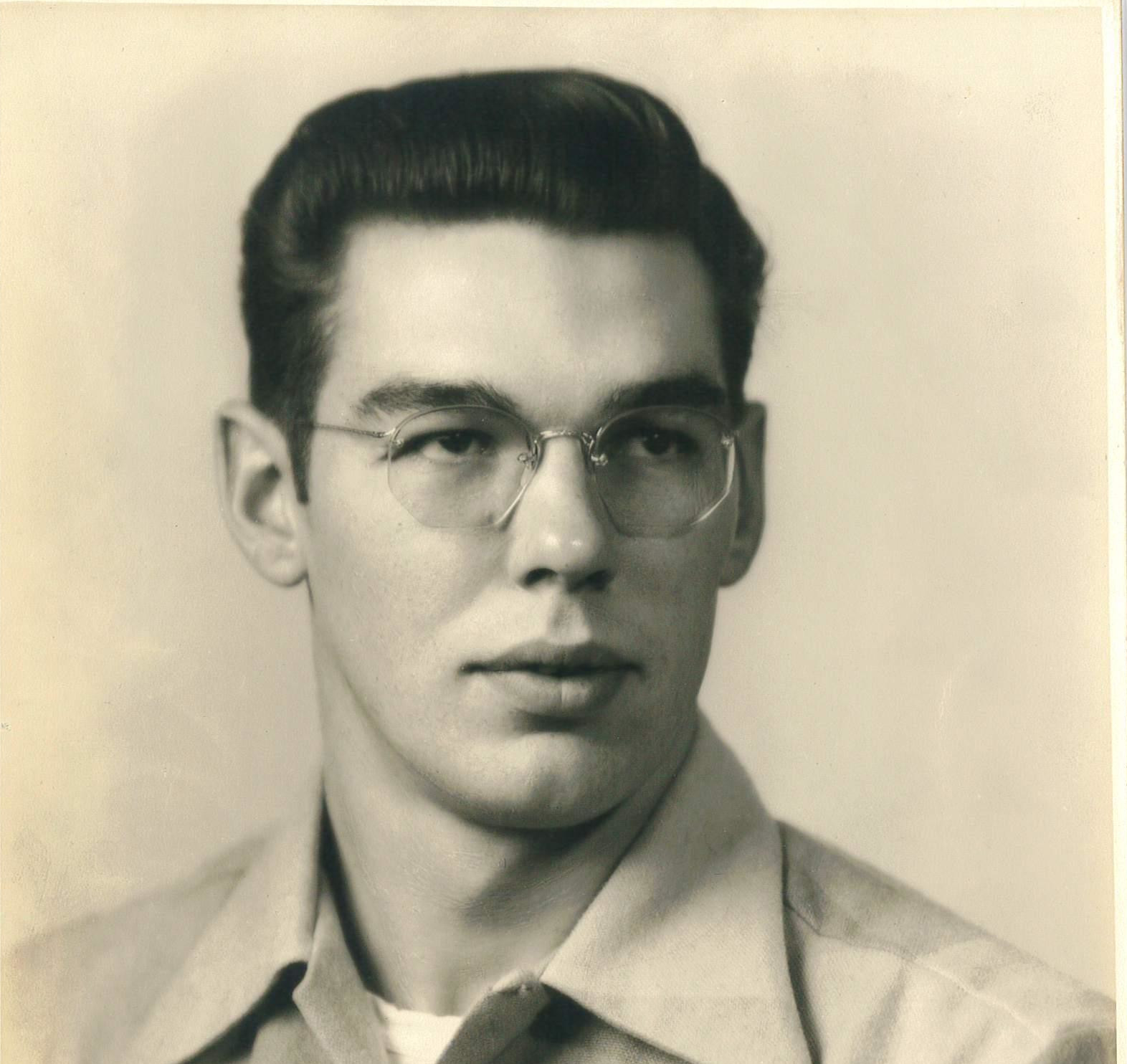
Willis Webb, better known as Lefty, passed away January 4, 2022.
Lefty was born in Humboldt County on December 20, 1929, to Willis and Esther Webb. He spent his younger years in Korbel, Blue Lake and nearby lumber towns. Lefty had amazing stories about his escapades with his close Blue Lake friends: Jack, Pete and Reggie. Many a story has been told of their high school youth, wild summers and trips to the Bay Area. His memory was so clear, and his stories so vivid and descriptive, that you could picture these rascals having the time of their lives, fulfilling all of their crazy dreams and making the most of every moment!
In 1950 he went into the Army and served as a medic in the Korean War. Again, Lefty’s stories about his time In Korea were highly descriptive and he talked about the beauty of the county and the people he met while stationed there. While war is never easy, Dad try to remain focused and open-minded about the task at hand. He treated all with respect and dignity. He was a proud Army Veteran and loved this country. Whenever he was out and about, you could be certain he would be proudly wearing his Korean War Veteran hat! Once Lefty was back from the war, he and his posse continued kicking up their heels in many a fancy car that he owned and cruised about town in. The Arcata Plaza was a favorite haunt for them to visit!
Lefty met and married Rita Larsen in the mid-1950s. He adopted her daughter Jewel and soon after they welcomed daughter Michelle, aka Mitchie. He built a home for his family on Liscom Hill Road by Blue Lake and worked for Simpson Timber Company in Korbel. He was quite the worker: started out loading box cars at Simpson and ended his years there in the maintenance department. There wasn’t anything he could not build or repair. He and his great friend, Gary, took care of many a maintenance issue at Simpson Timber. He moonlighted and provided for his family by working on many homes and businesses in the Blue Lake and surrounding areas. One fun story: I had Dad in the Annie and Mary Parade in 2021, and while we were enroute, Dad pointed out all the homes and buildings he had worked on or built in all his past years in construction. It was one of my favorite times with Dad. Plus, I had quite the Blue Lake history lesson!
Lefty lost his first wife, Rita, and remarried Shirley Davis. He and Shirley spent most of their years in Orleans. He had 5 acres and a big shop that kept him busy. He was never one to stop and relax! Always had many projects going and ideas for more in his head. He put in a beautiful orchard, vegetable garden and rows and rows of berries! The family loved getting together in the summer and spending time in the sun, plus enjoying the bounty from the garden.
Lefty and Shirley loved to travel, and one of their favorite destinations was Yuma, Arizona. They later made it their permanent home and spent time with friends and traveling to Mexico while there.
When Shirley passed away in 2019, Lefty moved back to Humboldt County to live with his daughter, Michelle. He arrived just before his 90th birthday and had a wonderful celebration with friends and family! We were blessed to have him with us and to hear about his life. His stories are forever etched in our hearts. Fortunately, we have many of these stories and his history recorded so we can pass these on to future generations!
Lefty is survived by his daughter Michelle Voyles (David), Grandsons Brett and Lane Voyles, Brian Sneed (Judith) and great grandson Everett. Stepchildren Ricky ( Linda ), Danny and Laurie Davis. Step-grandchildren Cindy, Catrina, Daniel, JD, Tina, Jimmy, Chelsea and Lilyauna, many step-great-grandchildren and step-great-great-grandchildren! He was an outstanding family man and loved all with his whole heart! Many memories are being talked about by his friends and family as this is being written.
Lefty was pre-deceased by his parents Willis and Esther Webb, brother Charles aka Bud Webb, first wife Rita Webb, second wife Shirley Webb, daughter Jewel Sneed, and step-grandson Gus Krause.
Many thanks to Hospice of Humboldt, the local VA Home Health Team and Timber Ridge McKinleyville. Your compassion and care for Dad was greatly appreciated!
My wish is that you reflect on a wonderful memory and story that you may have of Lefty. He left us all with so many smiles!
###
The obituary above was submitted on behalf of Lefty Webb’s loved ones. The Lost Coast Outpost runs obituaries of Humboldt County residents at no charge. See guidelines here.
OBITUARY: George (Bill) William Rogers, 1933-2022
LoCO Staff / Saturday, April 2, 2022 @ 6:56 a.m. / Obits

George (Bill) William Rogers, age 88, was born July 2, 1933, in Sacramento, to Harry Rogers and June McCready Rogers. Bill passed away surrounded by his family on March 22, 2022.
Bill grew up in Crannell where he developed his skills and love for hunting and fishing. Throughout his life he spent many hours hunting, fishing, and diving for abalone with family and friends. He loved his time in the outdoors, especially the many years he spent with his good friend Bob Hoopes.
Bill attended Arcata High School (AHS) and excelled in both academics and sports. He was awarded the White Sweater, the highest honor that combined academics, athletics, and other extra-curricular activities. Competing in football, basketball, and baseball, Bill’s accomplishments were later acknowledged when he was inducted into the Arcata High School Hall of Fame in 2008. Go Tigers!
While attending AHS, Bill met his high school sweetheart and future bride, Dolores Carvalho. They were married April 26, 1952. Bill and Dolores would have celebrated their 70th wedding anniversary this year. Dolores would always tease Bill about needing his mother to sign for him to get married because he had not reached the age of consent, which was 21 for young men in those days. The family was put on hold as Bill was drafted and served in the Army from 1953 - 1955. Shortly thereafter, Bill and Dolores started their family, with Nancy arriving first, followed by Diane, Sharon, and Carol. Bill supported his growing family over the years through work at Hammond Lumber Company, Hyster Company and the City of Eureka, from which he retired in 1996.
During his life, Bill became an avid runner. He is often remembered running wearing his black & white watchman cap. Bill ran relays, marathons, and of course the Clam Beach Run beginning with the second annual run in 1967. Bill was especially proud of the fact that he ran a sub-three hour (2:56) marathon at the Avenue of the Giants. Bill did quite a few of his training workouts at Humboldt’s Redwood Bowl. He would only take his children with him to explore the campus on the condition that they had to complete at least one lap around the track. One of Bill’s favorite running stories was the time he ran down to the bottom of the Grand Canyon and back up to the top. He arrived at the top before his meeting time with Dolores wearing only his running shoes and his running shorts. Being extremely thirsty, he approached the bartender at the lounge at the top of the ravine asking for a beer with payment to come from Dolores when she arrived. The bartender gladly provided two beers to Bill to quench his thirst.
Family was very important to Bill. Much time was spent with Sunday drives and picnics, dinners at his parent’s house, and many camping and RV trips to destinations such as Richardson’s Grove, French’s, Benbow RV Park, and Wages Creek in Fort Bragg for abalone diving.
After retirement, Bill and Dolores spent many years traveling in their RV with a group called the Far North 10-10 Travel Club. The club consists of retired CHP officers and the associate members they sponsor. Bill and Dolores made many life-long friends through the club over the years. The 4:00 pm cocktail hour with hearty hors d’oeuvres was a favorite of Bill’s! Additional travels in the RV with special friends included many destinations across the United States and Canada. Another favorite traveling memory of Bill’s was a helicopter ride up to the Mendenhall Glacier in Alaska, where he got to exit the helicopter and walk around.
Attending grandchildren’s sporting events was another favorite pastime of Bill’s where he was often times one of the most vocal fans in the stands.
Bill was predeceased by his father, mother, father in-law John Carvalho, mother in-law Marie Scarbrough, son-in-law Brian LaDelle, and his favorite dog Babe.
Bill is survived by his wife of 69 years, Dolores, daughters Nancy Rogers (David Aliotti) of Monterey, Diane Lonn (Dave) of McKinleyville, Sharon LaDelle, of Eureka, and Carol Rogers (Kenny Sauers) of Fortuna; by his grandchildren, Elise Aliotti of San Francisco, Louis Lonn (Michelle) of Arcata, Riley Lonn of McKinleyville, Brian Hope (Kristen) of Eureka, Andra Amaroso (Clinton) of Redding, Michelle Rodrigues (Stephan) of Eureka, Amanda Stonebarger (Jason) of Fairfield, and Cory Stonebarger of Blue Lake; by his great-grandchildren Raylee, Jace, Derek, Shane, Hanna, Nathan, and Caiden; and many other in-laws, cousins, nieces, and nephews.
Memorial contributions may be made in Bill’s name to the Humboldt County Historical Society, St. Jude Children’s Research Hospital, or a charity of your choice. The family wishes to thank Mad River Community Hospital and the amazing staff of the ER, ICU, Pain Management Clinic, and Wound Care departments for the excellent and compassionate care they provided to Bill during his time there. Also, a special thank you to neighbors Mark and Jenny for always being there to lend a hand. A Celebration of Bill’s Life will be held at the Plaza View Room, Jacoby Storehouse, Arcata, CA, on April 16, 2022 from 2:30 p.m to 5:00 p.m.
Two quotes symbolize Bill’s life: “In the end, it’s not the years in your life that count. It’s the life in your years,” Abraham Lincoln; and “If you don’t have time to do it right, when will you have the time to do it over?” John Wooden.
###
The obituary above was submitted on behalf of Bill Rogers’ loved ones. The Lost Coast Outpost runs obituaries of Humboldt County residents at no charge. See guidelines here.


